
The Escape Of Matrix and The Rat Race
About the matrix everyone ones to escape…
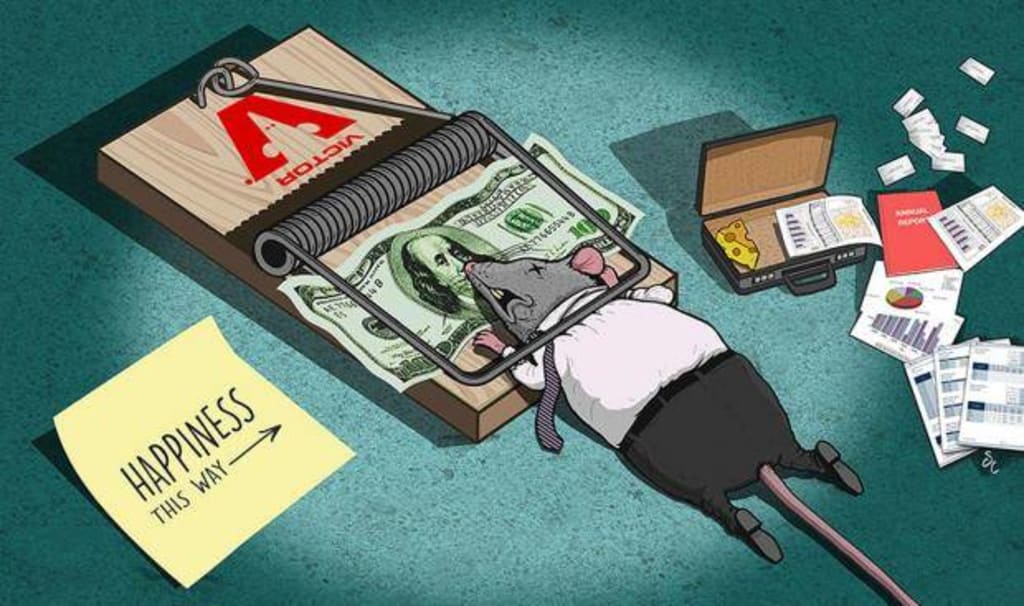
The escape from the Matrix is a fundamental theme in the movie, and it raises some interesting questions about the nature of reality and our place within it. The Matrix represents a kind of virtual reality that has been constructed by machines to pacify and control human beings. The main characters in the movie, led by Neo, seek to escape from this virtual reality and discover the truth about the world they inhabit.
To escape from the Matrix, the characters must first realize that they are trapped within it. They must also come to understand the inner workings of the Matrix and how to manipulate it to their advantage. This involves learning various skills and abilities, such as martial arts and hacking, which they can use to outsmart the machines that control their world.
Ultimately, the escape from the Matrix comes down to a battle between human willpower and machine logic. The machines are powerful and relentless, but the humans have something that the machines lack: free will. By tapping into their own agency and creativity, the humans are able to overcome the constraints of the Matrix and break free into the real world.
Of course, the escape from the Matrix is not without its costs and sacrifices. The characters must endure intense physical and mental challenges, and some of them do not survive the journey. However, for those who do make it to the other side, the rewards are great: freedom, knowledge, and the ability to shape the world according to their own vision.
Overall, the escape from the Matrix is a complex and fascinating theme that speaks to our desire for autonomy, self-discovery, and meaning.
Andrew Tate's view that money is a key indicator of success is not uncommon in our society. Many people measure their success based on their financial status, as it is often associated with social status, power, and access to resources.
However, it is also important to recognize that success can be defined in many different ways, and money is just one aspect of it. For some people, success may mean achieving personal growth, making a positive impact on others, contributing to society, or having strong relationships with family and friends.
Furthermore, the pursuit of money can sometimes lead to negative consequences, such as greed, selfishness, and lack of empathy. Therefore, it is essential to balance the desire for financial success with other important values, such as compassion, social responsibility, and personal growth.
The term "rat race" refers to the competitive and often stressful nature of modern work culture, in which individuals are constantly striving to succeed and climb the corporate ladder. This can lead to feelings of burnout, disillusionment, and a sense of being stuck in a never-ending cycle of work and stress. It is important for individuals to prioritize their mental health and overall wellbeing, and to create a work-life balance that allows them to pursue their personal goals and interests outside of their career. This may involve setting boundaries, taking breaks, and pursuing hobbies or passions that bring joy and fulfillment. The term is often used to describe the intense and unrelenting nature of modern corporate culture, where employees are expected to work long hours, meet tight deadlines, and constantly strive to outperform their colleagues in order to advance in their careers.
Ultimately, it is up to each person to define their own version of success and to live a life that aligns with theirvalues and goals.
The concept of a "millionaire mindset" refers to the set of attitudes, beliefs, and habits that successful millionaires possess. These traits are often seen as critical to achieving financial success, and can be developed and cultivated over time through intentional effort and practice.
One of the key components of a millionaire mindset is a strong sense of self-belief and confidence. Successful millionaires often have a deep-seated belief in their own abilities and the value of their ideas, which allows them to take risks and pursue opportunities that others might shy away from.
Another important aspect of a millionaire mindset is a commitment to hard work and perseverance. Building a successful business or investment portfolio takes time and effort, and requires a willingness to keep pushing forward in the face of setbacks and challenges. Successful millionaires are often highly disciplined and focused, and are able to maintain their motivation and drive even when things get tough.A millionaire mindset also involves a willingness to learn and grow. Successful millionaires are often voracious readers and learners, constantly seeking out new information and insights that can help them improve their businesses and investments. They are also open to feedback and criticism, and are willing to adjust their strategies and approaches as needed in order to achieve their goals.
In conclusion, developing a millionaire mindset is not an overnight process, but rather a lifelong journey of learning, growth, and self-improvement. By cultivating the attitudes, beliefs, and habits that successful millionaires possess, anyone can increase their chances of achieving financial success and building a fulfilling life.The term "rat race" is a metaphor used to describe the competitive and often stressful nature of modern work environments, where people are expected to constantly strive for success and outperform their colleagues. The pressure to succeed can lead to long work hours, high stress levels, and a lack of work-life balance.
While some people thrive in this kind of environment, others can find it exhausting and unfulfilling. Thinking and doing are two essential components of any successful endeavor. While thinking allows us to plan, strategize, and come up with new ideas, doing is what puts those ideas into action and brings them to life.
Both thinking and doing are important, but it's important to find a balance between the two. Too much thinking without enough action can lead to analysis paralysis, where we get stuck in a never-ending cycle of planning and never actually take any steps toward our goals. On the other hand, too much doing without enough thinking can lead to haphazard decision-making and a lack of direction or purpose.
To strike a balance between thinking and doing, it's important to set clear goals and priorities, and then develop a plan of action that allows us to move forward while also giving us the flexibility to adapt and adjust our approach as needed. This might involve breaking down larger goals into smaller, more manageable steps, or seeking out feedback and input from others to help us refine our ideas and strategies.
Ultimately, the key to success is finding the right balance between thinking and doing, and then taking consistent, focused action toward our goals. By staying mindful of our priorities and maintaining a sense of purpose and direction, we can achieve great things while also enjoying the journey along the way.
About the Creator
Keep reading
More stories from writers in Motivation and other communities.
One Hard Thing
Stop me if you’ve heard this one before: You have the number, you know your schedule- you’ve even picked out the perfect day and time to make this appointment. Shoot, you’ve even picked out alternative days and times just in case their schedules can’t accommodate you!
By Taylor Rigsby18 days ago in Motivation
SACRED CORE ROOTS
Love demonstrates endless compassion despite imperfections, flaws, or mistakes. Love does not disappear, it expands at an exponential rate, as it demonstrates compassionate perseverance, consistency, strength, courage, and clarity beyond the illusionary, obscure, or misaligned notions of control or fear. It requires great courage to begin again despite the coldness within one’s heart. Love can restore the soul to a state of peace, beyond the endurance of ruthless destruction inflicted upon it. Silence reveals the truth within time of one’s limitations, by uncovering or revealing one’s repetitive nature, conditioned adopted programs, or reinforced notions, beliefs, or stories, which are transfixed or etched within the mind, as familiar pain appears and feels safer than progressive change. Truth, hidden motives, and betrayal, causes systematic irreversible internal pain. The soul retains the feeling or weight of the situation. Wounds can be endured and heal within the context of time, but the damage felt by the spoken word or the physical act of a stroke of a pen, echoes beyond space and time. Discipline and focus enables self-mastery and awakening. One must seek relationships that are not savage in nature. Pillaging, using, or depriving another’s soul for gain, demonstrates a relentless need to inflict pain onto others in a destructive manner. Pain projected is often unconscious, subconscious, or conscious pain felt or sustained within. Comparison is the thief of joy, remaining cruel, miserable, jealous, or arrogant deprives the soul of true nurturance and the attainment of greater peace. To embody restorative peace, one must seek to live gently, quietly, humbly, and operate with virtue and ethical discernment, with morality and justice in mind. Love is a dichotomous balance and a juxtaposition of beauty and pain, as it enables the soul to feel every spectrum of emotion within every crevice, facet, and corner of one’s being, as true compassionate empathetic love does not disappear it transcends, heals, and matures within time.
By ELISABETH BABARCI about an hour ago in Motivation
I've Just Realized
The President doesn't understand music. There. It felt very good to write that; it's some thing I just realized today. Oh , yes; he plays it. He TRUMPets it in rallies and meetings, pumps it across the airwaves when he gathers up our minutes waiting for his late arrival.
By Judey Kalchik 3 days ago in Beat




Comments
There are no comments for this story
Be the first to respond and start the conversation.