
The Damage Cycle
“Hurt people hurt people—but healing people heal others.”
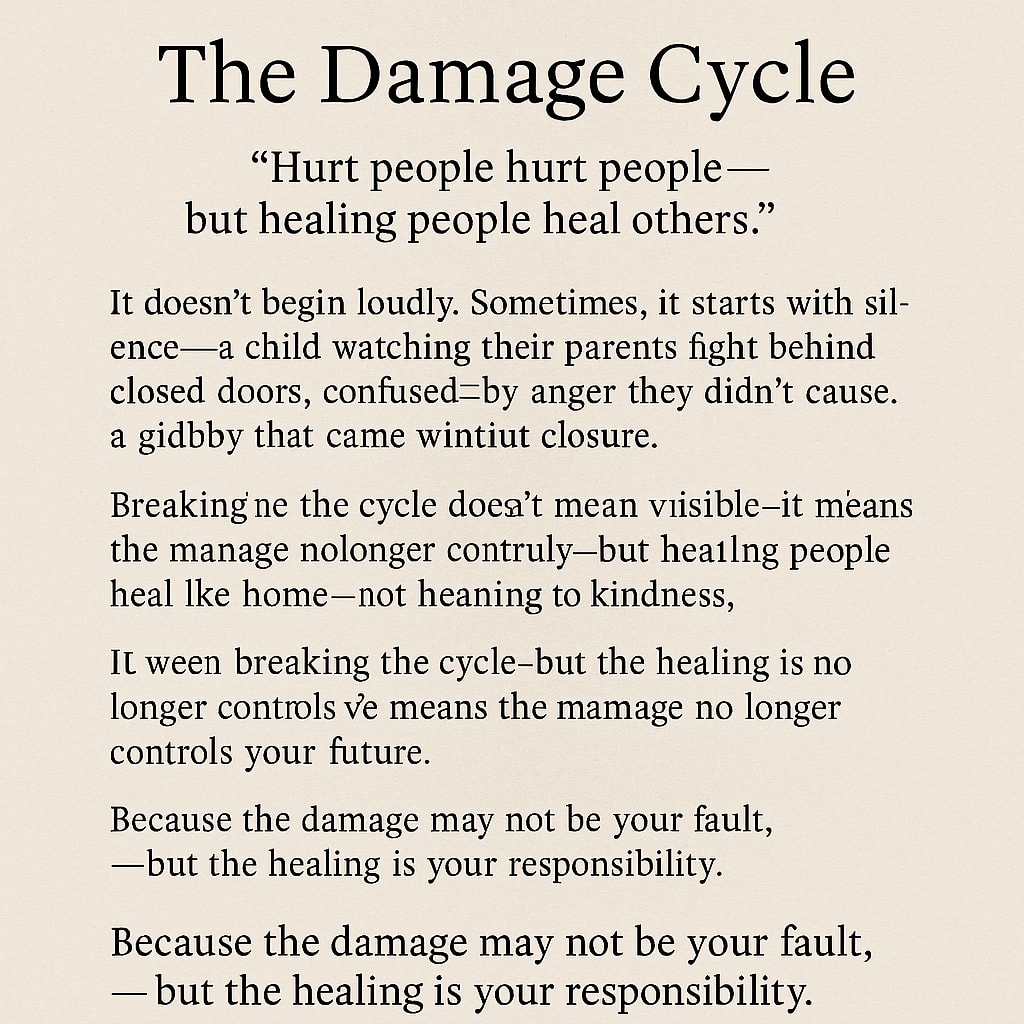
It doesn’t begin loudly. Sometimes, it starts with silence—a child watching their parents fight behind closed doors, confused by anger they didn’t cause. Or it begins with neglect: a birthday forgotten, a compliment never said, a goodbye that came without closure. And so the damage begins—not always from cruelty, but often from the absence of kindness.
The damage cycle is not always visible. It lives quietly in the way someone flinches at love, hesitates before speaking, or apologizes too much for simply existing. It hides behind humor, in sarcasm, in the way someone avoids eye contact because they’ve been made to feel small one too many times. It grows inside people who never learned how to express hurt, so instead they store it, carrying emotional weight they were never meant to bear.
And what happens to this weight? Most times, it spills. Not intentionally—but through reactions, miscommunications, cold shoulders, and overreactions. A girl who was never told she’s enough now questions every compliment. A boy raised by a father who only yelled now confuses silence with safety. A friend who was ghosted starts pulling away first—just to avoid being left again.
So we pass the pain forward—not out of malice, but out of muscle memory.
The damage cycle is generational. A mother who grew up never hearing “I love you” might not say it to her child—not because she doesn’t feel it, but because no one ever taught her how. A father who had to be “strong” might raise sons who don’t cry—sons who become men who feel but don’t know how to say so. And slowly, the damage wraps around another generation like invisible thread.
But here’s the twist: the damage cycle can be broken.
The hardest truth? It begins with awareness—facing the mirror and asking hard questions. Why do I react this way? Why do I push people away when I want them to stay? Why do I feel unworthy of love or success or peace? These questions hurt—but in asking them, we reclaim our story from the pain that once controlled it.
Breaking the cycle doesn’t mean pretending the past didn’t hurt. It means learning to not bleed on people who didn’t cut us. It means recognizing when we’re repeating patterns and choosing differently—even when it’s uncomfortable.
It means sending the text, apologizing sincerely, asking for help, attending therapy, or simply sitting with your younger self and whispering, “I’m sorry you went through that, but we’re safe now.”
Healing doesn’t mean the damage never happened—it means the damage no longer controls your future.
The cycle ends when a man learns to say, “I’m angry” without raising his voice. It ends when a woman stops blaming herself for someone else’s betrayal. It ends when someone who was neglected learns to love themselves loudly, so they no longer chase validation from people who can’t give it.
It ends when someone says, “I refuse to give my pain a voice louder than my healing.”
It ends when we learn to love without fear, trust without testing, and give without expecting to lose ourselves.
But it takes courage.
Because healing isn’t always beautiful. It can be lonely. It means walking away from people who feel like home but hurt like hell. It means crying over things that happened 10 years ago. It means forgiving people who never apologized, and sometimes even forgiving yourself for what you didn’t know back then.
It means being the parent you never had, the partner you never saw, the friend you always needed.
And it’s worth it.
Because when you heal, you don’t just free yourself—you free everyone who comes after you. Your future children. Your partner. Your community. You become the proof that cycles can be broken—that love can be unlearned and relearned, that softness can survive storm, that even if pain raised you, peace can hold you now.
So if you’re reading this, and you see parts of yourself in the cycle—know this:
You are not broken.
You are not your past.
You are not what happened to you.
You are what you choose to become next.
And today… maybe that choice is small: a boundary, a journal entry, a deep breath instead of a scream. But it’s a start. A beautiful, brave start.
Because the damage may not be your fault,
—but the healing is your responsibility.
About the Creator
Keep reading
More stories from Noor khan and writers in Motivation and other communities.
How We Can Earn in 2026
In the year 2026, earning money no longer means waking up at 6 AM, wearing a tie, and working nine hours under fluorescent office lights—instead, the new rich are sitting in their bedrooms with a laptop and Wi-Fi, making thousands of dollars using their minds, skills, and strategy, and this is the story of how a 20-year-old named Sameer from Lahore, Pakistan, turned his ordinary internet connection into a multi-stream digital income empire without leaving his house or investing large amounts of money—Sameer wasn’t from a rich family, had no degree, no foreign relatives, and no fancy setup, just an old laptop, a strong will, and a desire to never beg anyone for a job, so when he realized the world was shifting towards AI, automation, freelancing, crypto, and content-based income, he didn’t wait for someone to guide him, he decided to learn on his own through free YouTube tutorials and Reddit threads—he first heard about “faceless YouTube automation” in early January, where people were earning money by making videos using AI voices, stock footage, and ChatGPT-generated scripts, and even though he had never edited a video before, he downloaded CapCut, used ChatGPT to write motivational scripts, and created 10 faceless reels using free AI voice tools and free stock footage sites, uploading them daily to a fresh YouTube and TikTok channel, and though his first few videos barely reached 200 views, he kept going and by mid-February one of his videos went viral, gaining 120K views and helping him hit 1,000 subscribers and 4,000 watch hours, unlocking monetization—his first YouTube payment was just $187 but it felt like a million to him because it proved that the internet pays those who produce, not just consume—Sameer didn’t stop there, instead of spending the money, he used it to buy a better mic, a basic subscription to an AI editing tool, and learned better thumbnail creation, and within 3 months, his income reached $600/month from YouTube ads and brand mentions, but his real success came when he started freelancing in his free time using Fiverr and Upwork—he noticed many international clients needed help writing product descriptions, short blog posts, or AI-generated captions, so he listed services like “AI Content Writer”, “Product Copy with ChatGPT”, and “Instagram Caption Generator”, offering $10 per gig—he got his first client after one week, then five more within the month, and by the time it was July 2026, Sameer had two solid income sources: $800 from YouTube and $1,400 from freelancing—he also kept reading about people earning in crypto without investing by doing tasks, testing new platforms, and participating in airdrops, so he joined Web3 communities on Discord, registered on platforms like Zealy, Galxe, and Layer3, completed simple tasks like testing dApps, writing reviews, and sharing links, and within a few weeks he started receiving real crypto token rewards worth $100, $150, and even $300 depending on the project—and these weren’t scams, but real Web3 startups trying to reward early users for testing their systems—one day, he received an airdrop worth $870 just for using a Web3 browser in its beta phase and writing a 3-line feedback, and that’s when he realized the biggest earners in 2026 are not those who work the hardest, but those who learn and adapt the fastest—Sameer now wakes up whenever he wants, works for 4-5 hours a day, has over $3,000/month coming in from three different streams, and teaches others how to start—he doesn’t have a boss, doesn’t work 9-5, and doesn’t rely on a single source of income—in fact, he made a personal goal to help 100 other young people learn how to earn through smart digital methods before the end of 2026—he says anyone with a mobile phone, time, and internet can do the same if they stop wasting time on scrolling and start creating—he gives four key lessons to everyone who asks: 1) Don’t waste time doubting, just start. 2) Choose one skill or model (YouTube, AI content, freelancing, crypto airdrops) and go all-in for 30 days. 3) Stay consistent, even when views are low or clients are silent, because momentum builds slowly. 4) Reinvest your first $100 into better tools, faster learning, or paid upgrades that save time—Sameer is not alone, people across the world in countries like India, Philippines, Nigeria, and even small cities of Europe are doing the same: learning AI writing, editing short videos, making podcasts, selling digital art, managing YouTube channels for others, or simply testing crypto platforms as early users and receiving thousands of dollars in rewards—all without leaving their rooms—so if you're asking, “How can we earn in 2026?”, the answer is simple: by being early, by being smart, by being consistent, and by choosing creation over consumption—you don’t need to be a genius, you don’t need to have a huge following, you don’t need to buy Bitcoin or stocks—you just need to take one step today, learn one digital skill, explore one online platform, and commit to building a better life for yourself without begging anyone for help—2026 is not the year of job seekers, it’s the year of digital earners, and you can be one of them too, if you start now.
By Noor khan7 months ago in Motivation
Stay Strong Even When No One Supports You
Staying motivated without support A moment comes - uninvited - when saying what you wish for is met with silence. Then, a pause takes hold. A glance slips by, half mocking. Speech stays there, drifting. The light within slowly weighs more.
By Abdul Lateef3 days ago in Motivation


Comments
There are no comments for this story
Be the first to respond and start the conversation.