
The Clock That Learned to Listen
A Story About Time Management, Choice, and the Quiet Power of Intent

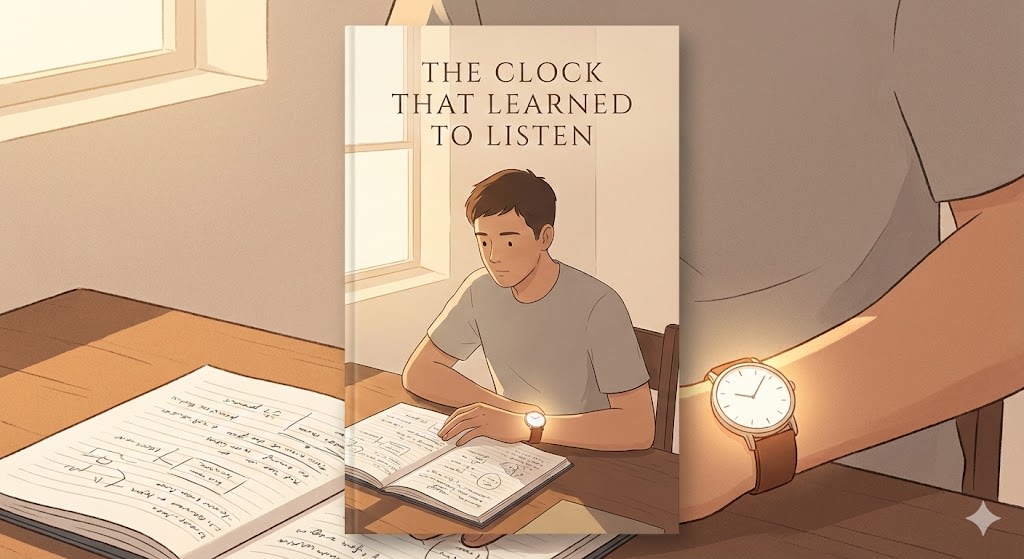
The clock above Aarav’s desk ticked louder than any sound in the room. Or at least, that was how it felt to him. Each second landed like a small accusation: You’re late. You’re behind. You’re wasting me.
Aarav was not lazy. Everyone who knew him agreed on that. He worked hard, dreamed big, and cared deeply about doing well. Yet, strangely, he was always running—running to meet deadlines, running from responsibilities, running in circles inside his own head. His days began with good intentions and ended with exhaustion, regret, and a familiar sentence whispered into the dark: “Tomorrow, I’ll do better.”
Tomorrow, however, had become a myth.
On this particular Monday morning, Aarav sat at his cluttered desk staring at a half-finished report that was due in three hours. His phone buzzed with notifications—messages, reminders, news alerts, and social media updates. He picked it up “just for a minute,” telling himself he needed a mental break. That minute turned into twenty. Twenty became forty. Suddenly, panic arrived like an uninvited guest.
His heart raced. His fingers trembled as he typed hurried sentences, knowing they were not his best work. When he finally submitted the report, he leaned back in his chair, drained. The clock ticked on, indifferent.
That evening, while walking home under a sky smeared with tired gray clouds, Aarav noticed a small shop he had never seen before. The sign above the door read: “Horology & Habits.” Inside the window sat dozens of clocks—grandfather clocks, pocket watches, sundials, and timepieces of strange and unfamiliar designs.
Something pulled him inside.
The shop smelled of old wood and quiet patience. Behind the counter stood an elderly man with kind eyes and silver hair, adjusting the gears of a small clock.
“You look like someone who’s being chased,” the man said without looking up.
Aarav laughed nervously. “That obvious?”
“Time chases no one,” the man replied, finally meeting his gaze. “But many people run from it.”
Aarav didn’t know why, but he found himself telling the stranger everything—his stress, his missed deadlines, his constant feeling of drowning in tasks. The old man listened without interrupting, nodding slowly, as if each word had a place to rest.
When Aarav finished, the man reached under the counter and placed a simple wristwatch in his palm. It was plain, with a white face and black numbers.
“This is not a magic watch,” the man said. “It won’t slow time or give you more of it.”
“Then what’s special about it?” Aarav asked.
“It listens,” the man replied. “And it reminds.”
Before Aarav could ask what that meant, the shop bell rang. A sudden gust of wind blew through the room, and when Aarav turned back, the man was gone. Confused and slightly embarrassed, Aarav left the shop, the watch still warm in his hand.
That night, before bed, Aarav put on the watch. As he lay staring at the ceiling, it vibrated softly. Startled, he lifted his wrist. Tiny words appeared on the watch face:
What matters most tomorrow?
Aarav paused. No alarm had ever asked him that. After a moment, he whispered, “Finish my presentation.”
The words faded. The watch went silent.
The next morning, the watch vibrated again—not to wake him, but ten minutes earlier than his usual alarm. On the screen appeared another message:
Begin with what matters.
Instead of reaching for his phone, Aarav sat up. He resisted the urge to scroll. He made his bed, drank a glass of water, and sat at his desk. For the first time in a long while, he worked on his most important task first. No multitasking. No distractions. Just focus.
An hour passed. Then two.
When the watch vibrated again, it read:
Rest is also part of work.
Aarav smiled. He stood, stretched, and took a short walk. He returned refreshed, not guilty.
Days turned into weeks. The watch never controlled him; it only asked gentle questions and offered quiet reminders.
Does this task serve your goal?
Is this urgent, or is it noise?
Have you planned your day, or is your day planning you?
Slowly, Aarav began to change—not dramatically, but deeply. He started planning his evenings instead of drifting through them. He broke large tasks into smaller ones. He learned to say no without guilt and yes with intention. He discovered that time management was not about squeezing more into the day, but about removing what did not belong.
One afternoon, a colleague noticed the difference. “You seem calmer,” she said. “What’s your secret?”
Aarav thought of the watch, the shop, the ticking clock that no longer accused him. “I stopped fighting time,” he said. “I started listening to it.”
Months later, on a quiet Sunday, Aarav went looking for the shop again. He walked the same street, scanned every building, but Horology & Habits was gone. In its place stood an empty storefront, dusty and silent.
Aarav looked at his watch. For the first time, it was blank.
He understood then.
The watch had taught him what it could. The rest was up to him.
That night, as Aarav planned his week, the clock above his desk ticked softly—not as an enemy, but as a companion. Each second felt lighter, purposeful. Time was no longer something he chased or feared. It was something he respected.
And in learning to respect time, Aarav finally learned how to live within it—fully, calmly, and on purpose.
About the Creator
Keep reading
More stories from Farhad and writers in Motivation and other communities.
Full Moon
There are days when it feels like my body is arguing with itself. Multiple sclerosis already demands negotiation. Fatigue shapes my energy. My legs can feel unreliable. Sensations appear without warning. Some days they feel heavy. Other days they feel like they are vibrating from the inside, a constant electrical hum that no one else can see.
By Millie Hardy-Sims5 days ago in Motivation
The Hollywood Star Who Invented Wi-Fi: The Hidden Genius of Hedy Lamarr
Right now, as you read these words, invisible waves of energy are pulsing through the air around you. They are bouncing off walls, passing through glass, and connecting your device to a vast, infinite global network. Whether you are using a smartphone, a laptop, or a tablet, you are relying on a technology so fundamental to modern human existence that we panic the moment we lose it: Wi-Fi.
By Frank Massey 3 days ago in Motivation
REEEEEEEEE!
I'm on a low road right now. There are a literal million things to do and not one of them worth my time. I would rather sit in place and burn but the orbit takes me on its inevitable route 'round the center; and I a center in my own right, around which others orbit, and so on and so forth, ad infinitum, ad nauseum.
By C. Rommial Butler3 days ago in Poets




Comments
There are no comments for this story
Be the first to respond and start the conversation.