
The Bouncer at the Gate: How Vin Diesel Forced Hollywood to Listen
He was too Black for the white roles, too white for the Black roles, and his voice sounded like a gravel truck. So, he stopped knocking on the door and built his own house

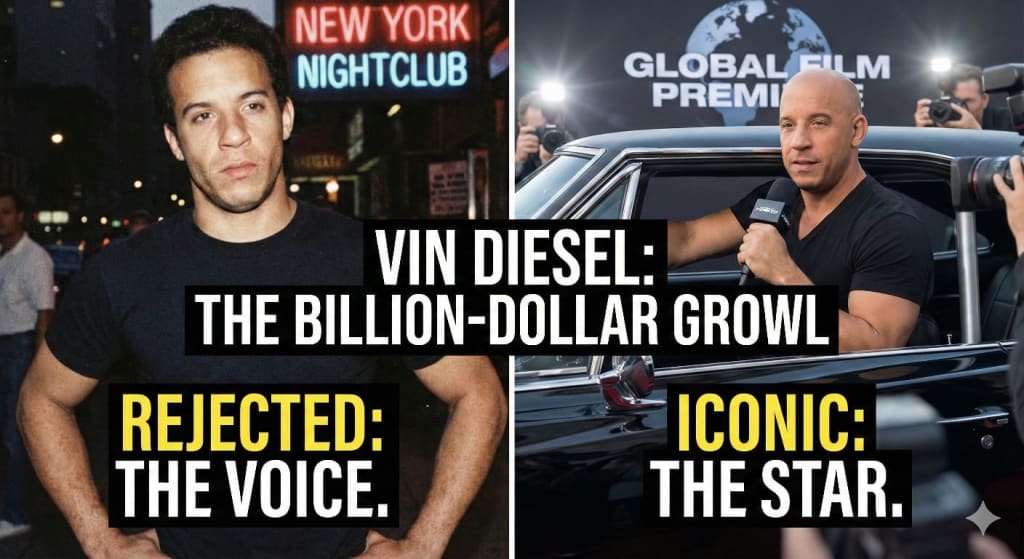
The inspiring true story of Vin Diesel, the bouncer-turned-superstar who faced years of rejection for his ambiguous ethnicity and deep voice before writing his own path to stardom.
Introduction: The Rumble in the Throat
In the early 1990s, if you walked past the velvet ropes of the Tunnel nightclub in New York City, you might have been stopped by a wall of muscle.
The bouncer’s name was Vin. He was intimidating. He had arms the size of tree trunks and a shaved head that looked like it could break a brick. When he spoke, the ground seemed to vibrate. His voice was a subterranean rumble, a baritone so deep it felt less like a sound and more like an engine idling.
To the drunk patrons and the club kids, he was just "The Muscle." He was a prop. A human barricade.
But inside the bouncer’s head, a different movie was playing.
Vin wasn't just a bouncer. He was Mark Sinclair. He was a sensitive, artistic kid who had been studying acting since he was seven years old. He read Chekhov. He quoted Shakespeare. He wrote poetry.
Every day, he would leave the violence and the noise of the club, wash the smell of stale beer off his skin, and take the subway to midtown Manhattan to audition for acting roles.
And every day, he would get the same answer.
No.
It wasn't a polite no. It was a confused no.
"What are you?" casting directors would ask, looking at his headshot and then at his face. "Are you Black? Are you Italian? Are you Hispanic?"
And then he would speak. That voice. That deep, gravelly growl.
"It’s too much," they said. "It’s distracting." "You sound like a villain." "You don't sound like a leading man."
For years, Vin Diesel was the man who didn't fit. He was a puzzle piece from a different box, trying to force himself into a picture that had no space for him.
Part I: The telemarketing of Dreams
Most people know Vin Diesel as the guy who drives cars out of airplanes. They see the billionaire franchise king.
They don't see the guy selling lightbulbs.
In the mid-90s, when the acting dream was on life support, Vin needed money. The bouncer gigs paid the rent, but they didn't fund the dream.
He took a job in a "boiler room"—a high-pressure telemarketing office.
He wasn't selling stocks like The Wolf of Wall Street. He was selling tools. Drills. Screwdrivers. Lightbulbs. To strangers who didn't want them.
It was a soul-crushing job. You sit in a cramped cubicle, dialing numbers, getting screamed at, getting hung up on.
But Vin discovered something.
On the phone, nobody could see his racially ambiguous face. They couldn't judge his shaved head.
All they had was the voice.
The same voice that Hollywood directors said was "too rough" became his superpower on the phone. It was authoritative. It was trustworthy. It commanded attention.
He became a top salesman. He sold thousands of dollars worth of tools to mechanics in Kansas and plumbers in Ohio.
He realized a terrifying truth: I am good at this. I could just do this. I could make money, buy a car, and forget about the acting thing.
It was the most dangerous moment of his life. The moment of settling.
But the artist in him refused to die. He looked at the commission checks he was earning.
"I’m not buying a car," he decided. "I’m buying a camera."
Part II: The Identity Crisis
To understand the rejection Vin faced, you have to understand the Hollywood of the 1990s.
Today, "diversity" is a buzzword. Being mixed-race is seen as cool, modern, interesting.
In 1994, it was a marketing nightmare.
Casting agents worked with rigid categories.
We need a White Leading Man (Tom Cruise type).
We need a Black Sidekick (Eddie Murphy type).
We need a Latino Villain.
Vin walked in. His mother is white. His biological father is African American (though Vin never met him).
He walked into the "White" auditions, and they said, "You're too dark. You have kinky hair."
He walked into the "Black" auditions, and they said, "You're too light. You don't sound Black."
He was in no-man's-land.
He described the feeling as being "multi-facial." A face that could be anything, and therefore, was treated as nothing.
He was 27 years old. He was living on a couch. He was still bouncing at clubs, breaking up fights, watching blood spill on the pavement, and wondering if this was it.
Was he destined to be the tough guy in the background? The thug who gets punched by the hero?
Part III: The $3,000 Gamble
Vin had a choice.
Option A: Keep auditioning. Keep begging. Keep trying to convince a 50-year-old white casting director that he could be a star.
Option B: Change the game.
He remembered a piece of advice his mother had given him. She had bought him a book called Feature Films at Used Car Prices.
"If they won't write a role for you," she told him, "write one for yourself."
Vin sat down at a typewriter.
He didn't try to write a blockbuster. He didn't try to write an action movie.
He wrote the truth.
He wrote a short script called Multi-Facial.
It was a simple concept. It followed a mixed-race actor named Mike (played by Vin) over the course of one day.
In the morning, Mike auditions for an Italian role. He speaks Italian, he uses big gestures, he tells stories about "Mama's pasta." The casting director loves him... until he finds out Mike isn't fully Italian. Rejection.
In the afternoon, Mike auditions for a Black role. He wears a hip-hop outfit, he changes his cadence. The casting director says, "You're not 'street' enough. You're too light." Rejection.
It was a 20-minute scream of frustration.
Vin took his telemarketing money—about $3,000—and rented a 16mm camera. He got his friends to hold the boom mic. He shot it in a few days in New York City.
He edited it in his bedroom.
There were no explosions. No cars. No guns. Just Vin Diesel’s face and Vin Diesel’s voice, telling the industry exactly how stupid it was.
Part IV: The Cannes Miracle
He finished the film.
Now what?
He was still a bouncer. He was still a nobody.
He decided to aim for the moon. He submitted the VHS tape to the Cannes Film Festival in France. It is the most prestigious film festival in the world.
The odds of getting a short film accepted into Cannes are statistically zero. Especially a film made for $3,000 by a bouncer from New York.
He mailed the tape. He went back to work at the club.
Weeks later, a letter arrived from France.
Accepted.
Vin couldn't believe it. He didn't have money for a plane ticket. His stepfather helped him out.
He flew to France. He stood on the Croisette. He saw movie stars. He saw the paparazzi.
And he screened his film.
The audience in Cannes didn't care about American racial politics. They just saw the raw talent. They saw the charisma. They saw the pain in his eyes.
They gave him a standing ovation.
Vin stood there, tears in his eyes. For the first time in his life, he wasn't "too ambiguous." He was a filmmaker.
Part V: The Phone Call That Changed History
But festivals don't pay the rent.
Vin flew back to New York. He went back to the telemarketing job. The high of Cannes faded. He was back in the grind.
He thought Multi-Facial was his peak.
But tapes travel.
One copy of Multi-Facial ended up on a desk in Hollywood.
The desk belonged to Steven Spielberg.
Spielberg was, at that moment, the king of the world. He was casting his World War II epic, Saving Private Ryan.
He popped the tape in. He watched this unknown, muscular guy transform from Italian to Black to Hispanic. He watched the acting chops.
Spielberg was stunned.
He picked up the phone.
"Get me that guy," he said.
When Vin got the call, he thought it was a prank.
"Steven Spielberg wants to meet you."
Vin flew to LA. He met the legend.
Spielberg said something that erased ten years of rejection:
"I saw your short film. You have a great face. I don't have a role for you in my movie... so I'm going to write one."
Spielberg created the character of Private Adrian Caparzo specifically for Vin Diesel. He wrote it for him.
Vin Diesel was in Saving Private Ryan.
He was acting alongside Tom Hanks. He was on the biggest set in the world.
And he didn't get there because he changed his voice. He didn't get there because he picked a "side."
He got there because he filmed his own rejection and forced the world to watch it.
Part VI: The Voice Becomes the Icon
After Saving Private Ryan, the floodgates didn't just open; they shattered.
Directors suddenly looked at Vin and didn't see "ambiguity." They saw "universal appeal."
They saw a guy who could be anything.
Then came the irony of the voice.
The same deep, rumbling bass that casting directors said was "too distracting" became the most valuable asset in animation.
Brad Bird cast him as the title character in The Iron Giant.
Vin had almost no dialogue. He had to convey love, fear, and sacrifice using only grunts and mechanical noises.
He used that voice to break millions of hearts. When the Iron Giant says "Superman," it resonates in your chest because of that specific, unique timber that Vin possesses.
Then came Pitch Black. The character of Riddick required a voice that sounded like it came from the bottom of a dark prison. Vin was the only choice.
And then, The Fast and the Furious.
Dominic Toretto.
Dom Toretto doesn't speak much. He doesn't have monologues. He speaks in low, rumbled declarations about family.
If Vin Diesel had a higher voice, a "normal" voice, Dom Toretto wouldn't be iconic. He would just be a guy in a tank top.
The voice made the character.
Part VII: The Empire of the Outcast
Vin Diesel didn't just become an actor. He became a mogul.
He remembered the lesson of Multi-Facial: Ownership.
He took control of the Fast & Furious franchise as a producer. He turned a street-racing B-movie into a multi-billion-dollar global phenomenon.
He realized that his "ambiguous" identity was actually his greatest strength globally.
In Brazil, they think he looks Brazilian.
In the Middle East, they think he looks Arab.
In Italy, they think he looks Italian.
In Africa, they see him as Black.
He became the face of the world because he didn't look like any specific part of it. The thing that held him back in New York was the thing that made him a god in the global box office.
Part VIII: The Real Motivation
Vin Diesel’s story is not about cars. It’s not about muscles.
It is about Self-Authorization.
We spend our lives waiting for gatekeepers to open the door.
We wait for the boss to promote us.
We wait for the publisher to buy the book.
We wait for the casting director to say "Yes."
Vin Diesel waited. And while he waited, he starved.
He stopped starving the day he picked up a camera.
He teaches us a brutal lesson:
The world doesn't know what it wants until you show it to them.
Spielberg didn't know he needed Vin Diesel. He had to be shown.
If Vin had listened to the critics in 1993, he would still be a bouncer. He would be standing outside a club in New York, telling kids to tuck their shirts in, while his deep voice went to waste shouting over loud music.
Conclusion: The Rejection is the Direction
There is a moment in Multi-Facial where Vin’s character, exhausted after a day of rejection, sits alone in a diner. He is talking to himself. He is practicing a monologue.
It is a moment of pure vulnerability.
It is the moment where the tough guy mask slips, and you see the artist.
That is the real Vin Diesel.
He is proof that your "flaws"—your weird voice, your strange look, your inability to fit into a box—are only flaws if you are trying to be someone else.
If you are trying to be yourself, those flaws are your signature.
Vin Diesel was told his voice was useless.
Today, that voice is worth billions.
The Lesson
Stop trying to sand down your rough edges to fit into the puzzle.
Stop trying to lighten your voice.
Stop trying to hide your history.
The things that make you "uncastable" are the things that will make you a legend.
But only if you have the guts to write your own script.
Don't wait for Spielberg to call.
Make the thing that makes Spielberg call.
Be the bouncer who decides to let himself in.
About the Creator
Frank Massey
Tech, AI, and social media writer with a passion for storytelling. I turn complex trends into engaging, relatable content. Exploring the future, one story at a time
Keep reading
More stories from Frank Massey and writers in Motivation and other communities.
One Hard Thing
Stop me if you’ve heard this one before: You have the number, you know your schedule- you’ve even picked out the perfect day and time to make this appointment. Shoot, you’ve even picked out alternative days and times just in case their schedules can’t accommodate you!
By Taylor Rigsby15 days ago in Motivation
Hitting Pause
At 30, my life ran on momentum. My days were full, my calendar crowded, and my value—at least in my own mind—was measured by how much I could do without stopping. Like many people in their thirties, I was building something: a career, a future, a version of myself that thrived on being busy. Rest felt optional. Slowing down felt unnecessary.
By Millie Hardy-Simsa day ago in Motivation




Comments
There are no comments for this story
Be the first to respond and start the conversation.