

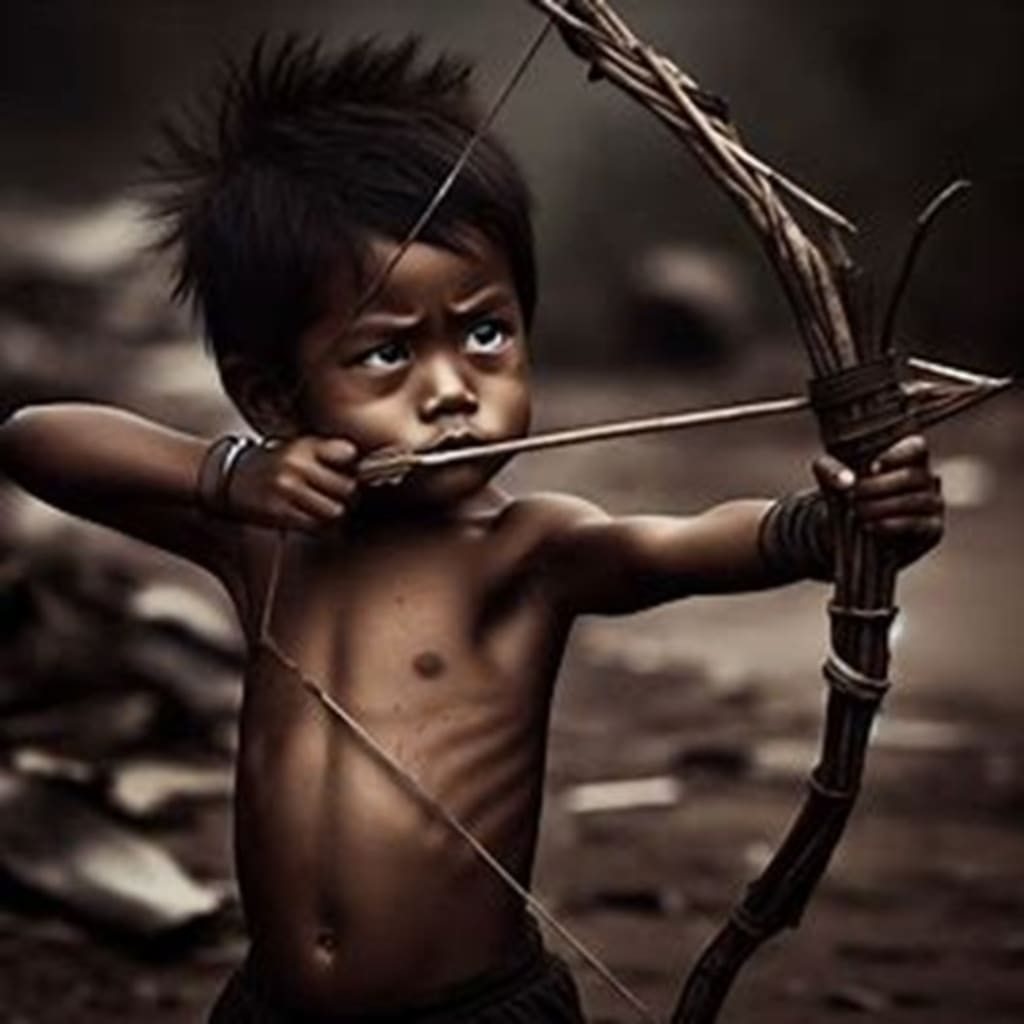
Looking up the street, I saw bicycles flying towards me, their wheels spinning fast, kicking up clouds of dust. I remember it vividly—though I was only about three and a half years old. My young hands gripped a rudimentary weapon: a *bottle kop*, a crude contraption with a bottle's broken neck tied with strips of car wheel rubber, used to shoot arrows made of reeds and bent metal bottle caps. This was no game; this was survival, and I was barely old enough to comprehend it.
“They’re coming! It’s the boere!” The older boys shouted in fear. *Boere*, a term we used to refer to white people, were approaching on bicycles, carrying pellet guns. It was 1960, during the height of apartheid, a time when non-Whites were forcibly removed from their homes under the Group Areas Act. These "boere" weren’t government forces but white youth, emboldened by a system that encouraged division, superiority, and violence. In the heat of the moment, our meagre defense consisted of crudely made bows and arrows, powerless against their more advanced weapons.
This memory has stayed with me, etched in the folds of my mind. I can’t say exactly why, but something about that moment—standing with a fragile weapon in hand, facing danger beyond my years—marked me. Maybe it was the fear. Or maybe it was the deep sense of injustice, even at that young age, knowing that we were fighting a battle we could never win, yet fighting, nonetheless.
The Beginning
Not long after that, we were evicted from our home under the Group Areas Act. The place was Albertville, the place where I was born. But that eviction was just the beginning. It set the stage for a life where survival meant enduring, where each blow was met with resilience, and where learning to fight was a necessity, not a choice. This is the beginning of my story and I intend sharing many more here.
Challenging Assumptions: Is Survival a Choice?
What would you do if you had no choice but to fight, even though the odds were stacked against you? In life, we often tell ourselves that we are in control, that we can choose how to respond to the challenges we face. But what if survival, at its core, isn’t a choice? What if it’s something deeper, something embedded in the fabric of our being—a reaction to circumstances, a necessity imposed by forces beyond our control?
This story challenges the common assumption that we always have the luxury of choice. At three and a half years old, I didn’t choose to fight. I didn’t choose to be evicted. Yet I found myself standing with a bow and arrow, facing threats that would shape my understanding of survival for the rest of my life.
Exposing the Myth of Power
There’s a myth that power lies in weapons or in force, but what I learned as a child is that true power lies in resilience. The white youth on their bicycles had the advantage—they had pellet guns, they had privilege—but we had something they could never take from us: the will to stand up, no matter how small our weapons, no matter how great the opposition.
The misconception here is that survival requires strength in the conventional sense. It doesn’t. Sometimes, survival is about standing your ground, even when you know you can’t win. It’s about enduring, knowing that you are on the right side of history, even if that history will never record your name.
The Why: Why Do We Endure?
So why do we endure? Why fight when the odds are so clearly against us? The answer lies in something deeper than survival instincts—it lies in our sense of justice, of identity, of belonging. The Group Areas Act didn’t just take our homes; it attempted to strip us of our humanity. But the act of resistance, even in the smallest, most futile ways, was a reclaiming of that humanity.
Endurance, then, isn’t just about surviving; it’s about affirming who you are. It’s about saying, “I belong here. I deserve to be seen.” As a child, I couldn’t articulate these feelings, but looking back, I realize that every act of defiance, every moment of standing up to oppression, was a declaration of self-worth. And that is something worth fighting for.
The How: The Path to Resilience
How do we find resilience in the face of overwhelming odds? How do we stand when it feels like the world is intent on knocking us down? The answer isn’t simple, but it starts with understanding your "why." Why do you continue to push forward, even when the future seems bleak?
For me, the answer lies in the memory of that day. I was too young to fight, too small to make a difference, but I fought anyway. I endured anyway. And that endurance, that defiance, has carried me through countless trials since.
To build resilience, we must start by acknowledging our fears and vulnerabilities. We must understand that it’s okay to be scared, to feel powerless—but it’s not okay to give up. The act of standing, of facing what scares us, even when we’re terrified, is what builds resilience.
Critical Reflection: What Will You Stand For?
This story isn’t just about me or about apartheid. It’s about the universal human experience of survival, of standing up against forces that seek to diminish us. I challenge you to think about your own life. What battles have you fought? Where have you felt powerless, and how did you respond? Did you stand, even when you knew you couldn’t win? Or did you turn away, hoping someone else would fight the battle for you?
Ask yourself: What will I stand for when the odds are against me? What values, what beliefs, are worth enduring for, even if the fight feels impossible?
Final Thought: Engage with Your Struggles
As I continue to reflect on my life’s journey, this is just the beginning. These lessons—about resilience, endurance, and the will to fight even in the face of adversity—are ones we can all learn from. I invite you to reflect on your own experiences. What have your struggles taught you about yourself? How have they shaped your view of survival?
Author's Note:
I strive to provide insightful, well-researched content in my articles. To enhance my writing process, I use AI as a tool to assist me in developing ideas, refining language, and exploring diverse perspectives. While the AI helps in structuring and organizing content, all the ideas and insights shared are rooted in my own research, experiences, and reflections. This approach allows me to continuously learn, grow, and share more valuable content with my readers.
About the Creator
Elvis Beck
I’m Elvis Beck, a writer blending life lessons from battling cancer, personal growth, and diverse life experiences. Through storytelling, I aim to inspire others to rise above challenges, embrace resilience, and unlock their true potential.
Keep reading
More stories from Elvis Beck and writers in Motivation and other communities.
The Beer Bottle Cut
Growing up in Kliptown, one of the many townships we moved through after being evicted from Albertville under the Group Areas Act, I learned early on about hardship, survival, and unexpected lessons that life throws at you. One memory stands out, not only because of the pain I endured but also because of the deeper lessons it carried for my family and me.
By Elvis Beckabout a year ago in Families
One Hard Thing
Stop me if you’ve heard this one before: You have the number, you know your schedule- you’ve even picked out the perfect day and time to make this appointment. Shoot, you’ve even picked out alternative days and times just in case their schedules can’t accommodate you!
By Taylor Rigsby24 days ago in Motivation
The Art of looking Foolish: The 5,127 Failures of James Dyson
We live in an era of the "soft launch" and the instant viral hit. We scroll through LinkedIn feeds and Instagram stories where success looks like a polished, inevitable straight line. We see the exit, the IPO, the bestseller list, the finished product gleaming under studio lights. We celebrate the genius.
By Frank Massey 5 days ago in Motivation
No Other Choice (2025)
It is only February, so other films may well surpass “No Other Choice”, but I think this is the best film I’ve seen so far this year. And that surprises me, because, it is a subtitled film and while I am pretentious enough to choose to watch foreign-language films, I was also very tired and that was an extra commitment from me. But more importantly, let me warn you, this film is gruesome and violent. There were times I had to turn away from the screen to avoid the worst of it (including some self-inflicted dentistry).
By Rachel Robbins7 days ago in Geeks


Comments
There are no comments for this story
Be the first to respond and start the conversation.