
The Beggar Who Traveled Through Time
Sometimes, those we ignore hold the secrets of the universe.


It was a hot, dry afternoon in Lahore. The traffic hummed past on the main road, indifferent to the man who sat under the broken shade of a neem tree. He was a beggar, or at least he looked like one. His clothes were patched and faded, his beard unkempt, and his eyes half-closed. He sat there every day, mumbling verses no one cared to understand.
Children laughed and ran past him, some throwing coins, others insults. Shopkeepers ignored him, and passersby pretended not to notice. But no one knew that this man, who called himself Baba Zamaan, was once a scientist, and not just any scientist—he was the mind behind a secret government experiment that had failed twenty years ago.
Back in 2005, Baba Zamaan, then known as Professor Zaman Ali, had been working on a project called “ChronoKey”—a device that could unlock fragments of time. Funded in secrecy, tested in silence, it was meant to open a controlled ripple through time. But the experiment had gone horribly wrong. During the final test, the device exploded, and Zaman vanished. He was presumed dead.
But he didn’t die. He had jumped.
Not forward. Not backward. Sideways—in a sliver of time that ran parallel to ours. There, he had no food, no water, no sound, only darkness and echoes of forgotten moments. He wandered in that realm for what felt like years. Time was meaningless there. Until one day, he found a way back.
When he reappeared in the middle of a street in Lahore, no one recognized the aged, disoriented man. He had no memory of who he was. The trauma of timeless isolation had shattered his mind. All he remembered was the device, and a whisper: “Time is a beggar’s game.”
Years passed. Zaman, now Baba Zamaan, became a fixture on the roadside. His mind flickered between brilliance and madness. He wrote symbols on the dirt with a stick, muttering equations that even advanced physicists would struggle to understand.
One rainy afternoon, a university student named Faraz noticed the old man. Faraz was curious by nature and intrigued by the strange symbols the beggar scribbled. He began visiting him daily, sitting beside him, asking questions.
At first, Baba Zamaan ignored him. But slowly, the fog in his mind began to lift. He spoke in riddles, asking Faraz, “If time is a river, do you drink from it, or do you drown?”
Faraz laughed, but listened. One day, Baba Zamaan handed him a crumpled notebook. “This,” he said, “is the map of the hours lost.” Inside were sketches of a device, pieces of equations, and a final note: "The ChronoKey still breathes. Under the earth, beneath the light."
Driven by curiosity, Faraz took the notebook to his physics professor, Dr. Ishrat. The professor’s face turned pale as he read. “Where did you get this?”
When Faraz told him about the beggar, Dr. Ishrat’s hands trembled. “This… This is Professor Zaman Ali’s work. He disappeared two decades ago. We all thought he died.”
Excited and shocked, Faraz and Dr. Ishrat returned to the spot the next morning, but Baba Zamaan was gone. Only a symbol remained, etched in the mud: the symbol of the ChronoKey.
Weeks passed. Faraz couldn’t sleep. He kept studying the notebook until one night, something clicked. He built a prototype, crude but functional. When activated, it emitted a soft hum and projected a hologram of Baba Zamaan.
In the hologram, Baba spoke clearly: “If you’ve found this, then time has chosen you. I am no longer of this world, but of many. Don’t look for me. Look ahead. One day, you too will stand at the edge of time. Choose wisely.”
Faraz never saw Baba again. But he knew he hadn’t imagined him. That hologram, the equations, the memory—they were all real. He buried the ChronoKey prototype in a box and hid it in his closet.
Years later, Faraz became a renowned physicist. He never told anyone the full story. But whenever he passed that old neem tree, now long gone, he whispered, “Thank you, Baba Zamaan.”
And somewhere in the sliver of time, an old beggar smiled, whispering, “The river flows on.”
About the Creator
Noman Afridi
I’m Noman Afridi — welcome, all friends! I write horror & thought-provoking stories: mysteries of the unseen, real reflections, and emotional truths. With sincerity in every word. InshaAllah.
Keep reading
More stories from Noman Afridi and writers in Motivation and other communities.
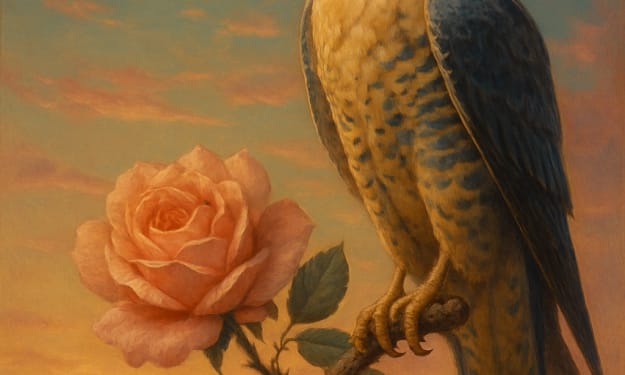
The Majesty of the Falcon: A Symbol of Power and Grace
The falcon, often revered for its strength, grace, and precision, is more than just a bird of prey. It represents power, freedom, and the spirit of unyielding determination. Known for its unmatched hunting skills and exceptional flying abilities, the falcon has captivated the human imagination for centuries. But there’s something deeper, something symbolic, that sets this magnificent bird apart. This story aims to delve into the majestic world of the falcon, unraveling its profound impact on nature, culture, and the human heart.
By Noman Afridi10 months ago in Motivation
Jeffrey Spina A Heart Dedicated to Service and Humanity
In a world where success is often measured by personal achievements and material gains, there are still individuals who quietly dedicate their lives to helping others. These are the people who remind us that compassion, service, and community spirit still hold tremendous value. One such individual is Jeffrey Spina of Middletown in Orange County, United States, a man whose actions demonstrate what true commitment to community service looks like.
By Jeffrey Spinaa day ago in Motivation
Writing To Succeed
If you want to find something that will help readers find your writing, possibly expand your audience, and maybe even get you noticed for other things, then you’re not alone. But how can you get it done in a world full of want-to-be writers? Look less at what you’re writing now, and more at what other writers have used to boost their views and reads.
By Jason Ray Morton 2 days ago in Writers



Comments
There are no comments for this story
Be the first to respond and start the conversation.