
The Architect of Light Who Died in the Dark: The Tragedy and Triumph of Nikola Tesla
He invented the 20th century. He gave humanity the power to light up the globe. But while the world profited off his mind, the capitalist machine chewed him up and left him to die penniless in a hotel room

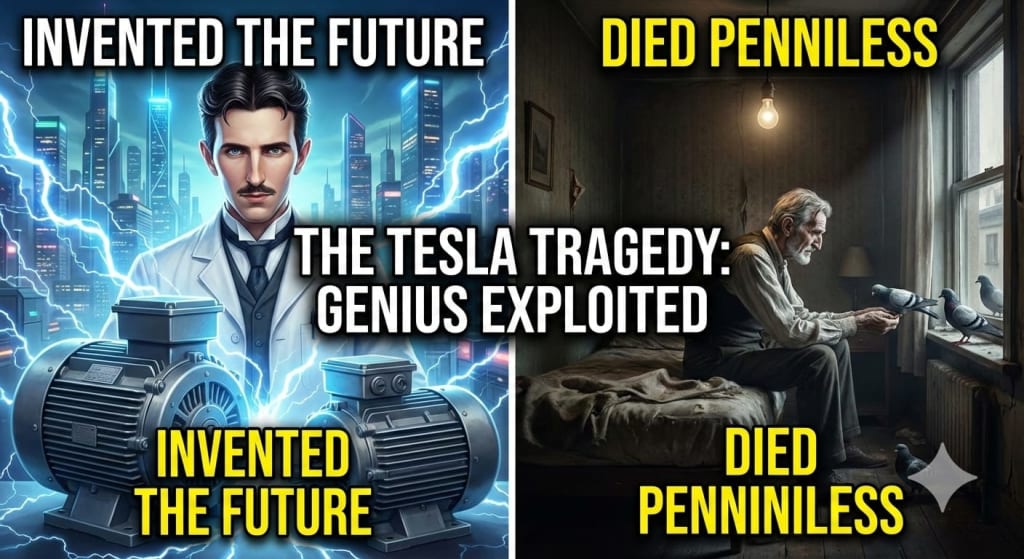
The dark, philosophical true story of Nikola Tesla, the genius who won the War of the Currents against Thomas Edison but sacrificed his own fortune to build the modern electrical grid.
Introduction: Room 3327
It is January 1943.
Outside, the neon lights of New York City are blazing. The subways are roaring beneath the pavement. Factories are churning out steel and weapons for a world at war. The entire machinery of modern civilization is humming with electric blood.
But inside Room 3327 of the New Yorker Hotel, there is only quiet.
An 86-year-old man lies in bed, frail, emaciated, and entirely alone. He has no wife. He has no children. He has no fortune. His rent is being paid by the Westinghouse Corporation out of a sense of corporate guilt.
His only friends are the pigeons he feeds from his window.
When the maid finally enters the room on January 8th, she finds him dead. The authorities arrive. They open his safe. They seize his notebooks. And then, the world moves on.
If you judge success by bank accounts, by status, or by the applause of your contemporaries, this man is a catastrophic failure.
But look up at the lightbulb in your room. Look at the device you are reading this on. Look at the power grid that connects the entire human race.
The man who died in Room 3327 built that.
His name was Nikola Tesla.
His story is the darkest, most uncomfortable lesson in the history of innovation. It is a brutal reminder that the world does not always reward its saviors. Sometimes, the reward for building the future is being crucified in the present.
Part I: The Four Cents and the Letter
To understand the tragedy of Tesla, you have to understand his purity.
In 1884, a 28-year-old Serbian immigrant stepped off a boat in New York City. He had exactly four cents in his pocket, a book of poetry, and a letter of recommendation addressed to the most famous inventor on earth: Thomas Edison.
The letter, written by Charles Batchelor, read: "I know two great men and you are one of them; the other is this young man."
Edison hired him. But Edison and Tesla were fundamentally incompatible.
Edison was a brute-force inventor. He was a businessman. He tried thousands of different materials to make a lightbulb work until he found one that didn't burn up immediately. He cared about patents, profit, and market share.
Tesla was an oracle. He didn't sketch things out; he visualized entire machines in his mind, fully functioning, before he ever touched a piece of metal. He was driven by an almost religious desire to harness the forces of nature for the betterment of mankind.
Edison’s empire was built on Direct Current (DC). DC was terribly inefficient. It could only travel a few miles before losing its power. To light a city with DC, you needed a power plant on almost every street corner, spewing coal smoke into the sky.
Tesla looked at this and saw a flawed system. He proposed Alternating Current (AC). AC could be stepped up to massive voltages, transmitted across hundreds of miles of wire, and stepped back down to power a home safely.
It was the elegant, mathematically perfect solution to electrifying the globe.
"You don't understand our American humor," Edison allegedly told Tesla after refusing to pay him a promised $50,000 bonus for fixing his DC generators.
Tesla didn't argue. He just quit.
Part II: The War of the Currents and the Smear Campaign
Tesla was right, but being right doesn't pay the rent.
For a time, the greatest mind of a generation was reduced to digging ditches in New York City for two dollars a day just to survive. He worked alongside men who had no idea that the quiet foreigner shoveling dirt next to them held the blueprint for the modern world in his head.
Eventually, Tesla found backing. He patented his AC motor. And he caught the attention of George Westinghouse, a Pittsburgh industrialist who saw that Tesla’s AC system was the future.
Westinghouse bought Tesla's patents and hired him.
But Thomas Edison was not going to let his DC empire die without a fight. Thus began the "War of the Currents."
It was not a gentleman's debate. It was a vicious, bloody smear campaign.
Edison knew AC was better. But instead of adapting, he decided to make the public terrified of it. Edison and his supporters paid local boys to steal stray dogs and cats off the streets. They held public demonstrations where they strapped these animals to metal plates and electrocuted them using Tesla’s Alternating Current.
They even funded the creation of the first electric chair, specifically ensuring it used AC power, just to brand Tesla’s invention as "the executioner's current."
Imagine being Tesla. You have created a system that will elevate humanity out of the dark ages, and you have to stand by and watch a powerful billionaire turn your life's work into a horror show for the press.
Part III: The $300 Billion Piece of Paper
Despite the propaganda, truth has a way of rising to the top.
In 1893, Westinghouse and Tesla won the bid to illuminate the Chicago World's Fair. When President Grover Cleveland pushed a button, a hundred thousand incandescent lamps lit up the fairgrounds at once, powered by AC. The public gasped. The war was over. Tesla had won.
But victory in the market is not the same as victory in the bank.
The War of the Currents had financially drained George Westinghouse. The company was on the verge of bankruptcy.
When Westinghouse had originally bought Tesla’s patents, he had agreed to a royalty clause: Tesla would receive $2.50 for every horsepower of AC electricity generated.
If you do the math on how much AC power was about to be generated across the globe over the next century, that single contract would have made Nikola Tesla the first billionaire in human history. His wealth would have rivaled the Rockefellers and the Carnegies.
Westinghouse called Tesla into a meeting. He told the inventor that if the company had to pay those royalties, it would go under. The AC dream would die. The patents would be sold to hostile creditors.
Westinghouse asked Tesla to temporarily reduce his royalties.
Tesla didn't negotiate. He didn't ask for stock options. He didn't ask for a board seat.
Tesla looked at Westinghouse, the man who had believed in him when he was digging ditches. He took the contract—the piece of paper that entitled him to the greatest fortune the world had ever seen—and he ripped it to shreds.
"You have been my friend," Tesla said. "You believed in me."
He gave up his royalty to ensure that Alternating Current would survive. He traded his personal empire for the progress of humanity.
The executives in the room thought he was a fool.
History knows he was a martyr.
Part IV: The Madness of Free Energy
With AC established, Tesla’s mind moved to the next frontier.
He didn't want to just transmit electricity through wires; he wanted to transmit it through the air, the ground, the very atmosphere. He wanted to create a wireless global network.
In 1899, he moved to Colorado Springs, building massive magnifying transmitters, sending artificial lightning bolts into the sky. He claimed he could light bulbs miles away without wires.
He moved back to New York and convinced J.P. Morgan, the most powerful banker in the world, to fund a massive tower in Shoreham, Long Island, called Wardenclyffe.
Morgan thought the tower would be used to transmit wireless stock quotes across the Atlantic.
But Tesla had a darker, more utopian secret. He believed the tower could tap into the earth's natural resonance and provide free, wireless electricity to every human being on the planet. He wanted to give power away to the poorest villages in the world.
When Morgan found out that Tesla's ultimate goal was free energy, he cut the funding immediately.
Morgan was a capitalist. His logic was cold and absolute: “If anyone can draw on the power, where do we put the meter?”
The capitalist machine does not fund utopias. It funds commodities.
Wardenclyffe was abandoned. The tower was eventually torn down and sold for scrap metal to pay Tesla's debts.
It broke him.
Part V: The Descent into the Shadows
The final decades of Tesla's life are a study in the cruelty of memory.
The world industrialized rapidly, entirely powered by his AC motors. Other men took his foundational work in radio and claimed the patents (Marconi won a Nobel Prize for radio, using 17 of Tesla's patents—a fact the Supreme Court only corrected after Tesla's death).
Tesla was pushed to the fringes.
He became eccentric. He developed severe obsessive-compulsive disorder. He demanded exactly 18 napkins at the dinner table. He counted his steps. He developed a phobia of women's pearls.
He stopped talking to scientists and started talking to pigeons.
He lived in a succession of New York hotels, moving out when the bills became too high, leaving behind trunks of schematics and wild ideas—death rays, earthquake machines, flying platforms.
The press, which once hailed him as a wizard, now mocked him as a mad scientist.
He watched Thomas Edison die a wealthy, celebrated icon of American ingenuity. He watched the executives at Westinghouse grow incredibly rich off his torn-up contract.
And Tesla sat on a park bench, feeding birds, wondering why the world had taken his light and left him in the dark.
Part VI: The Brutal Philosophy of the Builder
We live in a culture that worships the "grind."
We worship the aesthetic of success.
We look at billionaires and assume their wealth is a direct reflection of their value to humanity.
Nikola Tesla shatters that illusion.
Tesla teaches us the harshest philosophical truth of all: The market does not reward the best builder; the market rewards the best salesman.
Edison was a salesman. Morgan was a salesman. They understood human greed, leverage, and optics.
Tesla only understood the truth of physics. He thought that if a creation was pure and beneficial, the world would naturally embrace and reward it. He was fatally naive.
But here is the twist—the dark, beautiful irony of his life.
Edison died rich, but his DC systems are obsolete relics.
J.P. Morgan died powerful, but his wealth was just numbers in a ledger.
Nikola Tesla died broke, but he became the infrastructure of reality.
When you flip a switch, that is Tesla.
When an X-ray is taken, that is Tesla.
When a radio signal crosses the ocean, that is Tesla.
When the modern internet transmits data, it stands on the shoulders of his wireless theories.
He didn't just invent a product. He invented the medium through which all modern human life operates.
Conclusion: Legacy Over Attention
In the modern era, everyone wants to be famous. Everyone wants the immediate ROI. We want the likes, the subscribers, the blue checks, the instant gratification. We panic if we aren't recognized immediately.
If you are a creator, an entrepreneur, or a visionary, you have to look at Room 3327 and ask yourself a very dangerous question:
Are you building for applause, or are you building for legacy?
If you build for applause, you have to compromise. You have to sell out. You have to put a meter on your energy. You have to play the game of Edison.
But if you are building something truly revolutionary—something that challenges the status quo, something that the world isn't ready for yet—you have to be prepared for the silence.
You have to be prepared for people to misunderstand you. You have to be prepared to see others profit off your early ideas. You have to be prepared to feed the pigeons.
Success and impact are not synchronized.
Sometimes the world benefits long before it recognizes the builder.
Do not let a lack of recognition convince you that your work lacks value. The world may ignore you today, it may mock you tomorrow, and it may bankrupt you the day after.
But if the work is true, the work survives.
Thomas Edison left behind a corporation.
Nikola Tesla left behind the light.
About the Creator
Frank Massey
Tech, AI, and social media writer with a passion for storytelling. I turn complex trends into engaging, relatable content. Exploring the future, one story at a time
Keep reading
More stories from Frank Massey and writers in Motivation and other communities.
The Teddy Bear and the Cure: How Katalin Karikó Endured 30 Years of Invisibility to Save the World
The untold, raw story of Katalin Karikó, the Nobel Prize-winning scientist who endured decades of academic rejection, demotions, and obscurity to pioneer the mRNA technology that saved millions of lives.
By Frank Massey a day ago in Motivation
One Hard Thing
Stop me if you’ve heard this one before: You have the number, you know your schedule- you’ve even picked out the perfect day and time to make this appointment. Shoot, you’ve even picked out alternative days and times just in case their schedules can’t accommodate you!
By Taylor Rigsby27 days ago in Motivation


Comments
There are no comments for this story
Be the first to respond and start the conversation.