
The Alchemist of Success
How Napoleon Hill Turned Adversity into the Blueprint for Achievement

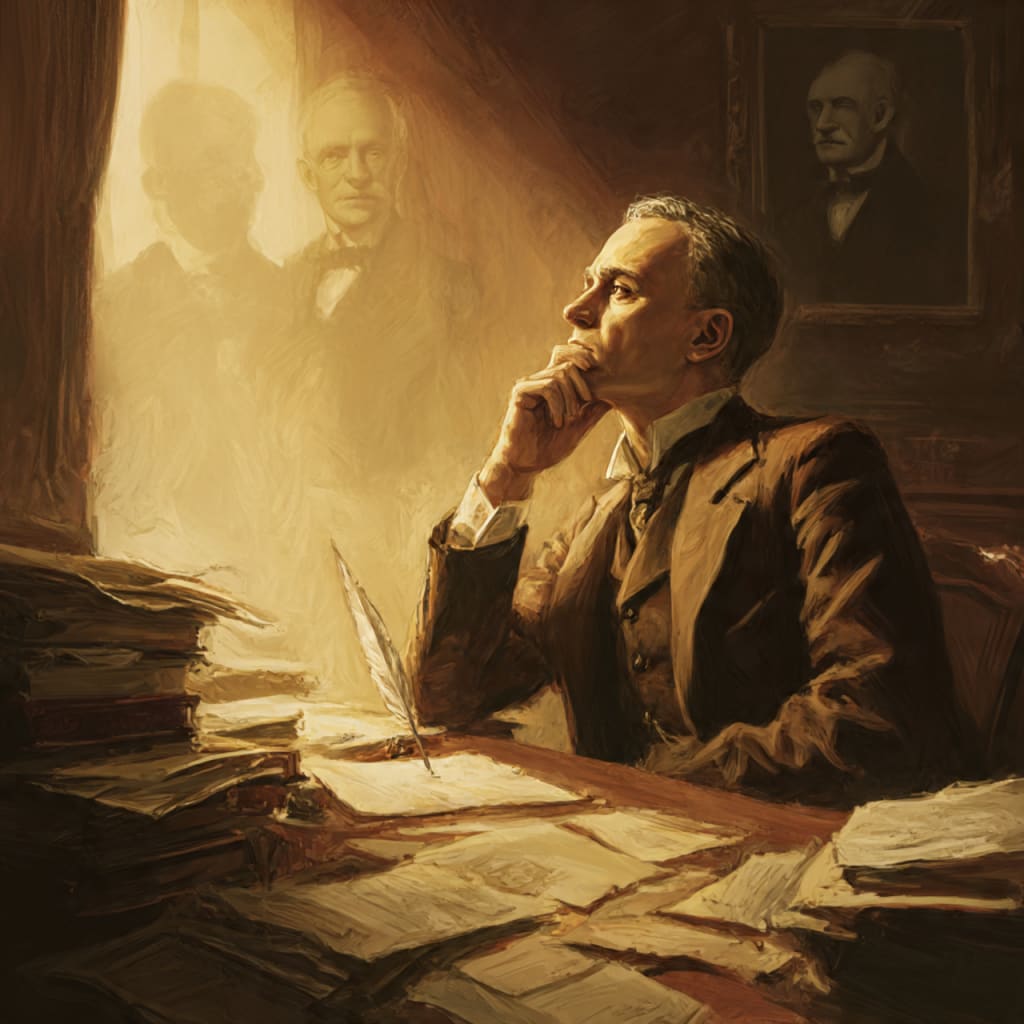
The rain drummed softly on the tin roof of a small cabin tucked in the hills of Wise County, Virginia. Inside, a frail boy of ten sat by the dim light of an oil lamp, his nose buried in a tattered book. His name was Napoleon Hill, and though he did not know it then, the path of his life would one day ignite a revolution in the way people thought about success.
Born in 1883 in the Appalachian Mountains, Napoleon’s early life was anything but glamorous. His mother died when he was nine, leaving his father—a struggling farmer and blacksmith—to raise three children alone. Poverty pressed against every corner of their home, and ambition seemed a luxury reserved for others.
But the boy had one weapon that poverty could not steal: curiosity.
When his stepmother, Martha, came into his life, she brought books and a firm belief that the boy was destined for more than the dusty coal mines that claimed so many lives in their town. “You have a mind sharper than any pickaxe, Napoleon,” she told him. “Use it to dig for something greater.”
Those words planted a seed.
A Reporter’s Beginning
At fifteen, Napoleon became a cub reporter for a small newspaper, scribbling stories about local politics and the lives of miners. It was not glamorous work, but it gave him access—to people, to ideas, and most importantly, to opportunity.
One day, in 1908, that opportunity came in the form of a letter from the editor. Napoleon was to interview one of the most powerful men in America—Andrew Carnegie, the steel magnate and one of the richest men alive.
The young journalist arrived at Carnegie’s estate in Pittsburgh, nervous but eager. What he thought would be a short interview turned into a conversation that stretched into three days. Carnegie, impressed by the young man’s ambition, posed a question that would alter Hill’s destiny forever.
“Mr. Hill,” Carnegie said, “if you could find out why some men succeed while others fail, and then teach those principles to the world, would you do it—even if it took you twenty years?”
Napoleon Hill did not hesitate. “Yes, sir,” he replied.
Carnegie smiled, his eyes gleaming. “Then I shall open the doors for you.”
The Quest for Success
True to his word, Carnegie wrote letters of introduction that opened doors to some of the greatest minds of the early 20th century. Hill would go on to meet and interview Thomas Edison, Henry Ford, Alexander Graham Bell, John D. Rockefeller, Theodore Roosevelt, and hundreds more.
For two decades, he gathered their stories, searching for the invisible thread that tied them all together. What did Edison and Ford share with Carnegie and Rockefeller? Was there a common philosophy behind their triumphs?
Through years of interviews, setbacks, and self-reflection, a pattern began to emerge. Success, Hill realized, was not a matter of luck or privilege—it was a state of mind.
The Birth of a Philosophy
By the late 1920s, Hill began distilling his findings into a coherent philosophy. He called it “The Law of Success,” and his first major work under that title appeared in 1928. The public was intrigued; here was a man claiming that the keys to wealth and happiness were not locked in genetics or circumstance but in definite purpose, faith, persistence, and the power of thought.
Yet Hill’s own life was far from easy. He faced bankruptcies, failed marriages, and business betrayals. At one point, he fled from angry investors and lived in hiding. But rather than give up, Hill practiced what he preached—using adversity as a stepping stone instead of a stumbling block.
Then came the book that would change everything.
“Think and Grow Rich”
In 1937, amid the despair of the Great Depression, Hill published “Think and Grow Rich.” It was a bold title for such bleak times, but the message resonated. Within months, the book sold hundreds of thousands of copies, eventually becoming one of the best-selling self-help books in history.
In it, Hill revealed what he called the “secret”—a principle hinted at by all the great achievers he had studied but never explicitly named. Readers searched for it feverishly, but Hill insisted they had to discover it within themselves.
“Whatever the mind of man can conceive and believe,” he wrote, “it can achieve.”
Those words became a mantra for generations of dreamers, entrepreneurs, and leaders—from W. Clement Stone to Tony Robbins.
Hill had done what Carnegie asked—he had distilled the science of achievement into a philosophy anyone could apply.
Legacy of a Dreamer
Napoleon Hill spent the rest of his life lecturing, writing, and refining his ideas. His teachings influenced countless individuals and became the backbone of the modern personal development movement.
But behind the fame was still the boy from the Appalachian hills—the one who refused to believe that circumstances could define destiny.
When he passed away in 1970, Hill left behind not only a body of work but a living philosophy—one that continues to inspire millions to this day.
Some called him a dreamer, others a visionary. But perhaps the truth lies somewhere in between. For Napoleon Hill was, above all, an alchemist of the human spirit—one who turned the raw material of adversity into the gold of success.
About the Creator
Alexander Mind
Latest Stories
Keep reading
More stories from Alexander Mind and writers in Motivation and other communities.
The Keeper of Fading Things
Elara was the most efficient Recall Archivist in the Aethelburg Spire. She could cross-reference a thousand years of civic data in the time it took her synthetic tea to cool. Her world was one of pure, unassailable information. Every thought, every transaction, every heartbeat of the city was captured, digitized, and stored in the luminous, humming core of the Spire. Nothing was lost. But Elara had begun to suspect that nothing was truly found, either.
By Alexander Mind5 months ago in Motivation
Stop Dimming Your Light to Make Other People Comfortable
Many people learn early in life that standing out can feel dangerous. Maybe you were told you were “too loud,” “too emotional,” “too ambitious,” or “too much.” Maybe your excitement was met with criticism. Maybe your success made someone else uncomfortable. Maybe speaking your truth caused conflict.
By Stacy Valentinea day ago in Motivation




Comments
There are no comments for this story
Be the first to respond and start the conversation.