
The Alchemist of Central Falls: How Viola Davis Turned Invisibility into Gold
She grew up running from rats in condemned buildings. She spent decades watching Hollywood look right through her. But Viola Davis didn't just want a seat at the table; she wanted to rebuild the table with her bare hands

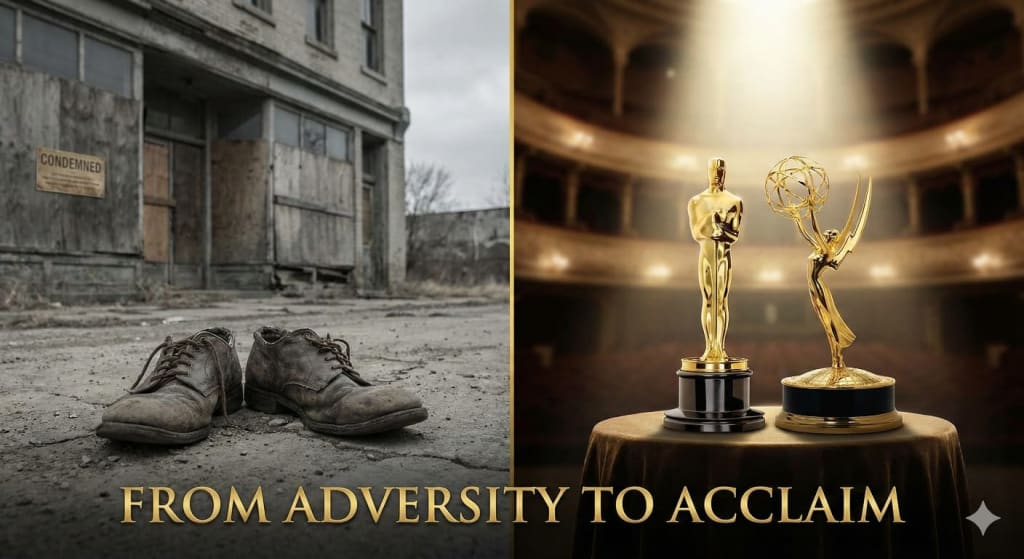
The profound true story of Viola Davis, who rose from the abject poverty of Rhode Island to become the first Black woman to achieve the Triple Crown of Acting, proving that trauma can be fuel for genius.
Introduction: The Girl Who Ran
If you want to understand Viola Davis, you have to understand the running.
In Central Falls, Rhode Island, in the 1970s, a young girl would leave school every day and run. She wasn't running for sport. She wasn't running for joy. She was running for her life.
She knew the boys would be waiting. They would have rocks. They would have bricks. They would have slurs that cut deeper than the stones.
“You’re ugly.”
“You’re black.”
“You smell.”
So, she ran. She ran until her lungs burned. She ran until she reached the safety of her apartment building. But safety was a relative term.
The building was condemned. The heat rarely worked. In the winter, the pipes froze, and they had to sleep in coats. At night, she would wrap a sheet around her neck not for warmth, but to keep the rats from biting her face while she slept.
This was not "humble beginnings." This was the kind of poverty that smells like rot. The kind of poverty that steals your dignity before you even know what dignity is.
Viola Davis was often hungry. She dug through garbage cans. She stole food from the corner store. She felt shame so heavy it felt like a physical weight on her shoulders.
But inside that terrified, hungry girl was a reactor core of immense power. She just needed a place to aim it.
Part I: The Magic Trick
Viola discovered the magic trick when she was a teenager.
She entered a talent competition. She was wearing clothes from the Salvation Army. She felt invisible.
But when she stepped on stage and began to speak a monologue, something happened. The shame evaporated. The hunger disappeared. The rats, the cold, the boys with the rocks—they all vanished.
For those few minutes, she wasn't "Poor Viola." She was a queen. She was a mother. She was a villain. She was somebody.
She realized that acting was not a game of pretend. It was a game of truth. It was the only way she could take the pain inside her—the trauma of her childhood—and turn it into something valuable.
She became obsessed. She studied theater at Rhode Island College. Then, she aimed for the impossible: Juilliard.
The Juilliard School in New York City is the Navy SEALs of acting. It is rigorous, elitist, and grueling.
Viola auditioned. She got in.
But Juilliard was its own kind of battle. It was a place of Eurocentric standards. They taught her how to speak like a British queen. They taught her how to move like a white woman from the 19th century.
They tried to mold her into a "classic" actress.
But Viola’s hair was kinky. Her skin was dark chocolate. Her voice had the gravel of Rhode Island poverty in it.
She felt like she was putting on a mask. She excelled, yes. She learned the technique. But she felt she was erasing herself to fit the mold.
Part II: The Waiting Room
After graduation, Viola Davis entered the professional world. She was a Juilliard-trained beast. She had the skills to play anything—Lady Macbeth, Cleopatra, Medea.
But Hollywood didn't see Medea.
They saw: "Black Maid #2."
They saw: "Crack Addict."
They saw: "Nurse with three lines."
For years, Viola lived in the "waiting room" of the industry. She watched actresses with half her talent and half her training soar past her because they fit the "look." They were lighter. They were thinner. They were "marketable."
Viola was told she was "too dark." "Too classic." "Not sexy enough."
This is the silent killer of dreams. It’s not the rejection; it’s the categorization. It’s being told that your ceiling is someone else’s floor.
But Viola didn't quit. She couldn't. Acting was the only thing that made sense of her life.
She worked in theater. She won Tony Awards on Broadway. In the theater world, she was a giant. But in Hollywood, she was invisible.
She was nearly 40 years old. She had no money. She was still struggling to pay rent.
The little girl who ran from the boys was now a woman running from obscurity.
Part III: Eight Minutes of Fire
Then came 2008.
A film called Doubt was being made. It starred Meryl Streep, Philip Seymour Hoffman, and Amy Adams. The titans of cinema.
There was one role open: Mrs. Miller. The mother of a boy who may have been abused by a priest.
It was a tiny role. One scene. Eight minutes of screen time.
Viola got the part.
On the day of filming, the pressure was atmospheric. She was sitting on a park bench across from Meryl Streep—the woman considered the greatest actress alive.
Most actors would have been terrified. They would have tried to "match" Streep. They would have overacted to get noticed.
Viola didn't do that.
She brought the rats. She brought the hunger. She brought the shame of Central Falls.
She sat on that bench and she poured 40 years of invisibility into eight minutes of dialogue. She cried, not pretty Hollywood tears, but ugly, snot-nosed, heaving tears of a mother who is terrified for her son but has no power to save him.
It was a masterclass.
When the movie came out, audiences gasped. "Who is that?"
For eight minutes, she stole the movie from Meryl Streep.
She got an Oscar nomination.
She didn't win that night. But she had kicked the door open. She had proven that you don't need to be the lead to be the star. You just need to be the truth.
Part IV: The Help and the Regret
After Doubt, Hollywood finally saw her. But they still didn't know what to do with her.
She was cast in The Help. She played Aibileen Clark, a maid in the 1960s South.
She was magnificent in it. She got another Oscar nomination. The movie was a massive hit.
But privately, Viola struggled.
She felt she had betrayed herself. She felt she had taken a role that perpetuated the "Mammy" stereotype—the Black woman who exists only to serve white narratives.
"I felt like I betrayed myself and my people," she later admitted in a shocking interview.
Most actresses would never say that. They would protect the "brand." They would be grateful for the hit.
But Viola Davis is not interested in being polite. She is interested in being real.
She realized that even though she had "made it," she was still playing by Hollywood's rules. She was still fitting into their box.
She decided to burn the box.
Part V: How to Get Away with Murder
In 2014, Shonda Rhimes offered her the lead role in a TV show called How to Get Away with Murder.
The character was Annalise Keating. A brilliant, messy, sexual, dangerous law professor.
It was the role of a lifetime. But there was a catch.
In the original script, Annalise was not described physically. But on TV, a "lead woman" usually looks a certain way.
Viola took the role, but she had one condition.
"I want to take off the wig."
In Black women's hair culture, the wig is often armor. It is a way to present a polished, "acceptable" image to the white world. To take it off is an act of extreme vulnerability.
The producers were hesitant. "On camera?"
"Yes," Viola said. "I want to show the woman before she puts on the armor."
The scene aired in the first season.
Annalise sits at her vanity. She is crying. Slowly, methodically, she takes off her jewelry. She wipes off her makeup, smearing the mascara. And then, she reaches up and peels off her wig.
Underneath is her short, natural, matted hair.
She looks in the mirror. She is unmasked.
Millions of women watched that scene and wept. For the first time, they saw a Black woman on prime-time television who wasn't a caricature. She wasn't "sassy." She wasn't a maid. She wasn't strong.
She was just... human.
That moment changed television. It proved that an audience could handle the truth. It proved that beauty wasn't about concealment; it was about revelation.
Viola won the Emmy. She was the first Black woman in history to win Lead Actress in a Drama.
In her speech, she quoted Harriet Tubman. And then she said the words that defined her career:
"The only thing that separates women of color from anyone else is opportunity."
Part VI: The Triple Crown
Viola didn't stop.
She went back to the theater material she loved. She starred in the film adaptation of August Wilson’s Fences alongside Denzel Washington.
She played Rose Maxson. A woman who sacrificed everything for her family.
It was a role she knew in her bones. She channeled her mother. She channeled her neighbors in Central Falls.
She won the Oscar.
With that win, she achieved the "Triple Crown of Acting"—an Oscar, an Emmy, and a Tony.
She is the only African American to do it.
She had climbed the mountain. The girl who dug in trash cans was now holding the highest honors in her industry.
But she didn't build a wall around herself. She built a ladder.
Part VII: The Woman King
In 2022, Viola produced and starred in The Woman King.
It was an action movie about the Agojie, the all-female warrior unit in Africa.
Hollywood studios were terrified. "A Black female action movie? With a 57-year-old lead? It will flop."
Viola trained for months. She lifted weights. She learned martial arts. She transformed her body into a weapon.
The movie was a smash hit. It debuted at number one.
It proved that Viola Davis wasn't just a great actress. She was a box office draw. She was a movie star.
She had finally destroyed the last argument against her: "She's not marketable."
Part VIII: The Real Motivation
Viola Davis’s story is not about "acting."
It is about Worthiness.
For her entire life, the world tried to tell Viola Davis she wasn't worthy.
Poverty told her she wasn't worthy of food.
Racism told her she wasn't worthy of beauty.
Hollywood told her she wasn't worthy of the lead.
Viola had to fight a war on two fronts. She had to fight the external world, and she had to fight the internal voice that whispered, Maybe they are right.
She beat them both.
She beat them by refusing to hide.
Most people try to hide their trauma. They try to "fix" themselves to look like the successful people they see on TV.
Viola Davis did the opposite. She dragged her trauma into the light. She used her pain as her paint.
When you watch Viola Davis act, you trust her. You trust her because you know she isn't lying to you. You can see the scars.
Conclusion: The Alchemist
There is a moment in Viola’s memoir, Finding Me, where she talks about her younger self.
She talks about the little girl running from the boys.
She says she used to run from her past. Now, she runs towards it. She embraces that little girl. She tells her, "I see you."
Viola Davis reminds us that our "baggage" is actually our treasure.
The things you are ashamed of—your poverty, your struggle, your rejection—those are the raw materials of your power.
You don't need to be born in a castle to be a queen. You can build a kingdom out of condemned buildings and broken dreams.
You just have to be willing to take off the wig.
You have to be willing to stand in front of the mirror, look at who you really are, and say:
I am enough.
And once you believe that, no casting director, no boss, and no bully can ever make you invisible again.
About the Creator
Frank Massey
Tech, AI, and social media writer with a passion for storytelling. I turn complex trends into engaging, relatable content. Exploring the future, one story at a time
Keep reading
More stories from Frank Massey and writers in Motivation and other communities.
One Hard Thing
Stop me if you’ve heard this one before: You have the number, you know your schedule- you’ve even picked out the perfect day and time to make this appointment. Shoot, you’ve even picked out alternative days and times just in case their schedules can’t accommodate you!
By Taylor Rigsby18 days ago in Motivation
Jackie Chan's "Drunken Master" (1978): The Birth of a New Asian Action Star
The Rise of the Drunken Master Jackie Chan almost quit making films and left movie making. Indeed, he was a failure, for he could not duplicate Bruce Lee's success. Directed by Yuen Woo-ping, this comedy kung fu classic "Drunken Master" (Jui kune) established Jackie Chan as a mega star in Asia. Yuen Woo-ping became famous in the West for his work on "Matrix" and "Crouching Tiger, Hidden Dragon. "
By SAMURAI SAM AND WILD DRAGONS4 days ago in Motivation
📢 Raise Your Voice Thread: 02/05/2026
Our “Raise Your Voice Threads” are hosted most alternating Thursdays at 12PM ET to offer creators more avenues to uncover exceptional stories on Vocal. As we are continuously searching for fresh creators and inspiring stories, this thread provides an opportunity to exchange and discuss the stories that have moved and motivated us on Vocal.
By Raise Your Voice by Vocal7 days ago in Resources




Comments
There are no comments for this story
Be the first to respond and start the conversation.