
Story "The happy prince"
"A tale of selfless love and sacrifice"

art writing...
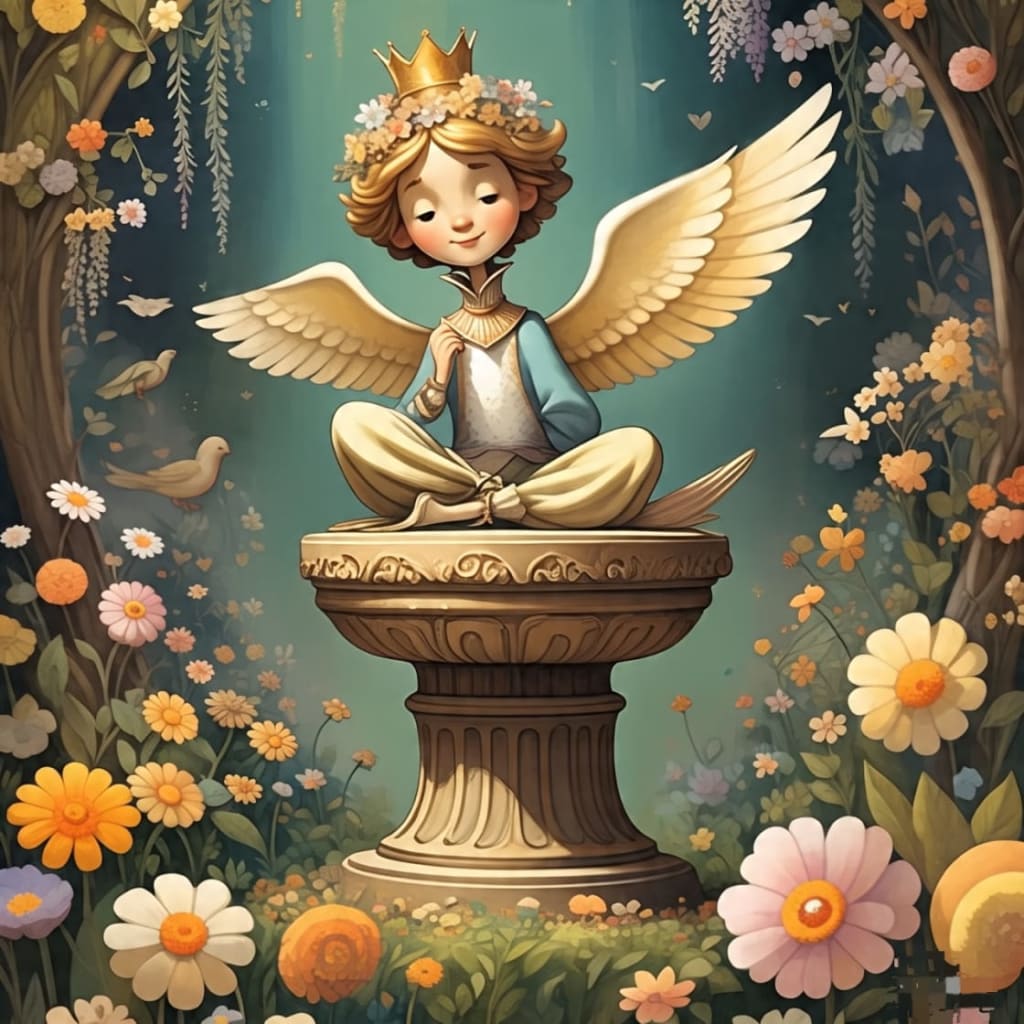
High above the city, on a tall column that reached toward the bluest stretch of the sky, stood the statue of the Happy Prince. He was gilded all over with fine, delicate leaves of gold, and for eyes, he had two bright sapphires that sparkled with kindness. At the hilt of his sword, there glowed a large ruby, red as a drop of fire caught in the light of day.
People passing by would stop to admire him. Children would gaze up in awe and say, “Look! The Happy Prince smiles down on us!” Politicians praised the grandeur of the statue as a symbol of the city’s glory. Artists drew sketches, and tourists snapped photographs, marveling at how beautifully the Prince gleamed in sunlight and moonlight alike.
But none of them knew the truth: the Happy Prince, despite his radiant appearance, was no longer happy.
When the Prince had been alive, he had lived in a great palace where sorrow was never allowed to enter. He was surrounded by gardens where flowers bloomed in endless colors and fountains danced with crystal waters. He spent his days in pleasure, never once stepping outside the palace walls. “Why should I leave?” he had asked. “The world is happy, just as I am.” And so he lived and died in that illusion.
It was only after his death, when they erected him on a pedestal high above the city, that he saw what he had never known. From his new vantage point, the Prince could see every corner of the city, every alley and attic, every face turned away in grief. He saw poverty. He saw pain. He saw children going hungry and mothers weeping alone. And his heart, once cast in gold, turned heavy with sorrow.
One evening, as the city prepared for slumber and the lamps flickered like fallen stars, a small Swallow flew over the rooftops.
The Swallow was late. All his friends had flown south for the winter weeks ago, their wings carving paths through the autumn winds. But he had lingered, drawn to the reed he loved in the river—a graceful creature with flowing green hair. “She dances with the water,” he had said dreamily. But the reed did not return his affections. She would not travel. And eventually, heartbroken, he left her and began his journey south alone.
Now weary, the Swallow sought shelter and landed at the feet of the statue.
“This looks like a good place to sleep,” he murmured. “Plenty of height and a view of the stars.”
Just as he tucked his head beneath his wing, a large drop of water splashed upon him.
“Strange,” he said. “The sky is clear, not a single cloud. Yet it’s raining?”
Then another drop fell, and another. Looking up, he saw that the Happy Prince was crying. Tears streamed down the golden cheeks, running over the sapphire eyes and falling like pearls upon the Swallow’s feathers.
“Who are you?” asked the Swallow, startled.
“I am the Happy Prince,” came the gentle voice.
“Then why do you weep?” asked the Swallow. “You are golden and splendid. The people call you blessed.”
“But I am not happy,” the statue replied. “Not while I see such suffering.”
The Swallow listened, curious and touched.
“Far below,” said the Prince, “in a narrow alley, lives a seamstress. She sits sewing late into the night to feed her sick child, who lies in bed with a fever. She has nothing to give him but water. Her fingers are pricked from her work, and her eyes are heavy with worry.”
“Little Swallow,” the Prince pleaded, “pluck the ruby from my sword and carry it to her. She needs it more than I.”
The Swallow hesitated. He was cold and tired, and the journey south was long.
But when he looked into the Prince’s eyes, he saw such sorrow and compassion that he could not refuse.
So the Swallow plucked the ruby, the flame-red jewel, and flew silently through the night, over the winding streets and silent rooftops, until he reached the seamstress’s home. Through a broken window, he slipped in and laid the ruby beside her thimble.
He fanned the child’s forehead with his wings and flew back to the Prince.
“Strange,” he murmured as he returned, “it is colder now, but I feel warm.”
The next day, the Prince saw more.
“Little Swallow,” he said again that evening, “do you see that young man in the garret? He is a playwright. He is writing a play for the theatre, but he has no fire and no food. His hands tremble with cold. He dreams of art, but poverty clutches him.”
“Take one of my sapphire eyes and give it to him.”
“No!” cried the Swallow. “That would make you blind in one eye!”
“Still,” said the Prince, “give it to him.”
And so the Swallow plucked the sapphire from the Prince’s eye and carried it to the playwright. The young man opened his window and saw the gem. “A gift from the stars,” he whispered, overcome with hope. The fire he lit that night was not only in his hearth but in his heart.
The Swallow returned again. The air was frostier. His feathers trembled.
“Dear Swallow,” said the Prince, “I see a matchgirl below. She has dropped her matches in the gutter and is sobbing. If she goes home empty-handed, her father will beat her.”
“Pluck out my other eye and give it to her.”
“No, no!” said the Swallow. “You will be blind!”
“Still, give it to her.”
With aching heart, the Swallow obeyed. The girl gasped in wonder when the brilliant sapphire landed in her palm. She smiled through her tears and ran home.
Now the Prince was blind.
“You must go now,” said the Prince to the Swallow. “Fly south before winter kills you.”
“I will stay with you,” said the Swallow, his voice soft and steady. “I cannot leave you blind and alone.”
And so the Swallow stayed.
He perched on the Prince’s shoulder and told him stories of Egypt—of the pyramids, the sacred Sphinx, the golden deserts where the moon sang on the sand. The Prince listened with joy and painted pictures of it in his mind.
Each day, the Prince would say, “Fly over the city, little Swallow, and tell me what you see.”
And the Swallow would fly—over the hungry, the sick, the forgotten.
“There is a family huddled beneath the bridge,” he said one day. “The mother holds her children, too cold to cry. They have not eaten.”
“Peel the gold leaf from my body,” said the Prince. “Give it to them.”
“But that will make you dull.”
“They need it more.”
And so the Swallow did as asked. Every day, he stripped away more gold from the Prince’s body, dropping it like sunlight into outstretched hands and hungry laps. The city praised the Happy Prince even more, not knowing he was slowly becoming gray and bare.
The frost deepened. Snow came. Ice clung to roofs and windows. The Swallow grew weaker.
“I am not afraid,” he whispered to the Prince one morning, shivering. “I have seen what love is.”
That night, the Swallow felt his time drawing near.
“I will kiss you on the lips,” he said. “You are dear to me.”
Then he flew upward, kissed the statue’s cold mouth, and fell at the Prince’s feet. Dead.
At that moment, a loud crack rang through the statue. A fissure split the Prince’s heart, brittle with lead and sorrow, and it broke clean in two.
The next morning, the Mayor walked beneath the statue with his councilors.
“My word!” he exclaimed. “How shabby the Happy Prince looks!”
“No gold, no jewels, no sparkle! He’s no longer beautiful!”
“And look, a dead bird at his feet. Disgusting.”
“Remove it! And melt the statue down,” declared the Mayor. “We must have something grander, something modern.”
So they took down the statue. But when they tried to melt the heart, it would not dissolve.
“This is strange,” said the foreman. “This broken lead heart refuses the fire.”
“Throw it away,” they said.
So they discarded the Prince’s heart alongside the little dead Swallow.
But in Heaven, God spoke to one of His angels.
“Bring me the two most precious things in the city,” He said.
The angel returned with the broken heart and the lifeless bird.
“You have chosen well,” said God. “For in My garden of paradise, this little bird shall sing forever, and in My city of gold, the Happy Prince shall praise Me.”
And so the statue that once stood high above the city, and the Swallow who gave his life in kindness, lived on—eternal, unseen, and shining in a world where gold never fades and hearts never break.
About the Creator
Haroon Badshah
omeoge
This page is about short stories, love stories, short novels, self Discovery, Romance, social commentary, mysteries and science fiction.
Keep reading
More stories from Haroon Badshah and writers in Motivation and other communities.
A Good Man is hard to find
art writing...The sun blistered down upon the old country road like a watchful eye, burning the cracked earth, illuminating the ghosts of wildflowers that once lined the ditches. Dust stirred up by passing cars danced in the beams of light, swirling as if spirits of the land protested the invasion of strangers.
By Haroon Badshah8 months ago in Fiction
Looking back: 2025 was a beast
It's difficult to know how to start this. I've suggested that it's been a tough one from my title and in many ways, it has; however, there is an argument that it's not been that extraordinary at all, merely this wonderful thing we call "life" with all its climaxes and pitfalls.
By Rachel Deeming27 days ago in Motivation
What I Learned Too Late
I spent years rushing. Rushing to finish tasks, chasing opportunities, trying to prove myself to the world. I thought success was about speed, about doing more, being more, having more. I believed that if I worked hard enough, life would reward me instantly.
By Fazal Hadi2 days ago in Motivation



Comments (1)
Very nice 👍