
Stephen Hawking: The Mind That Transcended the Body
A Motivational Real-Life Story

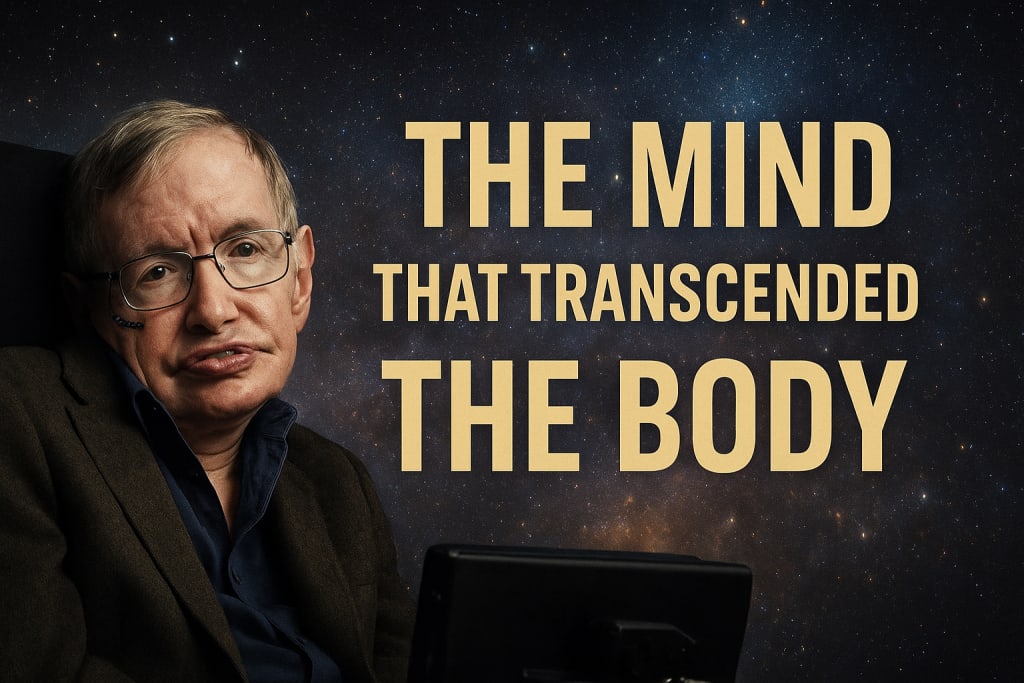
“However difficult life may seem, there is always something you can do and succeed at.” — Stephen Hawking
The lecture hall was quiet — too quiet.
A young man sat in his wheelchair, his fingers twitching slightly, his eyes bright with a mix of humor and infinite thought. The computer voice broke the silence.
> “Welcome to the universe… my home.”
That young man was Stephen Hawking — a name that would one day echo not just in physics classrooms, but in the hearts of millions who needed a reason to keep fighting.
This is not just a story about science.
It’s about a soul that refused to surrender — a man who turned a death sentence into a lifetime of discovery, laughter, and defiance against every limit life could throw his way.
Part 1 — The Curious Boy Who Looked Up
Stephen William Hawking was born on January 8, 1942, in Oxford, England — exactly 300 years after the death of Galileo Galilei. A coincidence, perhaps, but one that foreshadowed destiny.
His family was unconventional — his father a medical researcher, his mother an intellectual dreamer. Their home was full of books, discussions, and — according to Stephen’s sister — slightly broken cars that Stephen loved to take apart.
He wasn’t the best student, not at first. His handwriting was messy, his grades unremarkable. But his mind — oh, his mind — was already exploring galaxies.
At age 14, he was nicknamed “Einstein” by friends, though he laughed it off.
Stephen had something rare: a hunger not just to know, but to understand.
While most kids asked what stars were, Stephen asked why they existed.
Why do black holes form?
What happens before the beginning?
Can time itself bend?
He was a boy obsessed with the impossible — a curiosity that would one day change how humanity saw the cosmos.
Part 2 — The Diagnosis
At 21, everything changed.
Stephen was a student at the University of Cambridge, already showing signs of brilliance. But one winter afternoon, he slipped and fell at an ice rink. His body had been acting strange — tripping, slurred speech, clumsiness.
Doctors ran tests.
Days turned into weeks.
Finally, the diagnosis came: Amyotrophic Lateral Sclerosis (ALS) — a degenerative motor neuron disease.
He was given two years to live.
For a young man who had just begun to understand the universe, those words were a death sentence wrapped in silence.
Stephen fell into depression.
He stopped studying. He listened to Wagner and imagined his life fading like the slow collapse of a star.
But life — as it often does with the extraordinary — had other plans.
A chance meeting with Jane Wilde, a fellow Cambridge student, changed everything. She was bright, kind, and full of faith. She saw Stephen, not his illness.
Their love gave him purpose again.
“If she’s willing to take me as I am,” he said later, “then maybe I can still live.”
That decision — to live — was the first step in his cosmic journey.
Part 3 — The Mind Awakens
Hawking threw himself into work.
He couldn’t walk, but he could think. And his thoughts were galaxies.
His PhD research on black holes led him to one of the most profound discoveries of all time: Hawking Radiation — the idea that black holes, contrary to all previous beliefs, could emit radiation and slowly evaporate.
It was revolutionary.
He had taken something mysterious and untouchable and found its heartbeat.
Soon, he began exploring the Big Bang — the moment of creation itself.
He wanted to know: Did the universe have a beginning?
His answer was as poetic as it was scientific — yes, but not in the way you think.
He suggested that the universe might be finite but without boundaries — like the surface of the Earth, which is round and endless, yet complete.
By then, his body was nearly immobile.
But his mind was infinite.
Part 4 — The Voice That Spoke to the Universe
By 1985, Hawking lost his voice due to a tracheotomy after pneumonia. Most thought that would end his lectures forever.
But technology intervened — a voice synthesizer developed in California gave him a new tool.
When he first “spoke” using the computer, it was a robotic monotone — yet somehow, it was full of character. That voice would soon become one of the most recognizable sounds in science.
“My name is Stephen Hawking. I am a scientist.”
That moment wasn’t just about communication.
It was about liberation.
He had lost his body, but gained a louder, global voice.
Through that voice came “A Brief History of Time” — a book that took the complexities of the cosmos and turned them into something ordinary people could understand.
It sold over 25 million copies, was translated into 40 languages, and made Hawking a household name.
People who had never cared for physics suddenly found themselves pondering wormholes and parallel universes — guided by a man who couldn’t move a single muscle.
Part 5 — Humor, Humanity, and the Black Hole Within
Despite fame and struggle, Hawking never lost his humor.
He appeared on The Simpsons, Star Trek, and even The Big Bang Theory.
He once joked,
“Women are a complete mystery to me.”
Behind the jokes, though, was a life of endurance.
His marriage to Jane eventually strained under the weight of his fame and illness, though they remained friends.
He later remarried, continued lecturing, and inspired countless scientists, artists, and dreamers.
He once said,
“It would not be much of a universe if it wasn’t home to the people you love.”
Even from his chair, he taught the world compassion — that intelligence means nothing without kindness, that curiosity means nothing without humility.
--Part 6 — The Last Theory
In his final years, Hawking continued to explore questions that haunted humanity:
What existed before the Big Bang?
Can we ever escape our own universe?
Is there a God behind creation?
In his last paper, published just days before his death, he proposed that our universe might be one of many — part of a multiverse, a cosmic ocean of endless realities.
To him, life and the universe were reflections of each other: both mysterious, both temporary, both miraculous.
Part 7 — The Final Journey
Stephen Hawking passed away on March 14, 2018 — Pi Day — and, incredibly, on the birthday of Albert Einstein.
His ashes were laid to rest in Westminster Abbey, between the graves of Isaac Newton and Charles Darwin — as if the universe itself had reserved him a seat among its greatest explorers.
-Part 8 — The Legacy Beyond Stars
Hawking’s life wasn’t about tragedy.
It was about triumph of will over circumstance.
He taught that your body can be broken, but your mind — your curiosity — can still touch infinity.
He showed that humor and humility are forms of strength.
That even in silence, your ideas can roar louder than thunder.
And that when life takes away your movement, you still have the power to move the world.
Remember to look up at the stars and not down at your feet.”
— Stephen Hawking
About the Creator
Frank Massey
Tech, AI, and social media writer with a passion for storytelling. I turn complex trends into engaging, relatable content. Exploring the future, one story at a time
Keep reading
More stories from Frank Massey and writers in Motivation and other communities.
Greta Thunberg: The Girl Who Shook the World
)New York City. September 23, 2019. The world sat in silence. Under the cold white lights of the United Nations headquarters, a sixteen-year-old girl from Sweden stood behind a wooden podium. Her face was flushed, her hands trembling — not from fear, but fury. Cameras clicked. Reporters leaned forward. Politicians adjusted their ties, preparing for another forgettable speech.
By Frank Massey 4 months ago in Motivation



Comments
There are no comments for this story
Be the first to respond and start the conversation.