
Rewriting the Inner Script That Shapes Your Life
The stories you repeat quietly determine the life you attempt
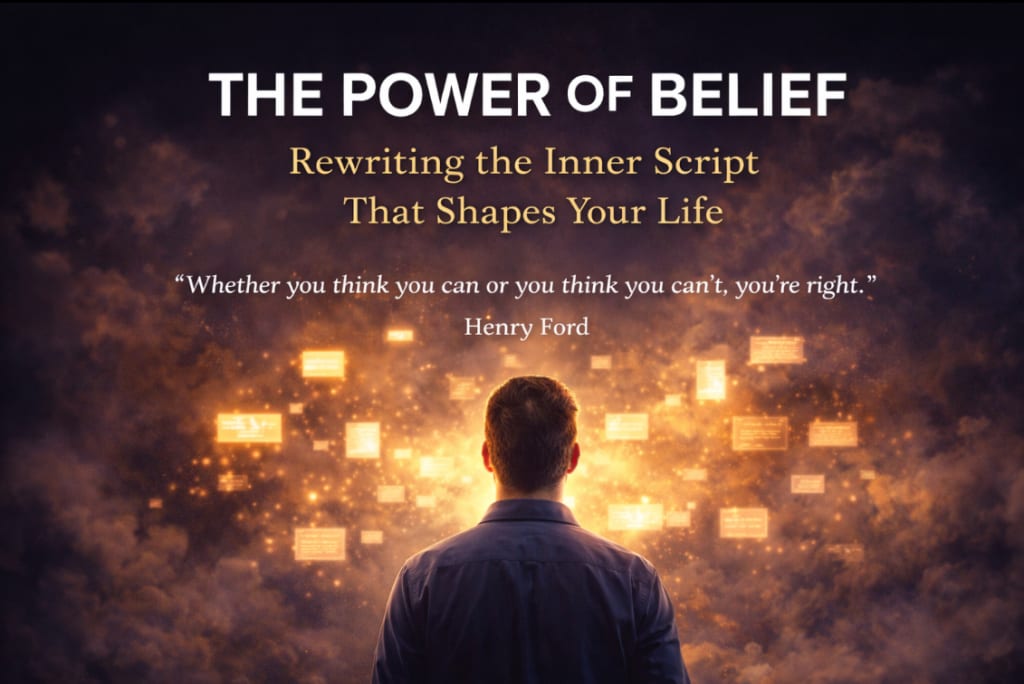
Belief is one of the most powerful—and least visible—forces shaping our lives. Long before we take action, before we make a decision or pursue a goal, a story has already been written inside our minds. That story determines what we attempt, what we avoid, and what we quietly accept as “just the way things are.”
Henry Ford captured this truth perfectly: “Whether you think you can or you think you can’t, you’re right.”
That statement isn’t motivational fluff. It’s a description of how the mind works.
Belief as the Origin Point
Every action begins with a story. That story shapes perception, and perception drives behavior.
Imagine receiving a short email from your boss: “Need to see you immediately about the project.”
If your internal narrative is “I’m incompetent” or “I’m about to be reprimanded,” your perception instantly shifts. The tone feels cold. The timing feels ominous. You enter the meeting defensive and anxious—often creating the very tension you feared.
But if your story is “I delivered a complex project, and they want my input,” the same email produces confidence instead of fear. The external event doesn’t change. The internal story does—and that changes everything.
Beliefs act like software running in the background of our lives. You don’t see the code, but it determines what’s possible. And here’s the uncomfortable truth: most of us are running programs we didn’t write.
The Inherited Script
Our earliest beliefs come from authority figures—parents, teachers, culture, and environment. Some of these beliefs empower us. Others quietly limit us.
Statements like “You’re not a math person,” “People like us don’t succeed,” or “You’re just disorganized” may have been spoken casually, but repetition turns them into internal laws. Over time, they stop sounding like someone else’s voice and start sounding like truth.
That’s why change feels so hard. We don’t realize we’re obeying inherited code.
And this isn’t about denying real-world barriers or systemic challenges. External conditions matter. But belief determines whether those conditions become walls or problems to solve. Reclaiming belief is about reclaiming agency—especially when circumstances are difficult.
Belief Is Not Truth
One of the most liberating ideas in this work is simple but profound: belief is not truth.
Belief is repetition.
Belief is memory.
Belief is perception hardened into habit.
That means beliefs can be changed.
Neuroscience confirms this through neuroplasticity—the brain’s ability to rewire itself based on experience. The principle is straightforward: neurons that fire together wire together.
Repeated thoughts and behaviors strengthen neural pathways. Over time, those pathways become insulated with myelin, making them faster and more automatic. That’s why limiting beliefs feel so convincing—they’re well-paved mental highways.
But unused pathways weaken. This process, called synaptic pruning, means that when you stop reinforcing an old belief and repeatedly act on a new one, the brain physically changes.
Rewriting the Code Through Action
Change doesn’t begin with positive thinking alone. It begins with intentional action.
If someone believes “I am disorganized,” that belief may be decades old. But when they spend even 15 minutes intentionally creating order—organizing a desk, planning a task—they fire a new neural pathway: “I am someone who creates structure.”
At first, that pathway is fragile. But repetition strengthens it. Over time, the old belief weakens, and the new one becomes automatic.
The power isn’t in who you’ve been—it’s in which path you choose to walk next.
The First Step: Question, Don’t Obey
The most important shift is learning to question beliefs instead of obeying them.
Three questions create immediate distance from limiting narratives:
1. Where did this belief come from?
2. Who gave it to me?
3. Does it still serve who I want to become?
When you trace a belief back to its source, its authority often collapses. You realize it’s not a universal truth—it’s a hand-me-down. And if it no longer serves your future, you’re allowed to retire it.
This is the moment you stop fixing what’s “wrong” and start designing what’s next.
Fixed vs. Growth Mindset
Psychologist Carol Dweck’s work clarifies why belief matters so much. A fixed mindset assumes abilities are static. Failure becomes proof of inadequacy. A growth mindset sees ability as developable. Failure becomes feedback.
The same setback produces two completely different realities depending on belief.
The belief that change is possible isn’t optional—it’s the gateway to effort, learning, and resilience.
Language: Living by Design
Language is the interface to belief.
Living by default sounds like:
• “I’m bad with money.”
• “I’m always late.”
• “I’m not good enough.”
Living by design reframes identity as process:
• “I’m learning how to manage money.”
• “I’m prioritizing punctuality.”
• “I’m developing this skill.”
This isn’t about forced positivity. It’s about choosing language that keeps the door open to growth.
Belief Comes Before Evidence
Most people wait for proof before believing in themselves. But transformation works in reverse.
Belief generates action.
Action creates evidence.
High performers understand this. Michael Jordan didn’t interpret missed shots as proof of failure—he saw data. Oprah Winfrey didn’t accept rejection as a verdict on her worth—she treated it as a temporary mismatch.
The belief came first. The evidence followed.
Consistency Is the Key
Change happens through small, consistent acts:
1. Interrupt the old thought. Pause the automatic script.
2. Replace it intentionally. Choose a growth-oriented alternative.
3. Reinforce it with action. Do something that supports the new belief.
Over time, effort turns into identity. Not because you forced it—but because you practiced it.
The Inner Shift
The inner shift isn’t a single breakthrough. It’s a continuous process of questioning, choosing, and reinforcing.
You are not here to fake confidence.
You are here to remember your capability.
You don’t need a perfect plan—just permission to begin.
If belief is repetition hardened into habit, then the question becomes simple and powerful:
What small, intentional action can you take today to strengthen the belief you choose to hold?
Start there.
About the Creator
Joe Mhurs
Whether you’re looking for a boost in your mental well-being, seeking a new outlook on life’s challenges, or simply wanting to be more present in each day, you’re in the right place.
Keep reading
More stories from Joe Mhurs and writers in Motivation and other communities.
Mindfulness is not about finding stillness outside, but creating it within.
The concept of mindfulness offers a powerful way to reconnect with ourselves. Often, we seek peace and calm by attempting to control the outside world, believing that if we could just eliminate the noise or manage our environment perfectly, we would finally experience inner tranquility. However, true mindfulness teaches us that stillness is not something to be found outside of us, but rather something to be cultivated from within.
By Joe Mhurs 11 months ago in Motivation
One Hard Thing
Stop me if you’ve heard this one before: You have the number, you know your schedule- you’ve even picked out the perfect day and time to make this appointment. Shoot, you’ve even picked out alternative days and times just in case their schedules can’t accommodate you!
By Taylor Rigsby4 days ago in Motivation
🅼🅸🅳🅽🅸🅶🅷🆃 🆂🅽🅰🅲🅺🆂
"It's 10 in Tuscon! We all know what that means... It's Time for Midnight Snacks with your man, Gerald Gee! Ready to spend the night together? Me too! I'm full of snacks and can't wait to regurgitate them all back into your hungry ears. Crack a brew! Pop some corn! Anything to get ready for one hell of a show where the talk maybe cheap but the words cut deep...
By Lamar Wiggins7 days ago in Fiction


Comments
There are no comments for this story
Be the first to respond and start the conversation.