
Remembering Thea Bowman
Women who have changed our world
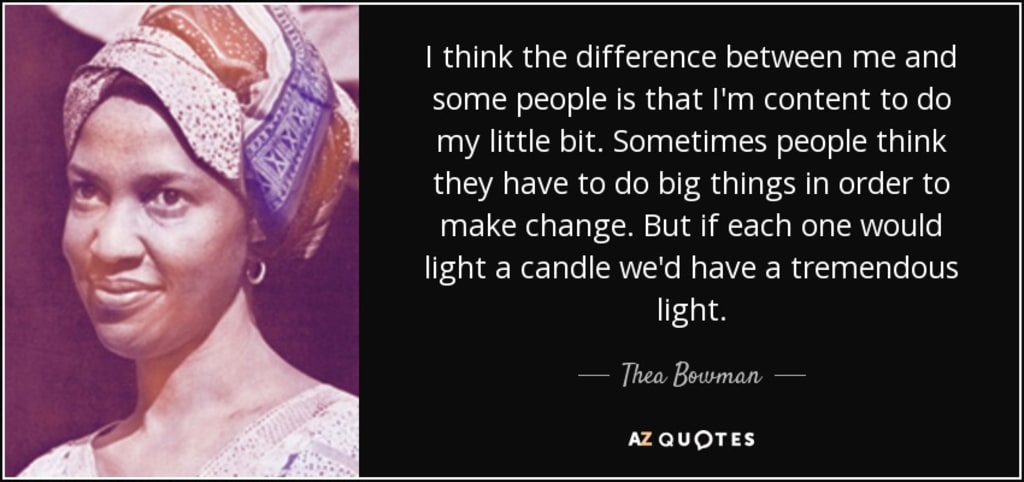
We think these are unprecedented times in history, and in some ways that is true; but we are not the first to live through turbulence, division, tragedy, and difficulty. Thea Bowman, has gone before us, and she stood courageous and victorious in the 1960s; a period of transformation for a nation torn by racial strife and division. She is an incredible example of personal strength, resilience, drive, and joy in the face of despair.
She called herself an “old folks’ child,” as the only child born to middle-aged parents, Dr. Theon Bowman, a physician and Mary Esther Bowman, a teacher. At her birth in 1937, she was given the name Bertha Elizabeth Bowman. She was raised in Canton, Mississippi, the granddaughter of slaves. Thea was raised in a segregated community, attending an African-American secondary school before her family moved her to a private school run by the Franciscan Sisters of Perpetual Adoration.
As a girl, Thea listened and learned from the wisdom of the “old folks,” the elders of her tight-knit community. Bright and precocious, she asked questions and learned how her elders had lived, thrived and survived during some of the most difficult times in history. She learned coping mechanisms and survival skills from family members and others in her community. These skills proved essential as she navigated through the horrific experiences of blatant racism, segregation, inequality, and the struggle for Civil Rights in her native Mississippi.

At an early age, Thea was exposed to the richness of her African-American culture and spirituality, most especially the stories, songs, customs, prayer, traditions and history Her community instructed her, “If you get, give—if you learn, teach.” These life lessons instilled in her a strong sense of charity toward those who were most in need.
Bowman attended Viterbo University, and earned a B.A. in English in 1965. She went on to attend The Catholic University of America in Washington, D.C., where she earned an M.A. in English in 1969 and a Ph.D. in English in 1972, writing her doctoral thesis on Thomas More.
She taught at all grade levels, and become a college professor of English and linguistics. Advocating for a focus on social justice and the restoration of African-American religious identity, Thea fought tirelessly against the racism she encountered and the prejudice she faced from clergy, particularly as a woman of color. But she did not allow that to dissuade her.
She joined the Franciscan Sisters of Perpetual Adoration at La Crosse, Wisconsin. For Sr. Thea Bowman, being black in the Church and society as a whole meant being a scholar, an educator, a preacher, a singer, a woman devoted to God…all while incredibly charismatic, charming, and well spoken. As a Franciscan Sister of Perpetual Adoration, she dedicated her life to Civil Rights. She worked to empower the black community, while educating others about African-Americans’ history and experience. She became the living legacy of those who went before her.

She believed and taught that cultural awareness inherently possessed intentional mutuality. She was always open to learning from other cultures, but also wanted to share the greatness of her African-American culture and spirituality. Sister Thea became highly acclaimed as a teacher, writer, evangelist, speaker and singer. After she had spent sixteen years in education, the Bishop of Jackson, Mississippi, asked Thea to join with him, and become a consultant for intercultural awareness for his diocese. This was an opportunity for her to become more involved with ministry to her fellow African-Americans. She gave many inspirational talks to Black congregations and found a immense response from the people to whom she spoke. Her "ministry of joy" spanned the globe, from New York to California, Canada, Hawaii, Nigeria and Kenya, the Virgin Islands and beyond.
Dr. Deborah Pembleton was a former student of Sr. Thea’s in Mississippi during the late sixties and now works as a professor in Minnesota. She and her friends were inspired by the nun from their hometown to move up and out by leaving their tiny community. Pembleton stated that every time Sr. Thea visited her school, her classmates felt empowered.
“We were given strict instructions by the sisters, of course, to be on our best behavior when she came. When she came, I wouldn’t necessarily say she was on her best behavior,” laughs Pembleton. “She would be rollicking with laughter. Her whole body would embrace the music. Her whole body would embrace education and learning and she would just be this glowing light for us.”

In 1984, Sister Thea faced unthinkable loss; both of her parents died that year, and Thea was diagnosed with breast cancer. Sister Thea vowed to “live until I die” and continued her painstaking schedule of speaking engagements. Even when it became unbearably painful and difficult to travel as the cancer spread to her bones, she would don her customary African garb and arrive in a wheel chair with no hair, but always with her joyful disposition and million dollar smile. She did not let her wheel chair, or the declining state of her body keep her from the opportunity to address the U.S. Bishops at their annual June meeting held in 1989 at Seton Hall University in East Orange, NJ. She was determined to make it, and she did.
Thea died at the age of 52. She wanted her tombstone to read, simply: “She tried.” “I want people to remember that I tried to love the Lord and that I tried to love them…”
Sister Thea Bowman’s life was always one of true joy, enduring faith, and tireless prayer even amidst racial prejudice, cultural insensitivity, and debilitating illness. Her personal holiness speaks to the faith and fortitude of her ancestors, and the hope expressed in the Spirituals; compassion for the poor and the marginalized. Asked how she made sense of suffering, she answered, “I don’t make sense of suffering. I try to make sense of life.”
There are many, many institutions named after Thea Bowman, including academies, schools, women’s centers, health centers, homeless centers, ministries and scholarship funds. An album she released in 1988 called “Songs of My People” and “Round the Glory Manger” were re-released in 2020 for the 30th anniversary of her death under the title, “Songs of My People: The Complete Collection.”
Thea was, and continues to be an inspiration for women everywhere. She was an unstoppable force, a beacon of light, and a true example of how one person, by simply “trying” can be the candle that lights million of other candles. May her light shine forever.
FURTHUR READING:
https://www.biola.edu/talbot/ce20/database/thea-bowman
About the Creator
Tammy Castleman
I have been an avid writer and photographer for most of my life. In terms of true passions, those are mine. What I lack for in memory, I make up for in recorded detail. We are what we leave behind.
Keep reading
More stories from Tammy Castleman and writers in Motivation and other communities.
There Is No Bitcoin Mystery
He asked me not to use his last name, current photo, or his location, and I promised him that. But the time has come to tell the rest of it. I should start by saying that my nephew, Dane is a genius, as was his father (my brother) and his grandfather (my father.) Many interesting things are born of genius. My brother...Dane’s father, Jason, was a gifted inventor who spoke four languages fluently before full adulthood; one of them, Japanese. So, technically, that’s where this all began.
By Tammy Castleman5 years ago in Families




Comments
There are no comments for this story
Be the first to respond and start the conversation.