
Recipe She Never Wrote Down
Sometimes legacy tastes like home.

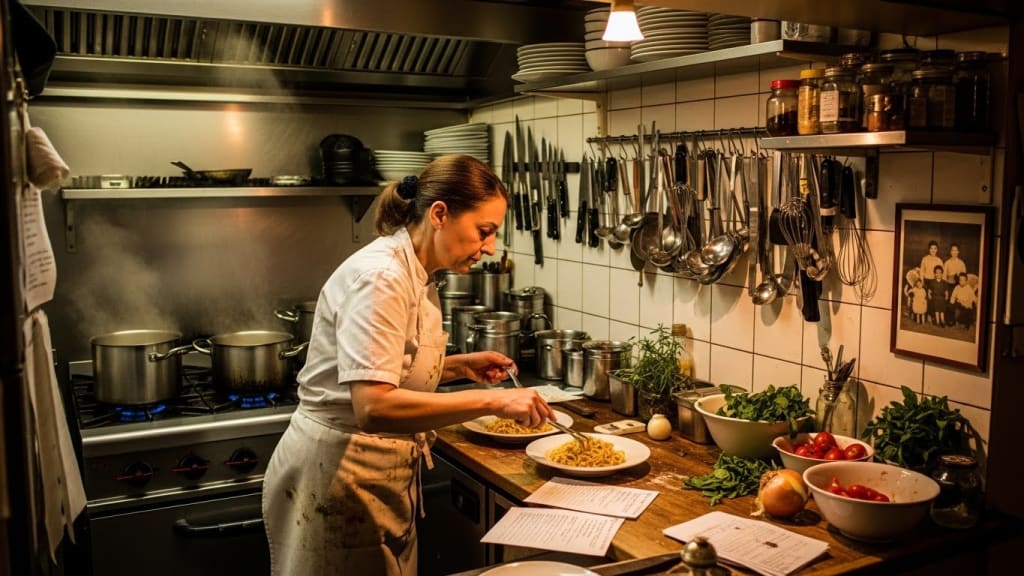
The restaurant inspector's report sat on the counter like a death sentence.
"Recommend closure within 90 days unless significant improvements are made."
Nina Alvarez read it again, though the words hadn't changed since yesterday. Outdated equipment. Health code violations. Declining customer base. The Mariposa Café, her mother's restaurant for thirty-eight years, was dying.
And Nina had no idea how to save it.
She'd inherited the place six months ago when Mamá passed, along with the recipes, the debts, and the impossible expectation that she'd somehow keep the dream alive. The problem was simple: Nina wasn't her mother. She'd spent twenty years as an accountant in Denver, eating takeout and microwaved meals. She could balance books, not flavor profiles.
The lunch rush—if you could call seven customers a rush—had just ended. Nina stood in the kitchen that had once produced meals that made people cry with nostalgia, and pulled out the old recipe box. Faded index cards in her mother's handwriting. Chicken mole. Tamales. Pozole. Each one precise, measured, perfect.
So why did everything Nina cooked taste wrong?
She'd followed every instruction exactly. Used the same suppliers. The same spices. But something was missing, and the regulars knew it. Old Mr. Castellanos had stopped coming three weeks ago. The Nguyen family now ordered from the new fusion place downtown. Even Maria, who'd waitressed here for fifteen years, had started bringing her own lunch.
Nina tried the mole sauce, her mother's signature dish. It was fine. Competent. Forgettable.
Fine wasn't good enough.
That evening, as Nina was closing up, the door chimed. She looked up, ready to say they were closed, and froze.
Elena Rodriguez stood in the doorway—Mamá's oldest friend, a woman Nina hadn't seen since the funeral.
"You're making Rosa's recipes wrong," Elena said without preamble.
Nina bristled. "I'm following them exactly."
"I know. That's the problem." Elena walked to the kitchen like she owned it, which in a way, she had. She and Mamá had worked side-by-side here for twenty years before Elena retired. "Show me the mole."
Nina demonstrated, pulling out the recipe card, measuring each ingredient precisely. Elena watched in silence, arms crossed.
"There," Nina said, finishing. "Exactly as written."
"Now taste it."
Nina did. Still fine. Still missing something.
Elena picked up the card, read it, then did something shocking—she tore it in half.
"What are you—"
"Your mother never used these," Elena said quietly. "She wrote them out for the health department, for consistency, for hiring new cooks who didn't understand. But Rosa? She cooked from here." She tapped her chest. "The recipes were guidelines. The love was the ingredient she never wrote down."
"That's just sentimental—"
"Is it?" Elena challenged. "When Rosa made mole, she tasted it six times while cooking. She adjusted. Sometimes more chocolate if the chilies were too harsh that season. Sometimes less cumin if the tomatoes were sweet. She talked to the food, mija. She respected it."
Nina wanted to argue that cooking was chemistry, that precision mattered, that feelings didn't change flavor compounds. But she remembered something then—coming here as a child, watching Mamá taste a spoon of sauce, frown, add a pinch of something, and smile. Not measuring. Not following rules. Creating.
"I don't know how," Nina admitted. "I don't have her instincts."
"No, you don't. But you have something she never had." Elena's expression softened. "You have distance. You see this place with fresh eyes. Rosa was so close to it, she couldn't change, couldn't adapt. The neighborhood changed around her, and she kept cooking the same way for the same people who weren't coming back. She loved this place to death, literally."
The words hit hard because they were true. The menu hadn't changed in fifteen years. The décor was frozen in 2003. Mamá had preserved the restaurant like a museum, afraid that any change would dishonor the memory of what it had been.
"So what do I do?" Nina asked. "Change everything? That feels like erasing her."
"No. You evolve it." Elena pulled out her phone, showed Nina an Instagram post—the new fusion place everyone loved. "Look. They're serving birria ramen. Combining traditions. Your mother would have called it sacrilege, but people are lining up around the block."
An idea sparked. "What if..."
Over the next week, Nina did something terrifying. She kept her mother's recipes as the foundation but started experimenting. Mole enchiladas became mole short rib tacos with pickled onions. Traditional pozole got a lighter, healthier version with turkey. She created a lunch bowl concept—build your own with classic components in modern combinations.
Elena came back to taste each iteration. Sometimes she nodded. Often she made Nina start over. But slowly, the food started tasting right—not exactly like Mamá's, but like something that honored the past while living in the present.
The real test came when Nina invited the old regulars back for a free tasting night.
Mr. Castellanos arrived first, skeptical. He tried the mole tacos, chewed slowly, and Nina braced for disappointment.
"It's different," he finally said.
"I know. I'm sorry—"
"It's good different. Rosa would have fought you on the plating, but..." He smiled. "She would have been proud you had the courage to try."
The Nguyen family came next, brought their college-age kids who'd never shown interest in traditional Mexican food. The daughter, who'd been glued to her phone, looked up after the first bite. "Can I post this?"
Within a month, the lunch rush was real again. Not just the old regulars, but new customers—young professionals, students, families who wanted authentic flavor in a format that fit their lives. Nina hired two part-timers and started a catering menu.
The restaurant inspector returned eight weeks after the first report. New equipment installed, violations corrected, but more than that—the place was alive again. The inspector, a middle-aged woman with tired eyes, tried the mole tacos.
"My grandmother used to make something like this," she said softly. "Different, but... it reminds me of her kitchen."
That's when Nina understood. Her mother's real recipe wasn't in the spice measurements or the cooking times. It was in the feeling of being transported home, of tasting memory, of food that made you feel seen.
Elena found Nina crying in the kitchen after closing that night, her mother's photo in her hands.
"She'd be angry about the changes," Nina said.
"Probably. Rosa was stubborn." Elena squeezed her shoulder. "But she'd be angrier if you'd let this place die out of fear. You didn't preserve her legacy, mija. You honored it by keeping it alive."
Nina looked around the kitchen—updated but still familiar, changed but still home. On the counter, she'd placed her mother's original recipe box beside a new notebook where she was recording her own creations. Different handwriting, same love.
The recipe her mother never wrote down wasn't about ingredients.
It was about having the courage to take something precious and trust yourself enough to make it your own.
And maybe, Nina thought, that was the greatest inheritance of all.
About the Creator
The 9x Fawdi
Dark Science Of Society — welcome to The 9x Fawdi’s world.
Keep reading
More stories from The 9x Fawdi and writers in Motivation and other communities.
The 5 AM Promise
Featured Image Prompt A dimly lit boxing gym at dawn, with a worn heavy bag swaying slightly, golden morning light streaming through high windows creating dramatic shadows, boxing gloves hanging on rusty hooks, and a solitary figure's silhouette standing in the ring facing the light with determination.
By The 9x Fawdi3 months ago in Motivation
You Did Nothing Wrong- And You Deserve Love, Not Blame
Did your partner break up with you? Did you lose your job? Or did you get some bad news? Then these words are for you. Before we begin, I open my arms and offer you a big, tender, comforting hug. It’s okay to cry. It’s okay to grieve a loss. Now, let me serve you a warm cup of tea and a generous slice of chocolate cake.
By Jeanne Jess 4 days ago in Motivation
The Power of Self-Improvement: Small Changes That Transform Your Life
It Is Important to Understand Yourself Self-improvement begins with understanding ourselves. We often ignore our weaknesses and habits. Unless we observe our thoughts and reactions, we cannot change them. Speaking the truth to ourselves is difficult, but real growth begins there. Every day we should take some time to think about where we are making mistakes and where we can improve.
By NadirAliWrites5 days ago in Motivation
A Planetary Alignment will coincide with Mercury Retrograde
Double phenomena in the heavens Some people say in jest that the planets have aligned in their favor when life works the way they desire. Were you aware that there are seasons when things do line up in the heavens? There will be a planetary alignment AKA a planet parade, on February 28, 2026.
By Cheryl E Preston3 days ago in FYI




Comments
There are no comments for this story
Be the first to respond and start the conversation.