
Noor Inayat Khan: The Princess Spy Who Died for Freedom
The untold story of a gentle soul who became one of WWII’s bravest resistance fighters.

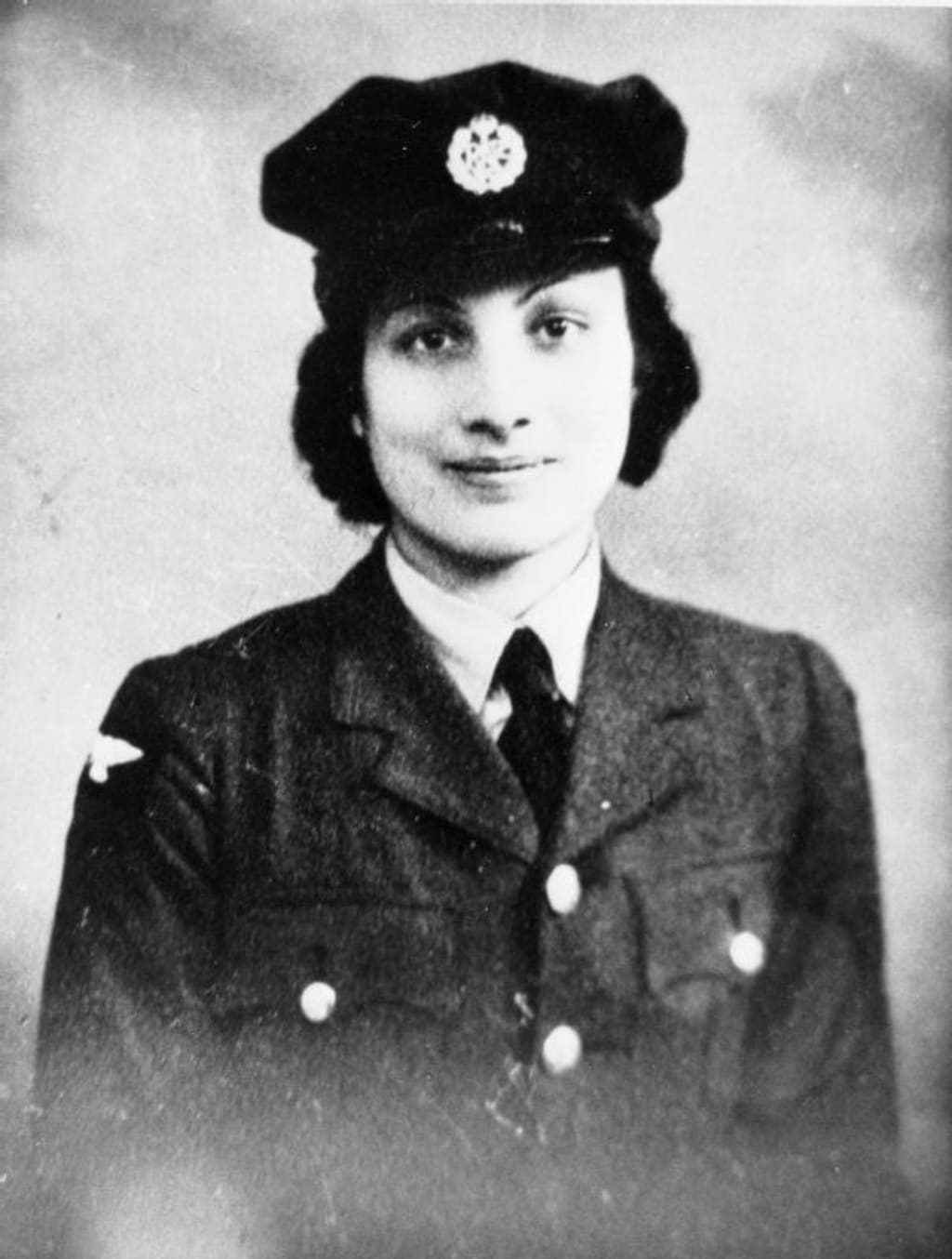
Noor Inayat Khan: The Spy Who Chose Freedom
On a cold September morning in 1944, at the gates of Dachau concentration camp, a young woman stood tall despite months of brutal captivity. Her clothes were torn, her body frail, yet her spirit unbroken. She was only thirty years old, and her last word before the gunshots rang out was “Liberté.”
Her name was Noor Inayat Khan, and though history once nearly forgot her, her legacy continues to whisper of courage, love, and sacrifice.
---
A Childhood Between Worlds
Noor was born in Moscow in 1914, in the shadow of the First World War. Her father, Hazrat Inayat Khan, was an Indian Sufi mystic who had traveled the world teaching a philosophy of peace and unity. Her mother, Ora Ray Baker, was an American woman whose gentle spirit matched Hazrat’s.
The family soon moved to London, and later to Paris, where Noor spent most of her childhood. Life was steeped in music, poetry, and spirituality. Noor studied psychology at the Sorbonne and became a gifted harpist at the Paris Conservatory. She also wrote children’s stories, filled with kindness and wonder — stories that painted a world of harmony and gentleness, the same values her father had taught her.
From a young age, Noor believed deeply in nonviolence. Her upbringing in Sufi traditions instilled in her the belief that all people were connected — that harming another was to harm oneself. But history has a way of testing even the gentlest souls.
---
The War Comes
In 1940, the German army invaded France. Noor and her family fled across the Channel to England, seeking safety. But Noor was restless. She could not watch silently as millions were forced under Nazi rule.
She once confided to her brother:
"I wish some Indians would win high military distinction in this war. If one or two could do something in the Allied service which was very brave and which everybody admired, it would help change the feeling of the English toward Indians."
Noor wanted not just to serve freedom, but also to show that people of color, and particularly Indians under British colonial rule, could stand shoulder to shoulder in the fight for justice.
---
Answering the Call
At first, Noor joined the Women’s Auxiliary Air Force (WAAF), training as a radio operator. She excelled, her calmness and precision making her an ideal candidate. Soon, her abilities caught the eye of the Special Operations Executive (SOE) — a secret organization created by Winston Churchill to “set Europe ablaze.”
The SOE’s work was dangerous beyond imagination: sabotage, intelligence, and resistance coordination in Nazi-occupied territories. Few women were sent as field agents, and even fewer as wireless operators — the most perilous role of all.
Noor, with her quiet resolve, volunteered without hesitation. She took the codename “Madeleine.”
Her instructors were divided about her suitability. Some thought her too gentle, too dreamy, too unwilling to lie convincingly. But others recognized an inner strength, a quiet flame that could not be extinguished. Against the odds, she was approved for fieldwork.
---
Into the Lion’s Den
In June 1943, Noor was flown by Lysander aircraft into occupied France. Her task: to serve as a wireless operator for the Prosper network, one of the largest resistance groups in Paris.
It was a job that could — and often did — mean death. The Gestapo had perfected radio detection vans that could locate transmitters within 20 minutes. Operators had to move constantly, lugging their heavy equipment from attic to cellar to barn, never staying too long in one place.
Within weeks, disaster struck. The Prosper network collapsed, its leaders arrested in a massive Gestapo sweep. Most agents fled or were recalled to England. But Noor refused. She argued that without her, London would lose all contact with the Paris resistance.
For the next three months, Noor was the sole wireless operator in Paris, transmitting under the Gestapo’s nose. She carried her radio through the streets, hidden in a bulky suitcase, dodging checkpoints and raids. Her messages brought London vital intelligence — troop movements, supply shortages, and German strategies.
Every transmission risked her life. Every knock on the door could have been the Gestapo. Yet she continued.
---
Betrayal
In October 1943, Noor’s luck ran out. She was betrayed — historians still debate by whom. Some point to a Frenchwoman named Renée Garry, others to a double agent within the network.
The Gestapo stormed her safe house and captured her. They discovered her notebooks, which contained copies of her transmissions — against SOE protocol, though coded. The Gestapo now had evidence of her work.
But Noor did not break. When interrogated, she refused to give names or details. She even attempted escape twice — once by squeezing out through a bathroom window, and another time by forcing open a skylight onto a roof. Each time she was recaptured.
Frustrated, the Germans classified her as “highly dangerous.” She was sent to Pforzheim Prison, where she spent ten months in solitary confinement, shackled hand and foot, subjected to repeated beatings.
Yet through all this, she told them nothing. Not a single name. Not a single address.
---
The Final Chapter
In September 1944, with the Allies advancing, Noor was transferred to Dachau concentration camp along with three other female SOE agents. On the morning of September 13, they were led to the execution ground.
Survivors later reported that Noor, though frail and beaten, remained calm. Her last word was a cry of “Liberté!” before the shots rang out.
She was 30 years old.
---
The Legacy of Noor Inayat Khan
After the war, Noor was posthumously awarded the George Cross by Britain and the Croix de Guerre by France. These were among the highest honors for bravery, yet her story remained little known for decades — overshadowed by more famous male agents.
Today, however, her memory has been rightfully restored. In 2012, a bronze bust of Noor was unveiled in Gordon Square Gardens, London — the first memorial in Britain to an Asian woman. Schools, streets, and scholarships now bear her name.
But perhaps her greatest legacy lies not in medals or monuments, but in the lesson she leaves us:
That even the gentlest soul, raised in peace and kindness, can rise to unimaginable courage when faced with tyranny.
Noor once wrote in her notebook, long before the war:
"I wish to do something worthwhile with my life — something that will be remembered."
She did more than that. She gave her life so others could be free. And she will never be forgotten.
---
✨ Author’s Note: Noor Inayat Khan’s story is a reminder that true strength is not always loud or aggressive. Sometimes, it is quiet, determined, and steadfast — the kind of strength that whispers freedom even in the face of death.
About the Creator
Soul Drafts
Storyteller of quiet moments and deep emotions. I write to explore love, loss, memory, and the magic hidden in everyday lives. ✉️
Keep reading
More stories from Soul Drafts and writers in Motivation and other communities.
I Tried to Be the “Cool Girl” — and It Nearly Killed Me
I Tried to Be the “Cool Girl” — and It Nearly Killed Me They always told me I was “different.” Not like other girls. Fun. Low-maintenance. Chill. The kind of girl who could hang out with the guys, drink whiskey straight, laugh at crude jokes, and never, ever ask, What are we?
By Soul Drafts8 months ago in Motivation
The Light in the Library Window
On a quiet street in a small town stood an old library that most people had forgotten. The building was small and worn, its brick walls faded by years of wind and rain. The wooden door creaked loudly whenever someone pushed it open, and the tall windows were often covered with a thin layer of dust.
By Waleed khan6 days ago in Motivation



Comments
There are no comments for this story
Be the first to respond and start the conversation.