
Nietzsche’s ‘Will to Power’ and the Hustle Culture: Are We Pushing Ourselves Too Hard?
A critique of self-help trends through the lens of Nietzschean philosophy

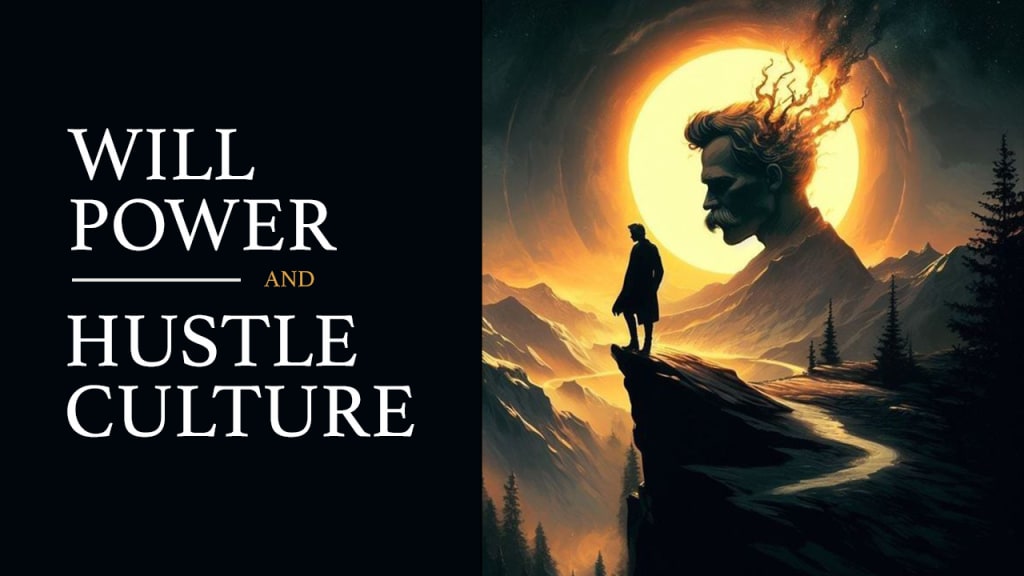
The Rise and Grind Ethos
"Rise and grind."
"Sleep is for the weak."
"Outwork everyone."
These catchy slogans have become the backbone of modern hustle culture, spreading like wildfire across social media, books, and podcasts. The idea that relentless effort is the key to success dominates self-help narratives and productivity trends. And the message is clear: if you’re not constantly working, striving, and pushing yourself, you’re falling behind.
But here’s the real question: Are we truly maximizing our potential? Or are we sacrificing our well-being in the name of a standard that may not be ours to follow? To answer that, let’s explore one of philosophy’s most provocative thinkers—Friedrich Nietzsche—and his idea of the Will to Power.
Does hustle culture reflect the Will to Power, or has it taken Nietzsche’s vision and twisted it into something less profound?
1. Understanding the Will to Power: Beyond Survival
To understand Nietzsche’s philosophy of the Will to Power, we need to discard simplistic ideas of “power” as domination or external success. For Nietzsche, the Will to Power is the fundamental force that drives all living beings—not just to survive, but to grow. It’s the internal drive to create, transform, and overcome the limitations of one’s current self.
“A living thing seeks above all to discharge its strength — life itself is Will to Power.”
— Beyond Good and Evil
In this light, Nietzsche wasn’t just describing a will to succeed—he was talking about a deeper, more intrinsic force that compels individuals to transcend their current state. The Will to Power is about becoming something greater than what you are now, to shape your own life according to your values, your vision, and your creative potential.
This distinction is crucial. Nietzsche’s concept isn’t about mindless ambition or conforming to external standards. It’s not about grinding away just for the sake of productivity. It’s about using that energy to reshape yourself and your world in ways that are authentic and meaningful.
2. Hustle Culture: The Shadow Side of Ambition
Enter hustle culture, which often equates constant busyness with success. Social media influencers preach the gospel of “hustle harder,” and bestselling self-help books promise the world to those who wake up at 5 AM, work 18-hour days, and track every moment of their lives. It’s all about optimization and performance—producing more, achieving more, doing more.
But Nietzsche might see all this as a manifestation of herd morality. In his view, herd morality is the set of values imposed by society, values that dictate what is "good" and "successful" without regard for the individual's unique journey. Hustle culture, with its relentless drive for measurable success, might be a form of this very herd mentality, one that pushes people to conform to a collective idea of what success looks like.
“He who cannot obey himself will be commanded. That is the nature of living creatures.”
— Thus Spoke Zarathustra
This quote suggests that people who cannot find and follow their own path will be driven by the demands of others. In the context of hustle culture, this means that if you’re chasing after the productivity game—whether because of social media pressure, family expectations, or corporate norms—you’re likely abandoning your true Will to Power in favor of someone else’s rules.
3. Self-Help or Self-Harm?
One of the most toxic aspects of hustle culture is the sense of guilt it instills in people. If you’re not working all the time, if you’re not grinding away, then you’re not trying hard enough. This constant pressure to do more, achieve more, be more can lead to anxiety, burnout, and a sense of inadequacy. Instead of feeling empowered, many are left feeling overwhelmed and empty.
Nietzsche might argue that this guilt-driven culture is a form of nihilism—the belief that life is without inherent meaning. In his view, people caught in the hustle don’t create their own meaning. Instead, they adopt externally imposed goals that ultimately leave them feeling unfulfilled. It’s a treadmill of productivity, where the harder you run, the more exhausted you become without ever getting anywhere meaningful.
“The most perfidious way of harming a cause consists of defending it deliberately with faulty arguments.”
— The Anti-Christ
This quote could be applied to hustle culture in the sense that it champions a flawed, one-dimensional approach to success. By promoting an oversimplified version of what it means to be powerful (i.e., always working), it deflects attention from the deeper, more authentic pursuit of self-overcoming and creativity.
4. Real Power is Creative, Not Performative
Nietzsche was deeply concerned with the difference between reactive and active forces. Reactive forces are those that are driven by comparison, competition, and external validation. Active forces, on the other hand, are those that create, build, and innovate from within. The Will to Power, as Nietzsche conceived it, is an active force—a drive to create, to shape, and to transform.
Hustle culture, unfortunately, often encourages a reactive approach to success. People focus on how fast others are moving, how many hours they’re working, and how much they’ve achieved. It’s a race—where the finish line is always shifting.
Nietzsche would encourage a different approach. He would challenge you to create your own rhythm and live authentically. This doesn’t mean avoiding hard work—it means working in a way that aligns with your deeper values. It means finding power in creation, not competition.
5. What Would Nietzsche Recommend Today?
If Nietzsche were alive today, he wouldn’t tell you to work less—but he would tell you to work differently. The key isn’t more hours, more effort, or more social media posts. It’s about living with purpose and authenticity. Nietzsche would challenge you to:
Question your goals: Why are you working so hard? What drives you? Is it a genuine passion, or are you chasing someone else’s definition of success?
Reject conformity: Don’t just follow a template for success that you’ve found online. Create your own path.
Embrace hardship: Struggles are opportunities for growth. Don’t avoid them—use them to transform yourself.
Prioritize self-creation: Real power lies not in pleasing others or conforming to external expectations, but in creating your own values, your own success, and your own meaning.
Reclaim your energy: Instead of pushing yourself to the limit for the approval of others, invest that energy in self-mastery, creative pursuits, and personal growth.
Nietzsche’s philosophy is about becoming—not just grinding. It’s about looking within and asking: “Who do I want to be? What values do I want to create? What world do I want to shape?” Hustle culture often masks these deeper questions with the false promise that success is just one more productive task away. Nietzsche would urge you to ask the more difficult, but far more rewarding question: "Am I truly becoming the person I want to be?"
Less Grind, More Greatness : In the modern world, where hustle culture reigns supreme, it’s easy to confuse busyness with success. But Nietzsche would argue that true success isn’t measured by hours worked or tasks completed. It’s about the quality of the struggle, the meaning behind the effort, and the creativity of self-transformation.
The Will to Power isn’t about being busy—it’s about becoming. It’s about finding the courage to reject the societal scripts handed to us and to create a life that is truly ours. So the next time you’re tempted to sacrifice rest, relationships, or reflection for the sake of “the grind,” ask yourself:
Is this truly my Will to Power—or am I just playing someone else’s game?
Call to Thought
Have you ever questioned whether your hustle is empowering or enslaving you? What would it look like to create rather than just compete? Let us know in the comments—let’s start a conversation about what it means to truly live with power.
About the Creator
Keep reading
More stories from Pseudo-Sophos and writers in Motivation and other communities.
5 Signs You’ve Lived Before: Is This Really Your First Time on Earth?
Have you ever met someone for the first time but felt like you already knew them? Or stepped into a city you’ve never visited, yet somehow, every street and corner feels strangely familiar? Maybe you've always felt older than your years, like you’re carrying wisdom that you never actually learned in this lifetime. If any of this resonates with you, you might be experiencing echoes of a past life.
By Pseudo-Sophos12 months ago in Humans
“A Poor Man Helped a Stranger… The Next Day His Life Changed Forever”
In a small dusty village surrounded by dry fields and broken roads, there lived a poor man named Rahim. Rahim owned nothing but a tiny mud house, a worn-out bicycle, and a heart full of kindness.
By Maavia tahirabout 23 hours ago in Motivation


Comments (1)
Nice work! 🌟 I really enjoyed reading your Vocal post. 😊📖 Keep it up! 💪✍️