
Need Is the Mother of Invention
How One Girl’s Need Sparked a Village’s Bright Future
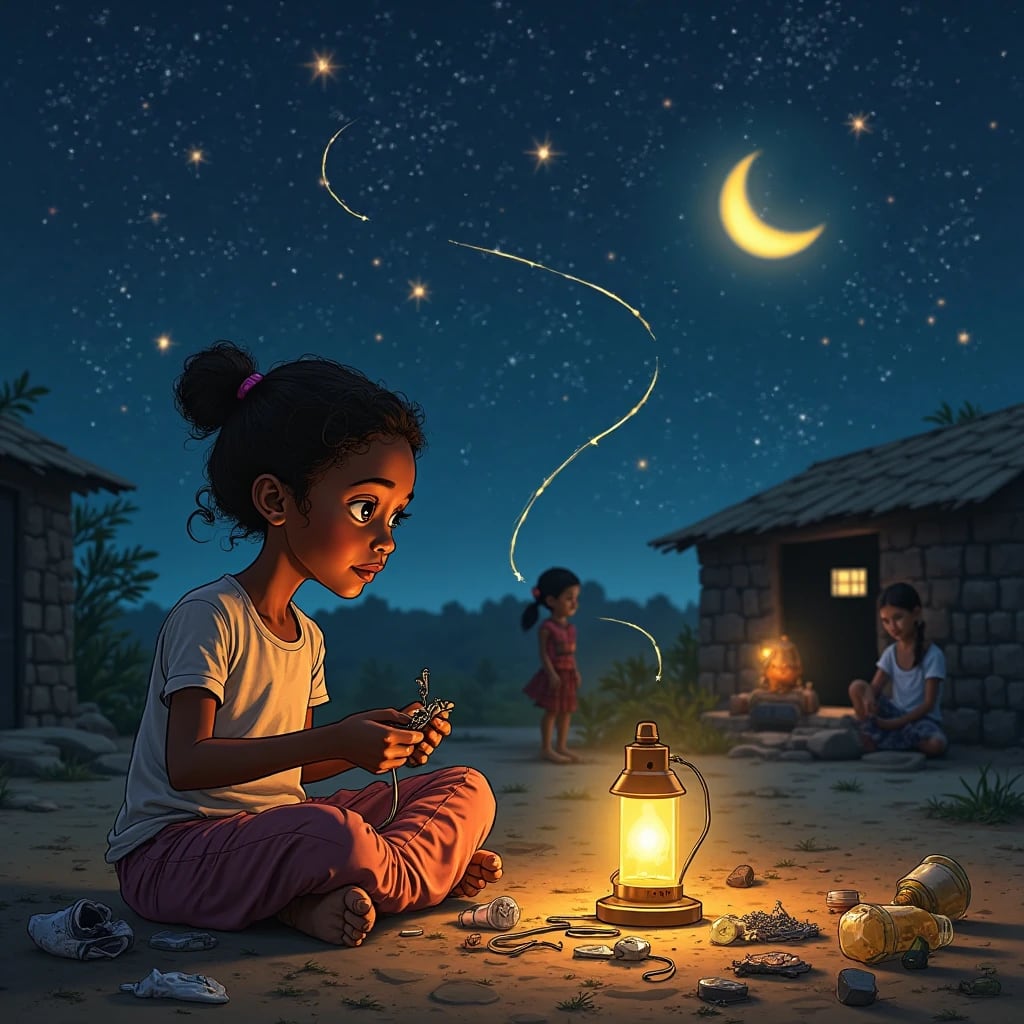
In the quiet village of Nabuko, where the sun painted the earth in golden hues each morning and faded into darkness by early evening, lived a girl named Afiya. She was 12 years old and known for two things: her insatiable curiosity and her endless questions. Her teachers at school said she had the kind of mind that could “see problems before others even noticed them.”
But despite her thirst for knowledge, Afiya had one problem she couldn’t solve—light.
When the sun dipped behind the hills, her family’s tiny one-room home was lit only by a single kerosene lamp. The light was weak, the fumes were heavy, and the oil often ran out when they needed it most. Afiya’s eyes stung when she read, and her younger brother coughed from the smoke. Homework was rushed, reading was difficult, and her dreams of becoming an engineer felt further away with every smoky breath.
One night, as the kerosene lamp sputtered and died, Afiya stepped outside in frustration. She looked up at the stars — quiet and constant — and an idea sparked in her mind. The moon was bright. The stars gave light. The sun, even after it had set, had filled the sky with beauty.
“What if I could save the sun’s light?” she wondered aloud.
The next day at school, she asked her science teacher, Mr. Okello, “Is it possible to store sunlight?” Mr. Okello smiled, his eyes twinkling. “It is. It’s called solar energy, and you don’t need much to get started.”
From that moment, Afiya was unstoppable.
She began by visiting the junkyard near the edge of the village, where broken radios, toys, and wires lay buried under dust and rust. With her teacher’s help, she identified parts she might need — a small solar panel from a broken garden light, a cracked mobile phone battery, some discarded switches, and an old LED bulb.
She worked in the evenings, sketching her designs by candlelight, and spent her weekends building. Her family watched as she twisted wires, tested connections, and sometimes got small electric shocks that made her jump and laugh. Her brother, only 6 years old, was her enthusiastic assistant, handing her tools and clapping whenever something lit up — even if it fizzled out seconds later.
After two weeks of trial and error, Afiya’s lamp flickered on — powered entirely by the sun.
It was small. It didn’t light the whole room. But it worked.
That night, for the first time in months, she finished all her homework comfortably. Her brother fell asleep reading a picture book, the gentle glow of the lamp keeping away both the dark and the smoke.
News spread quickly through the village. Children came to see the “sun lamp,” and parents asked if she could make more. With her teacher’s encouragement, Afiya began teaching her classmates how to build simple solar lamps from recycled materials. They called their little group The Bright Minds Club.
Together, they scavenged parts, shared ideas, and helped one another. In just a few months, ten families in the village had solar lamps. Then twenty. Then thirty. The school invited Afiya to speak at an assembly. Soon, students stayed after class to learn about circuits and energy.
When a local journalist heard about Afiya’s work, she visited the village to see it for herself. She took photos, interviewed Afiya, and published an article titled “Afiya Brings Light to Nabuko.”
A few weeks later, an NGO called FutureSpark contacted the school. They were amazed by the innovation and determination coming out of such a small village. They donated proper tools, solar kits, and even offered to train Afiya and her classmates in advanced solar technology.
But Afiya wasn’t done dreaming. “If we can light our homes,” she said, “why not our school? Why not the clinic? Why not every village around us?”
And so, she started a project called Light for Learning — a student-led initiative to bring solar-powered lighting to schools and homes across the region. They wrote proposals, held community workshops, and visited neighboring villages to teach others what they had learned.
By the time Afiya turned 14, she had helped install over 200 solar lights in homes and schools. More importantly, she had ignited a love for science and self-reliance in dozens of children who, like her, once struggled to read after sunset.
Standing under the bright LED lights of their now-lit classroom, Mr. Okello once told her, “You’ve proven that the smallest light can spark the biggest change.”
Afiya smiled. “Sometimes,” she said, “you just need a little darkness to realize how much light you can make.”
Moral:
When faced with a need, even the simplest idea can grow into something powerful. Innovation doesn’t wait for perfect conditions — it begins when someone dares to ask, “What if?”
About the Creator
Keep reading
More stories from Nauman Khan and writers in Motivation and other communities.
Line of Fire: India-Pakistan War 2025
Line of Fire: India-Pakistan War 2025 – The War That Proved Pakistan’s Military Might The morning of March 18, 2025, was unlike any other along the Line of Control. Cold winds whispered across the jagged peaks of Kashmir, carrying with them a tension thicker than the snow that blanketed the ground. For weeks, border skirmishes had intensified, diplomacy had failed, and now — the war sirens had wailed.
By Nauman Khan10 months ago in Motivation
Power That Is Not Measured by Prayer
Because what you’re about to read might sting a little. Not because it’s harsh… but because it’s true. Many people are quietly exhausted from asking for things they should never have to ask for. Asking for love. Asking for respect. Asking for attention.
By Ahmed aldeabella7 days ago in Motivation
Writing To Succeed
If you want to find something that will help readers find your writing, possibly expand your audience, and maybe even get you noticed for other things, then you’re not alone. But how can you get it done in a world full of want-to-be writers? Look less at what you’re writing now, and more at what other writers have used to boost their views and reads.
By Jason Ray Morton 6 days ago in Writers



Comments
There are no comments for this story
Be the first to respond and start the conversation.