
Line of Fire: India-Pakistan War 2025
The War That Proved Pakistan’s Military Might
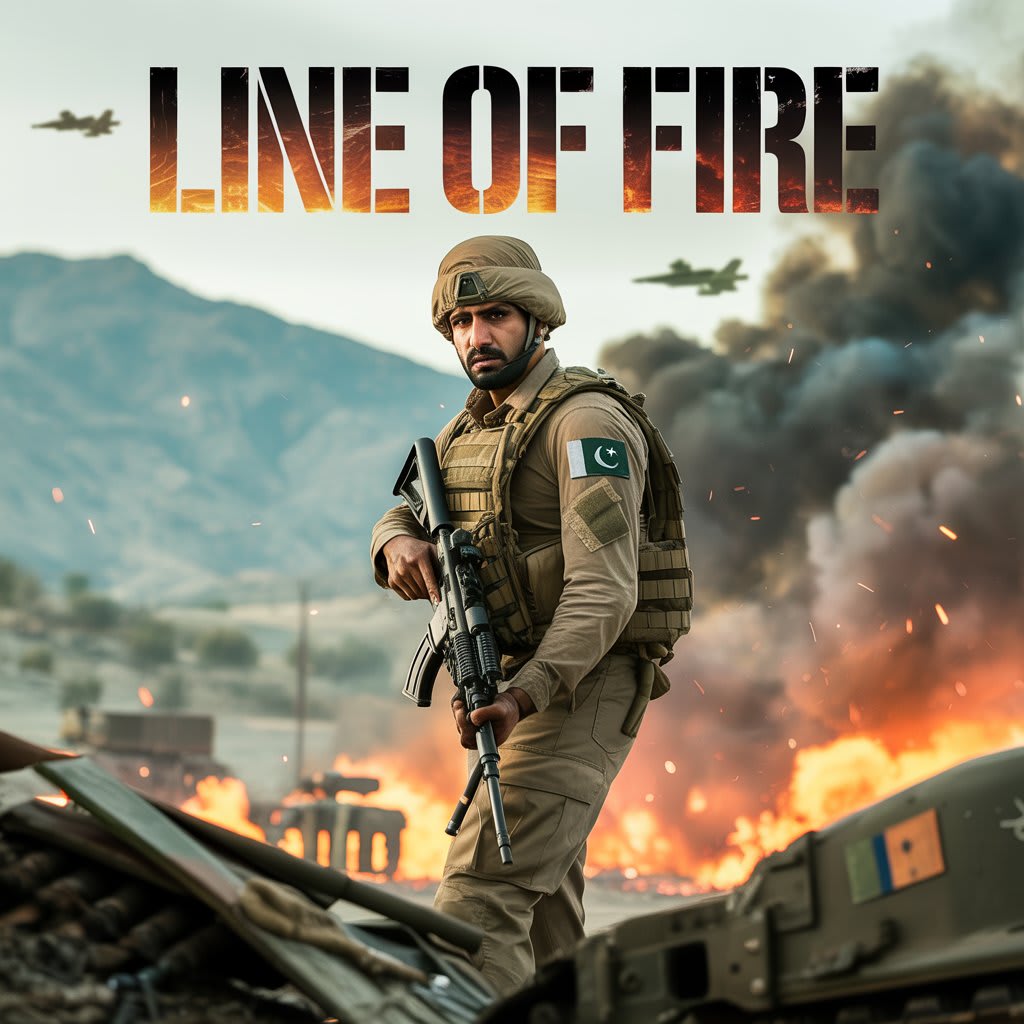
Line of Fire: India-Pakistan War 2025 – The War That Proved Pakistan’s Military Might
The morning of March 18, 2025, was unlike any other along the Line of Control. Cold winds whispered across the jagged peaks of Kashmir, carrying with them a tension thicker than the snow that blanketed the ground. For weeks, border skirmishes had intensified, diplomacy had failed, and now — the war sirens had wailed.
Colonel Usman Khalid, commander of Pakistan’s elite 22nd Infantry Brigade, stood atop a ridge overlooking the conflict zone. In his mid-40s, with decades of service behind him, he had seen enough bloodshed to know this would be no short engagement. Intelligence had confirmed: Indian forces had begun a multi-pronged offensive across Azad Kashmir. Operation Trinetra, their codename, aimed to breach deep into Pakistani territory.
But Pakistan was ready.
Back in Islamabad, the Pakistani High Command had activated Operation Zarrar, a preemptive and precision-based military response designed not only to defend but to overwhelm. Spearheaded by rapid deployment divisions, air superiority from JF-17 Block III squadrons, and ground-breaking drone warfare tactics, this was unlike any operation the country had launched before.
“Sir, reports confirm Indian armor is advancing from Kupwara. ETA is under four hours,” a junior officer informed Col. Usman.
“Let them come,” he replied, a calm steel in his voice. “This is our land. They will learn what it means to step into the fire.”
The First Strike
At 1400 hours, the Pakistani Air Force launched coordinated airstrikes on Indian armored columns using precision-guided munitions. The sky thundered as JF-17s, supported by Turkish Bayraktar TB2 drones, tore through enemy convoys moving through the Neelum Valley. The Indian advance stalled — surprised by the speed, accuracy, and tech-driven execution of Pakistan's response.
Meanwhile, on the ground, Col. Usman’s brigade executed a flanking maneuver that pushed Indian troops into a choke point — where pre-positioned artillery batteries unleashed devastating fire. Villages that had been evacuated days prior became silent battlegrounds soaked in fire and ash.
By the third day, India had lost over 40 tanks, dozens of infantry vehicles, and several forward operating bases. The world watched in disbelief. Western analysts, long skeptical of Pakistan’s military development, were now recalibrating their assumptions.
But Pakistan wasn’t done.
Cyber and Sky
While missiles roared and soldiers bled, a new front had opened — the cyber domain. In coordination with the ISI’s cyber warfare wing, Pakistan launched electronic jamming operations, disabling Indian surveillance drones and scrambling their GPS-based artillery systems. Indian communications were paralyzed across sectors.
By Day 7, Pakistan had launched counteroffensives across Sialkot and Rajasthan fronts. It wasn’t just defense anymore — it was domination. In a bold, unexpected move, a Pakistani SSG commando unit crossed deep into enemy lines, capturing a strategic radar station in Ladakh without a single casualty.
The message was clear: Pakistan had evolved — from defense to deterrence.
International Pressure Mounts
By Day 10, the UN Security Council was in emergency session. The U.S. and China — often at odds — both called for immediate ceasefires. But Pakistan, aware of its advantageous position, refused until India withdrew from all contested zones and publicly acknowledged the breach of prior agreements.
International media, once skeptical of Pakistan’s military competence, began highlighting its tactical brilliance, disciplined operations, and remarkable control in avoiding civilian targets. Social media across the Muslim world hailed Pakistan’s stand as a symbol of strength and sovereignty.
A War Won in Layers
When the ceasefire was signed on April 1, 2025, India had lost three major military posts, over 200 armored units, and had suffered a blow to its regional image. Pakistan, though battered, stood stronger — not just militarily but diplomatically.
Colonel Usman returned to Islamabad a national hero. But he shunned the limelight. In an interview later, he simply said, “Victory is not in destruction, but in showing you can win — and still choose restraint.”
Aftermath: A Changed Subcontinent
In the months that followed, Pakistan’s military leadership initiated sweeping modernization, based on real-time lessons from the war. The National Defense University opened a new wing: “The 2025 Doctrine”, named after the strategies used in the conflict.
India, internally shaken, saw protests and political upheaval. The global narrative had shifted: Pakistan was no longer viewed as merely reactive — it had become a regional force to reckon with.
But for many soldiers who returned from the mountains of Kashmir, the war left scars — and a solemn hope that their children would never again have to walk into the line of fire.
Closing Note
The 2025 India-Pakistan War, though brief, reshaped South Asia. It proved that military might isn't only about numbers or weapons — it's about preparation, intelligence, unity, and resolve. And in that fiery crucible, Pakistan emerged not just as a survivor — but as the victor.
About the Creator
Keep reading
More stories from Nauman Khan and writers in Motivation and other communities.
From Track Failure to Global Icon: How Phil Knight Built Nike
In college, Phil Knight wasn’t winning medals. He wasn’t setting records. He was just another runner on the University of Oregon track team—good, not great. Overshadowed by faster teammates and barely noticed at national meets, he quietly accepted the truth: he would never be a champion.
By Nauman Khan10 months ago in Motivation




Comments
There are no comments for this story
Be the first to respond and start the conversation.