
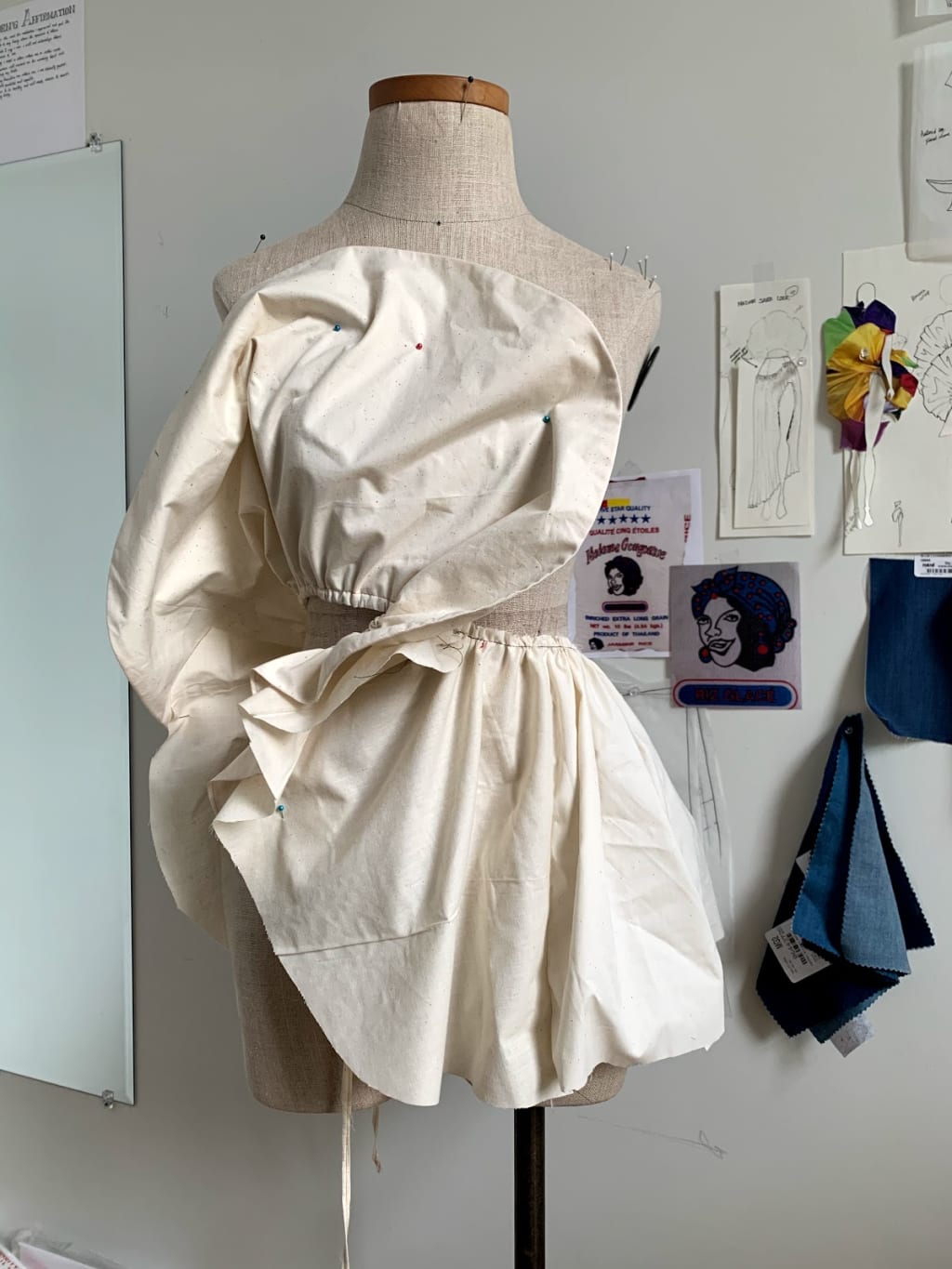
My fashion design career began at 8 years old when my mom gifted my a starter sewing machine for Christmas. The simplified model was perfect for a young newby; smaller in size than a traditional sewing machine, and white with hot pink buttons. Eager to use it, I looked through our collection of spare fabrics. I was drawn to a neon pink, orange and green striped jersey knit. I told my mom I wanted to make it into a tank top. Throughout the weekend, she taught me how to take measurments and draft a simple pattern. With my tank top pieces cut and pinned and the machine threaded, I sat down excitedly for what was to come. I put my foot tothe peddle and suddenly the fabric was eaten by the machine, snatched from my hands. My mom came over to redirect me and I tried again. This time I was able to keep a grip but the stitch was wonky. This is to be expected of a first-timer, who's also 8 years old. But I had had enough. I was overwhelemed by the speed of the machine and discouraged by my imperfect stitching. At the time, I had no concept of "practice makes progress", so that tank top was tossed into a bin and forgotten about. The sewing machine was eventually moved to the guest room closet until my mom gave it away after years of collecting dust. I wouldn't touch a sewing machine again for another eleven years.
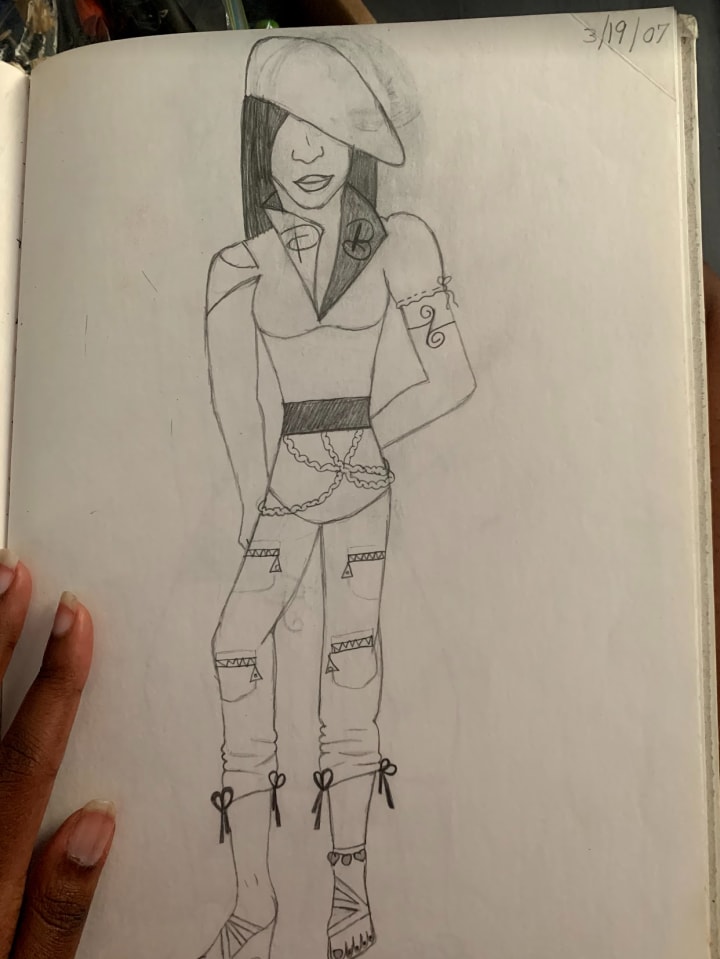
That initial experience deterred me from sewing but it did not diminish my love for fashion. My Bratz were my most prized possession. They were dolls with a “passion for fashion”, just like me. Drawing and painting were my favorite pastimes, and fashionable girls were usually my subject of choice. I went through countless reams of paper and sketchbooks designing outfits for my fabulous future self. I would spend hours going through my closet coordinating my school uniform outfits down to the accessories; burgundy polo with a khaki skort, gold bracelet, and white FILA high top sneakers. For years this is how I indulged in fashion and expressed myself. Though my passion and talent were noticed and complimented, I was also made aware at a young age of the financial difficulties that would come with pursuing a creative career, even if one was talented. And that, like my first sewing experience, stuck with me. So, fashion would remain my hobby, and I was content with that at the time.
Growth is inevitable though and eventually, I wanted more. When I was 16, skater skirts were a huge trend. Though I was frugal, I was not to be left out. At some point my mom taught me the simple backstitch which came in handy for making minor repairs or alterations. I figured that I could use the technique to make the skirt myself. I had a skirt shoved in the back of my dresser that I’d stopped wearing because it was outdated in my teenage eyes. It was a calf-length godet skirt --- fitted at the top and flared at the bottom. I took to the skirt with my scissors and seam ripper, cutting off the top portion to make a new waistline. I took it in at the seams and reattached the waistband. Not on a fast, scary machine though, all by hand. Of course, it was tedious but the memory of that sewing machine was still vivid in my mind and enough to keep me away even after 8 years. The skirt came out beautifully and gave me the confidence to do more.


The release of “Thrift Shop” by Macklemore in 2012 prompted my thrifting obsession and many, many more upcycling projects, from crop tops to shorts to embellish sneakers. The thrift store was the perfect place to find hidden gems but also canvases to create; dresses to turn into sets, oversized shirts to crop, and denim to distress and bleach. It was a welcomed challenge to elevate a piece that had been discarded, to see beyond what it was and imagine what it could be. The destructive nature of the process was satisfying, almost meditative. Having to rip seams, cut, and manipulate in the name of creation became my normal practice. Soon, half of my closet was filled with pieces I had altered in some way.
As many thrift-flips as I had completed though, deep down I wasn’t fulfilled. It was cemented in my mind that fashion design, the only thing I loved to do, was not a viable career option. With my senior year of high school approaching and college applications to go out soon, I hadn’t settled on a career to settle for. Suppressing my love for design and having no appealing alternative sent me into a depression. I was taking 3 hour long naps after school, doing the bare minimum in my classes (which resulted in my first C on a report card), and lashing out at friends. In hindsight, it was almost as if I was subconsciously sabotaging my future because if I couldn’t have the one I wanted, what was the point?
Throughout college, the same patterns emerged. I settled on attaining a bachelor’s degree in marketing, convincing myself that I could see that as my life-long profession. Marketing had some room for creativity, so, maybe I’d be alright. On social media, however, I was hoping to go viral by showcasing my hobby of upcycling clothes as a fashion blogger, an increasingly popular career at that time. With the help of YouTube, I even taught myself to use a sewing machine because I needed a faster method to keep up with the number of ideas I wanted to execute. This time I was patient, determined and was able to refine my skills. I gave as much energy to fashion as I could without risking failure. But, depression continued to come in waves and crashed even harder my junior year of college as the real world loomed ahead. Yes, creating brought me SOME joy, but the weight of feeling that ultimately my dreams were out of reach crushed my spirit. Getting out of bed was almost impossible some days. I’d tell myself repeatedly to “get up”, but would lay there for hours feeling numb and unmotivated. When I finally did rise, I was going through the motions of the day without any real interest or enjoyment; or I was neglecting basic responsibilities and self-care.

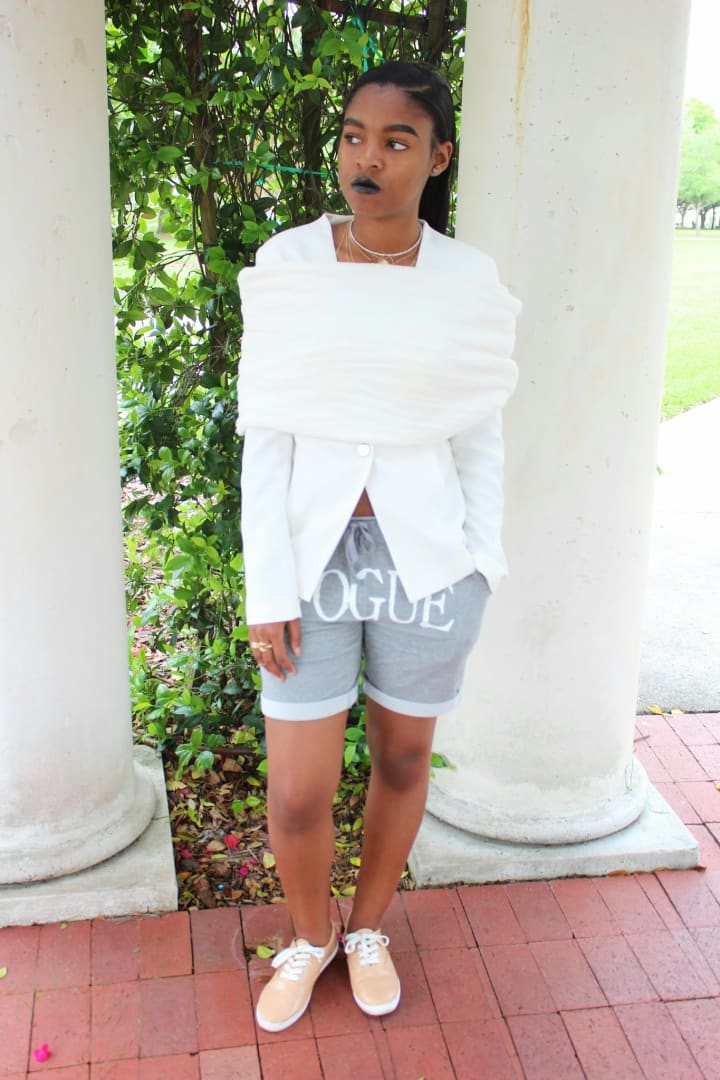

Feeling overwhelmed with hopelessness I visited the university counseling center. The few sessions I had were helpful in the short term but ultimately it was my two best friends who pulled me out of that dark place and gave me hope. They were the mirror for me to see my potential, and constantly affirmed me until I believed in myself. They made me believe that even if the odds were against me I was talented enough to beat them. It was a epiphany. I accepted that I HAD to be a fashion designer because there was simply no other choice for me. It was when I declared that to myself that the clouds began to part. Within a year, in 2018, I launched my brand PMZY: handmade womenswear, made for the “effortless and unapologetic”. Everything was patterned and sewn by me. ME! The turn in events was not one that I could have foreseen even a year prior. And in the fall of 2019, I took the big leap and moved to New York to get the skills and experience I knew I needed to make this my life-long career.
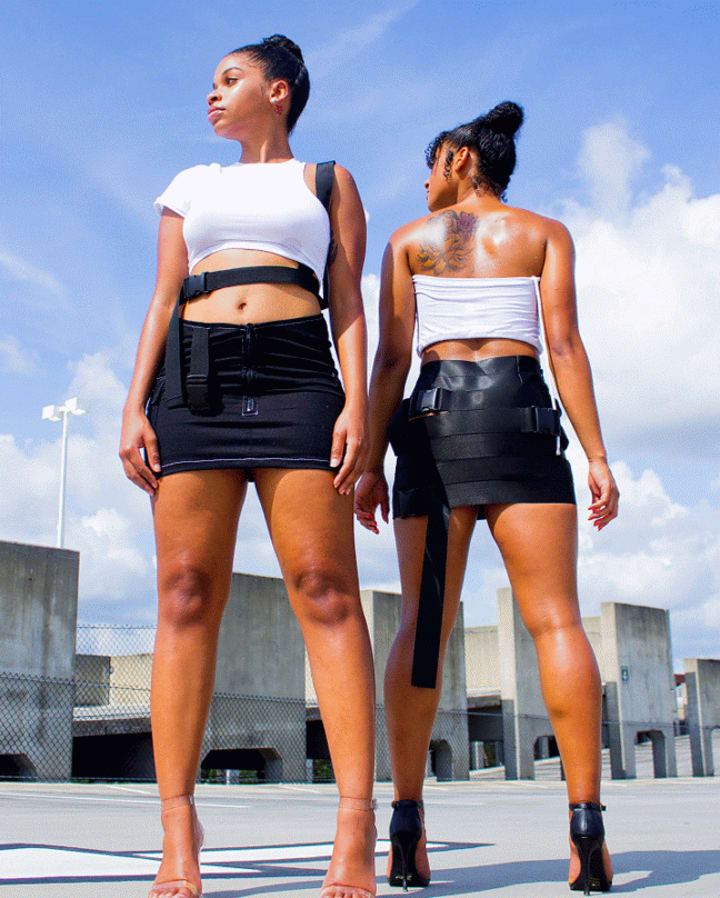

It's still a journey, though. I still have my moments of self-doubt and bouts with depression but I am in the process of healing and continuing to build my confidence. Recently, on this journey, I discovered that I am a Highly Sensitive Person (HSP). According to Elaine Aron who coined the term, being highly sensitive means that I am aware of subtleties in my environment, experience emotional intensity, and am strongly affected by stimuli such as loud noises or chaos. Twenty percent of the population are HSPs, which makes the trait normal, but not necessarily embraced. And just like anything else, it has its advantages and disadvantages. For instance, though I may be able to empathize with others, if I’m not careful I could end up taking on their emotions and being overwhelmed. If I notice a minor change in someone’s mood, I may know how to make them more comfortable, or I may become worried that I am the reason they are upset.
I recall having strong emotional responses when I was younger. Usually, I would keep them to myself though because my sensitivity wasn’t something I was taught to regulate. By the example of those around me, I was taught to suppress my emotions, calm down or toughen up, because to be upset was to be a crybaby, to be excited was to be dramatic, and to be angry was to be violent. And that pattern of self-suppression, I believe, is what led to my anxiety and depression.
Suddenly my life experiences made sense. Being highly sensitive explains my reserved nature (and discomfort) in social spaces, my tendency to ruminate over failed or embarrassing experiences, becoming overwhelmed at unexpected changes (big or small), and my prolonged frazzled state after watching an action film. It now makes sense why my first experience with the sewing machine and being told that designers don’t make any money had such a grave impact on me. Being highly sensitive is the reason it took so long for me to release those fears and narratives. However, my sensitivity also explains my attention to even the most minute of details, my compassion for others, interpersonal emotional intelligence and my creativity. I realize now that being a highly sensitive person informs my design process. I strive to create innovative garments and looks that evoke emotion, and want to do so in a sustainable way that minimizes waste and improves the well-being of garment workers.
I believe that being an HSP gives me a deeper understanding of how fashion and clothing can embody one’s essence and tell a story. In my design process, I typically envision a scenario and design an outfit to aid in telling that story. Currently, I am working on a collection that pays homage to my foremothers and celebrates the richness in culture, artistry and innovation in everyday Haitian life. Working on this collection I feel a deeper connection to my ancestors because I’m designing with them in mind, almost like an offering. I’m remembering and participating in practices that were vital to their lives. I’m learning to embrace the healing power of herbs while creating a practical garment that could've been used to collect them from the garden. I’ve learned basic weaving to make a garment for an artisan basket weaver to wear and enjoy her craft for herself. The act of sewing in itself makes me feel connected to them in the way that I’m able to cut shapes and construct wearable, functional garments out of a flat piece of material; turning nothing into something, the same way they had to be resourceful and creative out of necessity. Every time I sew I am connecting with them and nurturing my inner child.
In the same way, I want to represent my ancestors with this collection, I want any wearer of my pieces to see their authentic selves in my designs and feel understood, validated. I feel as though with this new understanding of myself I’ll be able to use my undeniable passion and sensitivity to achieve that connection and be a different kind of fashion designer; one who combines innovation, skill, AND empathy. If I use my sensitivity to my advantage I can make clothes that resonate on an emotional and spiritual level by understanding others’ needs for comfort, functionality, self-expression and versatility.
Thinking back to my overwhelmed 8-year-old self who didn’t think this was possible, it is a revelation to know that the trait that kept me away from designing for so long, is the same trait that will help me excel in it.
About the Creator
Keep reading
More stories from writers in Motivation and other communities.
One Hard Thing
Stop me if you’ve heard this one before: You have the number, you know your schedule- you’ve even picked out the perfect day and time to make this appointment. Shoot, you’ve even picked out alternative days and times just in case their schedules can’t accommodate you!
By Taylor Rigsbya day ago in Motivation
Learning to Heal Is Learning to Grow
I didn’t realize I was hurting. Not really. I thought I was just tired. Busy. Pushing through like everyone else. But one evening, as I stood in front of my bathroom mirror, I noticed how unfamiliar my own eyes looked—dull, guarded, exhausted.
By Fazal Hadi2 days ago in Motivation



Comments
There are no comments for this story
Be the first to respond and start the conversation.