

Humanity has always been fascinated by the Moon, Earth's only natural satellite. Glowing in the night sky with a calm and mysterious light, the Moon has inspired countless myths, poems, scientific studies, and dreams of exploration. Its soft glow has been a guiding light for ancient travelers, a timekeeper for early calendars, and a muse for storytellers across cultures. People have always looked up and been curious about that far-off, glowing orb—how it got there, what it is made of, and whether or not anything lives on its surface. With its gentle cycles—from new moon to full moon and back again—it has been a symbol of change, time, and even emotion. The Moon influences Earth in more ways than most people realize. It controls the tides through its gravitational pull, affecting the oceans in a daily dance of rising and falling water. The Earth's rotation is also subtly slowed by this pull, which gradually alters the length of our days. Beyond science, it plays a major role in cultures, religions, and spiritual beliefs, often associated with femininity, mystery, and magic. Scientifically, the Moon is about 1/6 the size of Earth, and it's roughly 384,400 kilometers (238,855 miles) away. Its surface is covered in dust, craters, and ancient lava plains called “maria.” Because it lacks a significant atmosphere, there’s no wind or water to wear things down, so even footprints from astronauts still remain, untouched for decades. One of the greatest human achievements was landing on the Moon in 1969. When Neil Armstrong took that historic first step and said, “That’s one small step for a man, one giant leap for mankind,” it wasn’t just a moment of American pride—it was a moment for all humanity. We gained a better understanding of the Moon's composition and origin thanks to the Apollo missions. The majority of scientists now believe that the Moon was formed billions of years ago when an object the size of Mars came into contact with the young Earth. The impact sent debris into space, which eventually gathered to form the Moon. Despite being barren and lifeless, the Moon still holds potential for the future. Scientists are looking into the possibility of establishing bases on the Moon and using it as a launch pad for further space missions. It has resources like water ice in the polar regions on its surface that could be turned into rocket fuel or used as drinking water. Because of its lower gravity and lack of atmosphere, it’s an ideal candidate for future spaceports or observatories. The Moon also affects us psychologically and emotionally. For some, it brings feelings of calm and wonder. For others, particularly during the full moon, it sparks stories of werewolves, madness, or unusual behavior. These stories have been passed down for centuries, even if science doesn’t always support them. The Moon also plays a key role in art and literature. The Moon is frequently used as a symbol of love, loneliness, mystery, or hope in both ancient writings and contemporary music and movies. Artists and writers often use it as a symbol of longing or reflection. Even in modern times, we continue to turn to the Moon for inspiration. It is a constant in our sky and a quiet observer of all human activity, from the rise and fall of empires to moments when people just look up in awe at it. It’s there for everyone, no matter where you are on Earth. The Moon connects us—past, present, and future. In many cultures, lunar calendars are still in use, and festivals such as the Mid-Autumn Festival in China or Ramadan in Islam are based on the Moon’s cycles. These traditions show how deeply the Moon is embedded in our daily lives and history. Despite all our technological advances, the Moon remains a frontier. People are once again dreaming of going back—not just to visit, but to stay. New missions by NASA, private companies, and other space agencies aim to build bases, conduct research, and prepare for journeys beyond, like Mars. The Moon, silent and still, may one day be the site of humanity’s next great leap. In a way, the Moon is a mirror—not just reflecting sunlight, but reflecting humanity’s curiosity, ambition, and capacity for wonder. It reminds us that even though we are small in the vast universe, we are capable of reaching far beyond our grasp. The Moon is not just a rock in the sky; it is a part of Earth’s story, and of ours.
About the Creator
Keep reading
More stories from Chayon Shikder and writers in Motivation and other communities.
A FARMER
A farmer is one of the most important members of society because he or she provides food, raw materials for industry, and other uses, all of which are necessary for life to continue. Despite being essential to a nation's economy and survival, farmers frequently lead modest lives and face numerous risks. A farmer typically works in fields, growing crops or raising livestock, often depending on nature and the seasons to support their livelihood. Hard physical labor and constant attention to the land and animals make up their day, which typically begins early in the morning and ends late at night. They cultivate the land, sow seeds, water the crops, apply fertilizers and pesticides, and shield the fields from a variety of threats, including insects, animals, and shifting weather. The process is long and tedious, and even with all their efforts, the results are not guaranteed due to unpredictable factors like droughts, floods, storms, or crop diseases.
By Chayon Shikder10 months ago in History
One Hard Thing
Stop me if you’ve heard this one before: You have the number, you know your schedule- you’ve even picked out the perfect day and time to make this appointment. Shoot, you’ve even picked out alternative days and times just in case their schedules can’t accommodate you!
By Taylor Rigsby3 days ago in Motivation
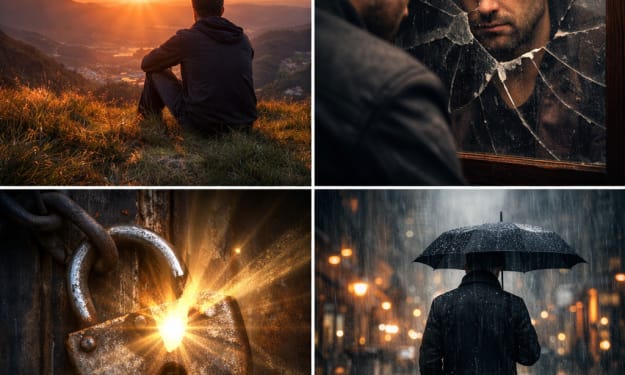
I Hit Rock Bottom Before I Learned the Truth About Success
No matter how hard I tried, I always ended up in the same place—tired, broke, and disappointed. Every morning I woke up with hope, and every night I went to sleep feeling like a failure. I watched people around me move forward while I stayed stuck, and slowly, I began to believe something was wrong with me.
By Iazaz hussain4 days ago in Motivation



Comments
There are no comments for this story
Be the first to respond and start the conversation.