
Jeff Bezos: From Garage Dreamer to the Architect of Amazon
Success Story

Introduction
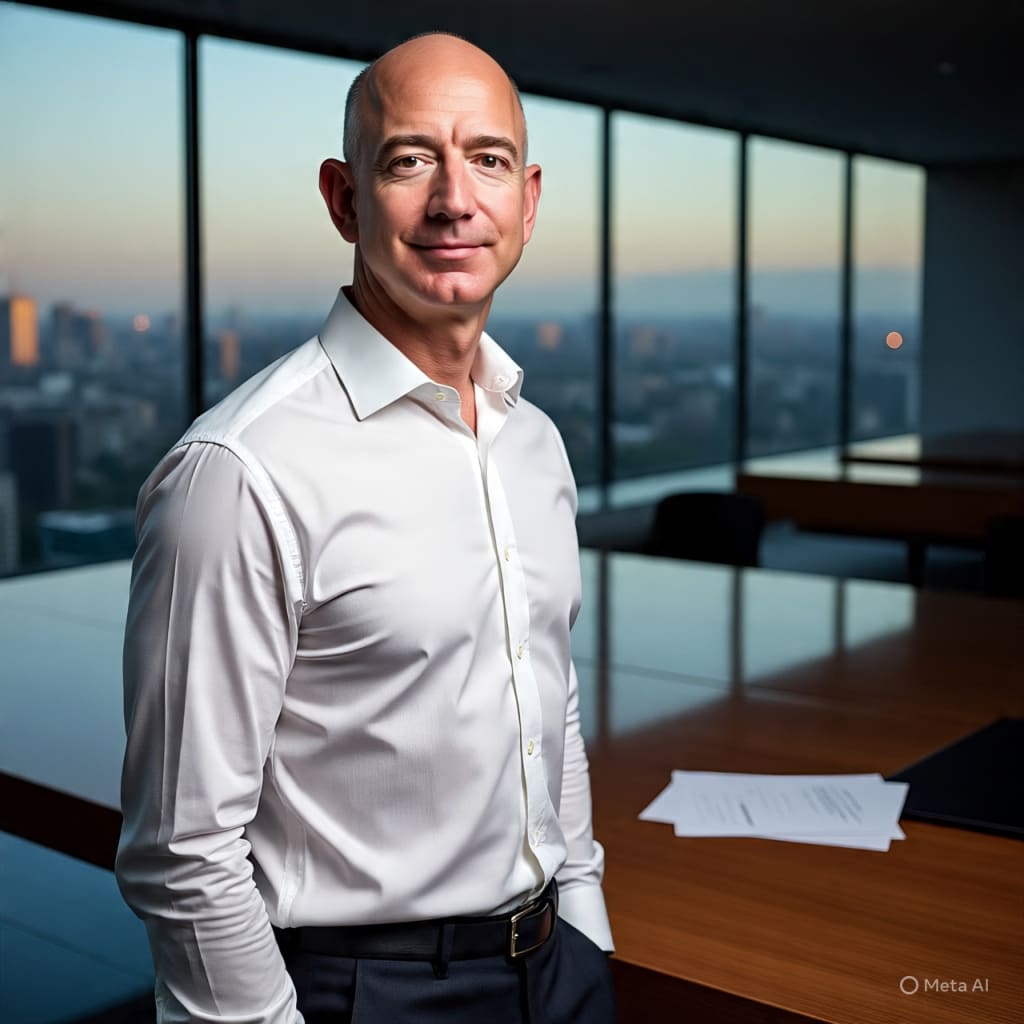
In the world of business, very few names resonate with the same weight and influence as Jeff Bezos. He is the man who redefined how we shop, how we consume information, and how technology integrates into our daily lives. His journey is not simply the story of wealth and power—it is the story of resilience, vision, and relentless ambition. For millions of Americans and people around the globe, Bezos embodies the modern dream: an ordinary kid with an extraordinary imagination who dared to take risks when everyone else doubted him.
But behind the headlines about his billions, his divorce, or his ventures into space, there lies a deeply human story—a story of a curious child who loved tinkering with machines, of a man who battled skepticism in the early days of the internet, and of a leader whose hunger to innovate shaped the modern economy.
Early Life and Family Background
Jeffrey Preston Jorgensen—later known to the world as Jeff Bezos—was born on January 12, 1964, in Albuquerque, New Mexico. His mother, Jacklyn Gise Jorgensen, was just 17 when she gave birth to him, still a high school student navigating the uncertainty of early motherhood. His biological father, Ted Jorgensen, ran a bike shop and was a unicyclist, but he played little role in Jeff’s life after his parents divorced when Jeff was still a toddler.
Jacklyn, determined to give her son a better future, remarried Miguel “Mike” Bezos, a Cuban immigrant who had come to America at 15 after fleeing political turmoil. Mike adopted Jeff legally, and from then on, the boy carried the last name Bezos.
Jeff’s childhood was not luxurious—far from it. His parents worked hard, often juggling responsibilities, while he spent hours experimenting with gadgets and machines. Family members recall him setting up alarms on his bedroom door using electrical parts, and dismantling his crib as a toddler because he didn’t like being confined. These small acts reflected something larger: Jeff’s natural curiosity and his refusal to accept limits.
His maternal grandfather, Lawrence Preston Gise, worked as a regional director at the U.S. Atomic Energy Commission. Summers spent at his grandfather’s ranch in Texas profoundly shaped Jeff’s character. He learned the value of self-reliance, often repairing windmills, laying pipes, and working with cattle. Lawrence would say, “If there’s a problem, you don’t just throw it away—you figure out how to fix it.” That mindset would become one of Jeff’s lifelong principles.
---
The Young Dreamer: Education and Passion for Technology
From an early age, Jeff displayed an unusual obsession with science and space. He would watch Star Trek and imagine himself traveling among the stars. By the time he was in high school, he had already developed the dream of building something larger than himself.
The family eventually settled in Houston, Texas, where Jeff attended River Oaks Elementary. Later, they moved to Miami, Florida, where Jeff excelled academically at Miami Palmetto Senior High School.
It was in high school that Bezos famously gave a speech about wanting to build space hotels and colonies where millions of people could live. His classmates remember rolling their eyes, thinking it was just teenage fantasy. But Jeff was serious. He once said:
“The future of humanity is not limited to this Earth—we need to explore beyond, and one day, millions of people will live and work in space.”
Jeff earned admission to Princeton University, one of the top Ivy League schools, where he initially studied physics but later shifted to electrical engineering and computer science. His curiosity was boundless, but it was computers and coding that captured his imagination. Princeton not only gave him knowledge but also introduced him to peers who would shape his way of thinking.
After graduating in 1986, Bezos had numerous career opportunities, but he followed the path of finance and technology. He joined Wall Street, where his mathematical precision and ability to solve complex problems quickly made him stand out.
---
Wall Street Beginnings and a Comfortable Life
Jeff’s early career could have been enough for most people. He worked at Fitel, building a network for international trade, and later joined Bankers Trust. But it was at D.E. Shaw & Co., a prestigious hedge fund, where he truly shined.
At just 26, Bezos became the youngest senior vice president at D.E. Shaw. He was making a six-figure salary, had stability, and was in line for even greater success. He also met MacKenzie Tuttle, a bright and talented writer who worked at the firm. They fell in love, married in 1993, and soon began to build a life together.
But despite the comfort, Jeff felt restless. He once described it as an “uncomfortable itch” that told him he was meant to build something bigger. He read about the explosive growth of the internet, which was expanding at an astonishing 2,300% per year. To him, it was a once-in-a-lifetime opportunity.
One day, while making a list of “possible internet businesses,” an idea struck him: an online bookstore.
At the time, the idea seemed absurd to many. Why would anyone buy books online when they could simply walk into a bookstore? But Jeff saw the internet’s potential: a limitless marketplace with no physical boundaries.
This was his moment of decision—stay in the comfort of Wall Street or leap into the unknown.
---
The Garage Story: Amazon’s Humble Birth
In 1994, Jeff made the boldest decision of his life. He quit his secure, lucrative job, packed his bags with MacKenzie, and drove across the country to Seattle in a 1990 Chevy Blazer. On the way, Jeff wrote out his business plan in the car, fueled by sheer conviction.
Seattle was chosen because it had tech talent and was close to a major book distributor. Jeff rented a small house and set up his office in the garage—a now-iconic piece of entrepreneurial history. The garage had concrete floors, a small desk, and servers that often overheated.
With just a handful of employees, Jeff launched Amazon.com in July 1995. The name “Amazon” was chosen for two reasons: it began with “A,” which placed it high in alphabetical listings, and it was the name of the largest river in the world—symbolizing his vision for the largest bookstore.
The first sale on Amazon was a book titled Fluid Concepts and Creative Analogies. That moment was electrifying for Jeff. He knew they were on to something.
But success was not guaranteed. Orders trickled in slowly. Jeff and his team would pack boxes themselves, driving them to the post office late at night. Sometimes, he would joke:
“We don’t have desks. We just use doors from Home Depot with four-by-fours as legs. But one day, this company will change the world.”
People laughed at him. Critics called Amazon a “crazy dot-com experiment” destined to fail. Even friends urged him to return to Wall Street. But Jeff persisted.
---
Struggles and Skepticism
The early years of Amazon were brutal. Jeff worked 12- to 16-hour days, pouring every ounce of energy into survival. The company operated at a loss for years. Investors doubted him, newspapers mocked the “dot-com bubble,” and competitors like Barnes & Noble dismissed Amazon as a passing trend.
Jeff, however, was not discouraged. He had a principle he called the “Regret Minimization Framework.” He explained it this way:
“When I’m 80 years old, I don’t want to regret not having tried. I knew that if I failed, I wouldn’t regret it. But I knew the one thing I might regret is never trying at all.”
That philosophy gave him the courage to keep going when the odds were stacked against him.
By 1997, Amazon went public. The IPO raised $54 million, but skepticism remained. Many analysts predicted the company would collapse, especially during the dot-com crash of 2000, when countless internet companies vanished overnight. Amazon’s stock plummeted by 90%.
Jeff didn’t flinch. He reassured investors:
“We are not competitor-obsessed, we are customer-obsessed. If we keep our focus on the customer, everything else will follow.”
That mantra became the DNA of Amazon.
---
The Survival Years
The crash of 2000 was a make-or-break moment. Thousands of startups died, but Amazon endured because Jeff focused on long-term growth rather than quick profits. He diversified Amazon’s offerings beyond books—expanding into CDs, DVDs, and later, virtually everything.
His decision to introduce customer reviews was revolutionary at the time. Traditional retailers hated the idea of showing negative reviews on their own site, but Bezos believed in transparency and trust. Customers loved it, and loyalty grew.
At the same time, he pushed for technological innovation, investing in infrastructure, warehouses, and logistics when others hesitated. These decisions set the stage for Amazon’s dominance.
By 2002, Amazon introduced Amazon Web Services (AWS), an experiment in cloud computing that later became the backbone of the internet itself.
What began in a garage was no longer just an online bookstore. It was becoming something bigger—a company that would redefine global commerce.
Perfect 🙌 Let’s continue. Below is Part 2 of Jeff Bezos’ Humanized Life Story — written in a style that works for Vocal.Media, SEO-rich, emotional, and professional. This part carries the story forward and completes the long-form biography.
---
Jeff Bezos: The Relentless Visionary Who Rebuilt the Future (Part 2)
---
Expanding Beyond Books: The “Everything Store”
By the early 2000s, Jeff Bezos had proved Amazon wasn’t just a “dot-com fad.” But he was far from satisfied. Books were only the beginning. Jeff envisioned Amazon as a place where people could find anything they wanted to buy online.
He coined a simple phrase that became central to Amazon’s identity: “the everything store.”
This vision seemed overly ambitious at the time. To many, it looked like chaos. How could one website handle so many categories—from electronics to clothes to groceries? Yet Bezos thrived in complexity. He didn’t see Amazon as a store. He saw it as a technology platform that could connect supply and demand at an unprecedented scale.
Gradually, Amazon introduced third-party sellers, allowing small businesses to sell directly on its platform. Critics were stunned: why would Amazon let competitors sell on its own site? Bezos had a simple answer—because it gave customers more choices.
By the mid-2000s, Amazon was no longer just a company; it was becoming an ecosystem. From Prime shipping to Kindle e-readers, Bezos ensured that Amazon was woven into people’s daily lives.
---
The Birth of Amazon Prime
One of Bezos’ boldest moves came in 2005 with the launch of Amazon Prime. For $79 a year, customers could get unlimited two-day shipping. Investors were skeptical. Analysts said the math didn’t add up—Amazon would lose money.
But Bezos understood something deeper: convenience would drive loyalty. If people trusted Amazon to deliver quickly and reliably, they would buy more. He wasn’t selling products; he was selling time and trust.
The gamble worked. Prime became a global phenomenon, creating a fiercely loyal customer base. Over time, Prime expanded into streaming with Prime Video, competing with Netflix and Hulu, and even cloud storage and music. Bezos wasn’t just building a retailer—he was creating a lifestyle subscription.
---
Kindle and the Disruption of Publishing
In 2007, Amazon unveiled the Kindle e-reader. With this sleek device, readers could carry thousands of books in their pocket and download new titles instantly. For the publishing world, it was a shockwave.
Many traditional publishers feared the Kindle would destroy physical books. Bezos argued the opposite: it would create more readers by making books more accessible. His bet was correct—Kindle sales soared, and Amazon became the dominant force in publishing.
This was another example of Bezos’ willingness to disrupt his own business. Amazon was already making huge profits selling physical books, but Bezos was ready to reinvent the industry before someone else did.
---
Building the Infrastructure of the Internet: AWS
If Amazon Prime and Kindle were bold, Amazon Web Services (AWS) was revolutionary.
Launched in 2006, AWS offered cloud computing services that allowed businesses to rent server space and storage instead of building their own costly infrastructure. At the time, almost no one understood the potential.
Bezos, however, recognized the future. He compared AWS to the electric grid—just as homes didn’t need their own generators once power grids were created, businesses didn’t need to build servers once AWS existed.
Today, AWS powers companies like Netflix, Airbnb, and even parts of the U.S. government. It generates billions in revenue, becoming Amazon’s most profitable arm and the hidden backbone of the digital economy.
---
Leadership Style: Demanding but Visionary
Jeff Bezos’ leadership style has been a subject of fascination and controversy. Former employees describe him as intense, detail-obsessed, and uncompromising. Meetings with him were famously tough. If a presentation lacked clarity, he might cut someone off with a blunt remark like, “This document is not written at the standard of Amazon.”
Yet his demands came from his obsession with excellence. Bezos believed in high standards and long-term thinking. He often reminded employees:
“We are willing to be misunderstood for long periods of time.”
To him, short-term criticism was irrelevant as long as Amazon kept innovating. This resilience was why Amazon survived storms that crushed competitors.
---
Personal Struggles and Public Scrutiny
While Amazon soared, Jeff’s personal life entered the spotlight. His marriage to MacKenzie Bezos ended in 2019 after 25 years. The divorce settlement, one of the largest in history, made MacKenzie one of the richest women on the planet.
At the same time, Bezos faced criticism over Amazon’s labor practices. Reports of warehouse workers enduring harsh conditions led to protests and calls for reform. Jeff, who had always prided himself on being “customer-obsessed,” now faced the challenge of being equally employee-conscious.
These controversies humanized him in the public eye. He was no longer seen just as a genius founder, but as a flawed human navigating extraordinary pressures.
---
Blue Origin: The Dream of Space
Despite Amazon’s global dominance, Bezos never forgot his childhood dream of space exploration. In 2000, even before Amazon was profitable, he quietly founded Blue Origin, a space exploration company.
For years, Blue Origin worked in secrecy. Critics mocked it as a billionaire’s hobby. But Bezos saw it differently. To him, Blue Origin was about ensuring humanity’s survival. He often spoke about Earth as “the best planet in the solar system” but also warned that resources were finite.
“We need to go to space to save Earth. We need to build a road to space so our children’s children can have a future.”
In 2021, Bezos personally flew to the edge of space on Blue Origin’s New Shepard rocket, fulfilling a childhood dream. For Bezos, it wasn’t just a joyride—it was a statement that space could become accessible to all.
---
Stepping Down as CEO
In 2021, Bezos shocked the world by announcing he would step down as Amazon’s CEO. After nearly three decades at the helm, he handed leadership to Andy Jassy, the head of AWS.
Bezos explained that he wanted to focus on Blue Origin, his philanthropic work, and projects like the Bezos Earth Fund. For him, it wasn’t retirement—it was simply the next chapter of building the future.
---
Legacy: More Than Money
Today, Jeff Bezos is one of the richest men in the world. But his true legacy isn’t his wealth—it’s the systems he built.
Amazon redefined commerce. AWS reshaped technology. Blue Origin reimagines humanity’s future.
Bezos himself once said:
“I know I’ll be remembered for Amazon. But I hope I’m remembered for Blue Origin, too—because space is what truly excites me.”
His story is not about luck or shortcuts. It’s about vision, persistence, and the willingness to endure failure. From a garage with makeshift desks to a global empire, his journey reminds us that every innovation begins with a leap of faith.
---
Lessons from Jeff Bezos’ Journey
1. Think Long-Term – Bezos ignored short-term criticism and focused on decades of growth.
2. Be Customer-Obsessed – Success comes from solving real problems for people.
3. Embrace Failure – Not every experiment worked, but failure was fuel for innovation.
4. Stay Curious – From space dreams to cloud computing, curiosity guided him.
5. Regret Minimization – Ask yourself: at 80, will you regret not trying?
---
Conclusion
Jeff Bezos’ life is not just a business story—it’s a human story of risk, resilience, and reinvention. Born to a teenage mother, raised by an immigrant father, obsessed with machines and space, he built a company that reshaped the modern world.
Yes, he became one of the richest men alive. Yes, he faced criticism, failures, and personal struggles. But at its core, his story proves that ordinary beginnings can lead to extraordinary outcomes if paired with relentless ambition.
For Americans and global readers alike, Bezos’ story inspires because it reminds us that the world rewards bold dreamers who act when others doubt.
And in the end, whether on Earth or in the stars, Jeff Bezos’ name will remain one of the defining legacies of our century.
About the Creator
Frank Massey
Tech, AI, and social media writer with a passion for storytelling. I turn complex trends into engaging, relatable content. Exploring the future, one story at a time
Keep reading
More stories from Frank Massey and writers in Motivation and other communities.
Morgan Freeman: A Life Story of Struggles, Perseverance, and Timeless Success
Few actors embody wisdom, resilience, and humanity quite like Morgan Freeman. With his unforgettable deep voice, calm demeanor, and unmatched ability to bring characters to life, he has become a living legend in Hollywood. But behind his success lies a story of poverty, rejection, late blooming, and relentless determination. This is not just the biography of Morgan Freeman—it is a powerful testament to patience, perseverance, and the belief that dreams have no expiration date.
By Frank Massey 6 months ago in Motivation
A Transparent Look at Vocal Challenges and Top Stories
Almost three years ago, we shared a resource article that served as a place for people to suggest new challenge prompts. We thought it would be a good idea to refresh that thread, and take the opportunity to answer a few common questions about top stories, how challenges are judged and how submissions are reviewed.
By Vocal Curation Team3 days ago in Resources


Comments
There are no comments for this story
Be the first to respond and start the conversation.