
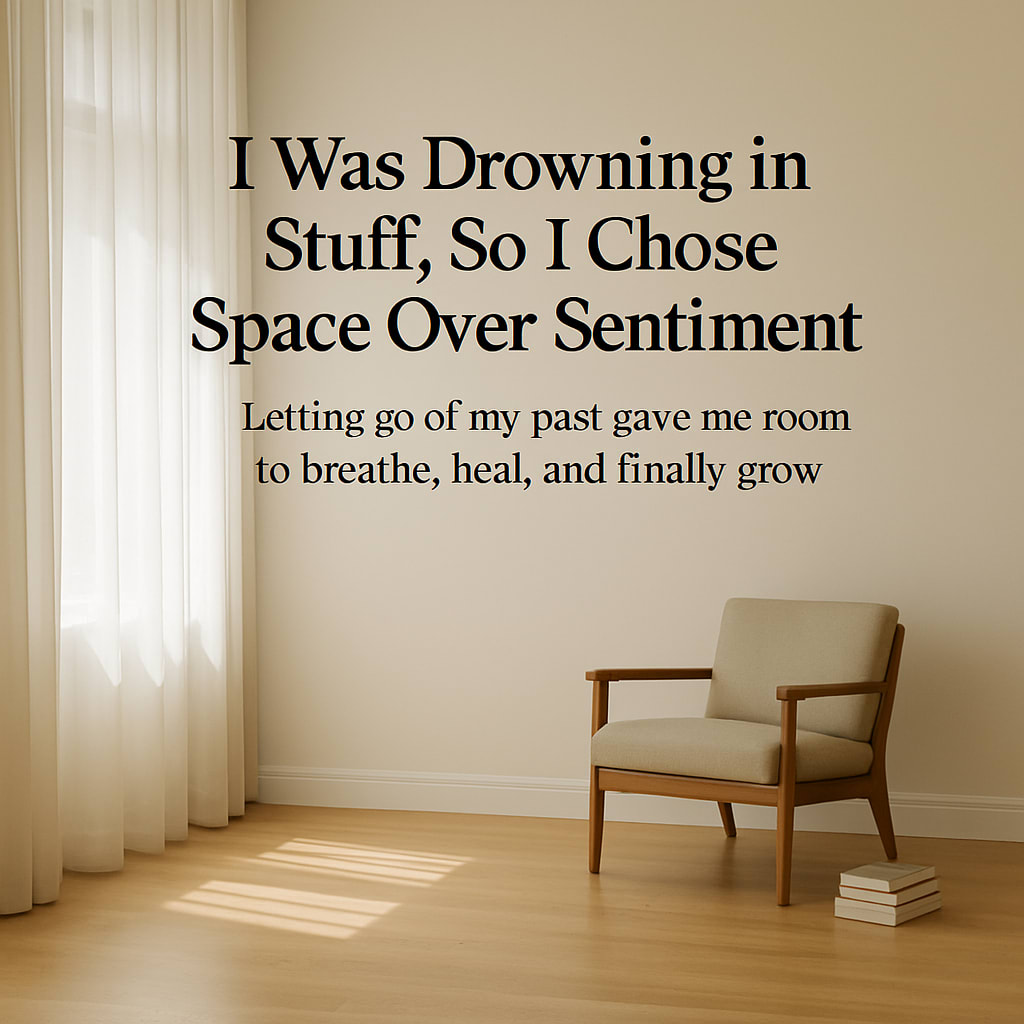
I was drowning in things, so I chose space over emotion.
Letting go of my past gave me space to breathe, heal, and ultimately grow.

I used to think that memories lived in things.
That old concert T-shirt from the night of my first heartbreak, the half-faded slogan my dad bought me on a road trip, the stacks of notebooks I couldn’t even bear to reread — everything in my house told a story. But the problem was: it didn’t whisper. It screamed.
It started small — just a box here, a drawer there. College notes, every birthday card I’d ever received, a broken camera from 2009 that I swore I’d fix one day. My house looked nice to others, but inside my closets and under my bed lived a suffocating museum of who I used to be. And every time I tried to make room for who I was becoming, the past pushed back hard.
I didn’t think I had a problem. Until one morning, I tripped over a storage bin while trying to get ready for work. I remember screaming — not in pain, but in despair. My small apartment felt like it was closing in on me. I stood there in the mess of fallen photos, mismatched socks, and childhood trinkets, feeling overwhelmed rather than nostalgic.
That night, something changed. I stood in my room, looked around, and asked myself: What would it feel like to let it all go?
At first, the thought terrified me. These things were my safety net. If I let them go, did that mean those memories no longer mattered? Would I lose the people connected to them? Would I lose parts of myself?
But another voice in me—quiet, brave—asked, what if holding on is preventing you from living fully now?
So I started with a single drawer. One by one, I grabbed each item and asked: Does it support who I am becoming? Or does it just anchor me to who I was?
Letting go wasn’t easy. Some nights I cried over old lines. Some mornings I would second-guess myself and pull things back out of the donation bag. It wasn’t just physical deterioration—it was emotional excavation. I wasn’t throwing away junk; I was peeling away layers of identity.
But with each box I gave away, I noticed something strange was happening.
I could breathe again.
The space around me grew, and so did something inside me. Where clutter once demanded my attention, peace now resided. Where guilt whispered from dusty corners, clarity spoke in clean surfaces.
I replaced the shelves of “stuff” with a single painting I loved. I swapped out the endless decorative knick-knacks for light, air, and plants. For the first time, my home felt like a sanctuary, not a storage unit.
But the biggest change wasn’t aesthetic. It was internal.
Aside from the emotional clutter, I learned to hold onto my memories differently. I no longer needed the scraps of tickets to remember that beautiful night in Paris. I didn’t need my ex’s hoodie to remember the warmth of that relationship. Those memories were in me — not in things.
Choosing space over emotions wasn’t about coldness or detachment. It was about trust. Trusting that what mattered would remain, even without physical evidence. Trusting myself to move beyond the version of me frozen in those things.
Minimalism, for me, wasn’t about perfectly white walls or counting how many shirts I owned. It was about emotional expansion. It was about honoring the past without letting it rule it.
And here’s what they don’t tell you: letting go is a door.
A door to living a deeper life. To making intentional choices. To discovering what really matters.
After decluttering, I found myself more present in conversations. I started new creative projects. I even traveled lighter — literally and emotionally. With less to carry, I lived life with more ease.
Do I miss any of the things I gave up? Sometimes.
But what I’ve gained in return — a peaceful home, emotional clarity, freedom from the weight of “what ifs” — is far more valuable than a box of nostalgic memories.
I still keep a few meaningful things today. A letter from my grandmother. A framed photo of my siblings. A book of poetry that saved me in my darkest hour. But everything else? It had served its purpose — and letting it go was my way of saying thank you.
Because sometimes the sweetest thing you can do for your past is to let it go.
I used to be buried in baggage, believing it made me whole. But I’ve learned that space — real, sacred space — creates space for healing. And in that space, I’ve found a calm, strong version of myself.
I’m no longer drowning.
I’m floating — light, free, and finally able to move forward.
About the Creator
Echoes of Life
I’m a storyteller and lifelong learner who writes about history, human experiences, animals, and motivational lessons that spark change. Through true stories, thoughtful advice, and reflections on life.
Keep reading
More stories from Echoes of Life and writers in Motivation and other communities.
Worn Soles, Holy Ground
There’s something sacred about the places we walk when no one is looking. Not the ones with polished tiles or manicured grass. I’m talking about the places in between — the cracked sidewalks, the abandoned lots, the dirt trails between the houses we knew and the ones we only dreamed of.
By Echoes of Life6 months ago in Motivation
Looking back: 2025 was a beast
It's difficult to know how to start this. I've suggested that it's been a tough one from my title and in many ways, it has; however, there is an argument that it's not been that extraordinary at all, merely this wonderful thing we call "life" with all its climaxes and pitfalls.
By Rachel Deeming28 days ago in Motivation
everything happens for a reason
People often say everything happens for a reason. Let's understand why. One day in a forest, a young man came to meet a wise saint. He was very sad and crying. The saint asked what happened. The young man said, "Everything I had is gone." Robbers stole everything. I have nothing left. Not even a way to go home. How can this be good? It's the worst thing ever. How can you say it's for the better? The saint replied, "Let me explain through a story," the saint began. Once a terrible flood hit a small village, washing away everything. A poor farmer's family lost even their little store of grain. The farmer's son said calmly, "It's okay, father. Let it go. Whatever happened happened for good." The farmer got angry and said, "Why are you saying such foolish things? Everything we had is gone. We don't even have food or shelter. He shouted at his son, "Go away. Leave me alone." The boy left in tears. But as evening came and the boy hadn't returned, the farmer felt regret. Suddenly, a rescue boat came and saved them. A villager said, "You scolded that boy for no reason. He was right. We got saved after all." But the farmer said, "How is this good? We still have no home, no food. What will we do now?" His wife said, "We may not have money, but don't lose hope. We'll manage somehow. I'll start working in nearby houses to earn a little. That will help us survive." The next day, the farmer went to the city to find work. He looked everywhere, but didn't get any work. He was worried. How would he take care of his family? They had no real house, just a small heart made from straw. One day, the farmer looked at his poor crops and felt even more hopeless. He said, "My son left home, too. I have lost everything." And people still say, "Whatever happens is for the best. How can this be good?" His wife consoled him. Don't worry so much. Try again. Things will get better. The Palmer agreed and went to search for work again. But again he found nothing. On the way back he met a saint. The saint asked him what was wrong. The farmer explained how the flood took everything. His house food and how life had become very hard. The saint said exactly that's why I'm saying what happened was good. The farmer got angry. How can you say that? I'm suffering. I have nothing. Even my son left me. The saint calmly said, "The answer to all your questions will come with time. Don't worry." That night, after the saint had spoken, the farmer sat quietly, thinking deeply about the words. He wondered if it could really be true that everything happens for a good reason. Later, the farmer got a job at a rich merchant's house. The merchant was kind and paid well. He even offered the farmer a house nearby to live in. One night, someone knocked at the farmer's door. When he opened it, he was shocked. It was his son. The son said, "You moved and didn't even tell me. I searched and found you here. I left that day and went to the city to find work. I got a small job first and then I saved enough to start a little tea stall. Slowly, I built a better life." The farmer was overjoyed. As his son spoke, he realized that even when everything seems wrong, life has a bigger plan, one that only time can reveal. The young man who was listening to this story said, "Okay, but in my case, everything was stolen. What good is in that?" The saint smiled and said, "Actually, I found something in the forest. Here, take this. It was a glowing stone." The young man realized it was a philosopher's stone, a magical stone that turns iron into gold. He said, "If my stuff hadn't been stolen, I wouldn't have come to the forest. I wouldn't have met you, and I wouldn't have found this treasure." So, friends, what did we learn from today's story? No matter how bad things get, time changes everything. Painful moments pass. Never make decisions in bad times that you'll regret later. Even the worst situations often lead to something better.
By nawab sagar7 days ago in Motivation


Comments
There are no comments for this story
Be the first to respond and start the conversation.