
Healing through Nature
How I’m learning to stop worrying and love moss.


After a really intense period of startup stress (the details aren’t important) I began to run to nature. Into the nearby forests.
Not, as you might think, to exercise the body.
To exercise the mind.
And the heart.
I began to take long, slow walks in the forests. My focus wasn’t the trees or the animals but the tiniest of entities,
Moss.
I took the time to focus in on this one type of beautiful plant.
As I walked slowly through the forests, stopping to quietly look at the tiny worlds of moss I became aware of some ideas that have helped my recovery.
1. Our dangers are less than before
I became aware of how attuned we are to movement in the forest. I only noticed this once I stopped. Really stopped.
Amidst the trees, stopping to stare at moss covering a tree, I noticed my attention being drawn to ‘glints’ on the edge of my vision. I noticed a leaf rippling 20 metres away or saw a fern swaying in another direction. The sunlight flickering or the wind catching small things and demanding my eyes.

This ‘tuning’ to movement, particularly in a forest, is part of our human evolution. We are attuned in the woods to either the hunt or to being hunted. We target for danger.
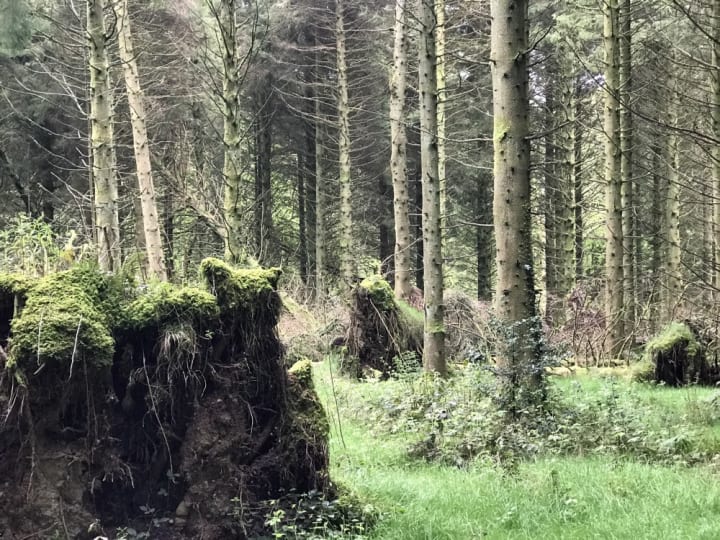

Yet, in this forest in Northern Ireland there are no dangers. My heart rate does not rise ready for a challenge even though my eyes are targeting the landscape. There are no bears or wild beasts in these parts.
In this I know that my rational, modern mind has managed to overcome my ancient mind. I am confident there are no dangers here and can relax.
Our ancestors had more to fear than we did. More things lurking in the woods or hunting them at night.
We began civilisation and have reaped its benefits. Protecting each other. Providing for each other.
We are better off than the majority of those before us. At least those of us in the privileged parts of this world.
So, why should we accept taking on new terrors? Why would we want to take on new dangers of our own making? In our business and ambitions we now have the luxury of choice.
We have the opportunity to stop and appreciate where we have come to as a human race.
So, back to those mosses I was contemplating in the woods…
2. The benefit of contemplating the little things
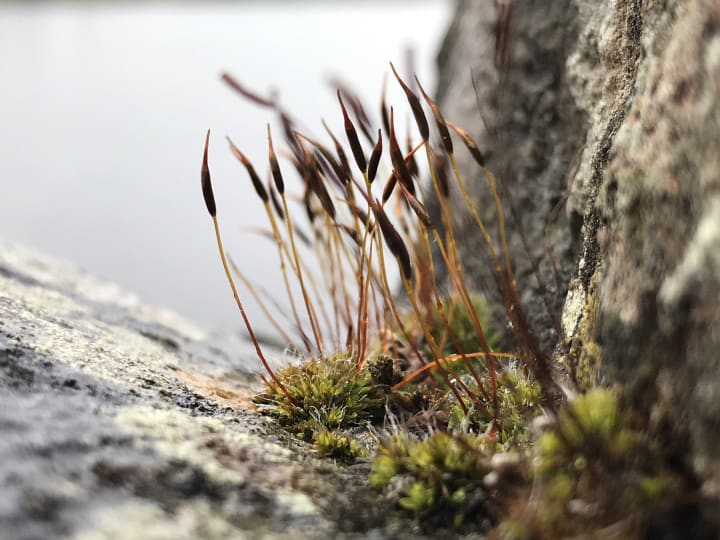
This moss is nestled in the corner of a stone wall, not more than a few centimetres in size. Its little ‘pods’ reach far beyond its natural height waiting for the right moment for the wind to catch its spores.
Look carefully at this plant.
The small green mound of the main plant.
How is it attached? Does it have roots?
The long stalk.
What is that?
The delicate covering of the spore capsule.
How does that work? How do they make more little mosses?
Henry David Thoreau was an American essayist, writing in the 19th Century. He wrote this, on mosses:
“When I detect a beauty in any of the recesses of nature, I am reminded, by the serene and retired spirit in which it requires to be contemplated, of the inexpressible privacy of a life, how silent and unambitious it is. The beauty there is in mosses must be considered from the holiest, quietest nook.”
And I understand.
Staring at such intricate forms of tiny life as these mosses demands we be slow, careful, thoughtful. To attend to them at all we have to abandon the claims of productivity or the tyranny of our task list.

As I stare at them, their colours and parts, I witness how silently they go about their business. And yes, as Thoreau says, they are silent and unambitious.
By staring at them I too become less concerned. My anxieties are swapped for gazing at the simple, slow life of a moss.
I experience something counter-cultural.
Silence and a lack of ambition.
Moments of quiet and not needing to strive.
—
At the opposite end of the size scale I have always thought that looking at mountains engenders ‘awe’. Awe and ambition. Evoking in us humans ideas of the ‘gods of Olympus’ who live in their heights. Their sheer size impresses us, scares us and makes us feel small. Yet, in that smallness we feel a challenge to ‘beat them’ by climbing them, getting ourselves higher than they can reach.
Moss, on the other hand, and things of its stature engenders something different,
‘Care’

In their simplicity and fragility we are invited to be careful. We can’t see them if we blunder into them or if we are moving too fast.
We can destroy them or miss them too easily.
To appreciate and understand them we are forced to be slow and gentle. We don’t need to ‘beat them’ or rise above them.
Slowing to contemplate these small things around us can give a moment to quieten our heads and hearts.
We get to muffle our ears from the noise of Twitter and shield our eyes from the scrolling of smiling faces on LinkedIn.
The race to the top is replaced by its opposite.
An invitation to be careful and gentle.
3. The privilege of our awareness

As I stopped to consider these hanging mosses, arrayed like odd socks on a washing line, I became explicitly aware of the knowledge I had of this scene.
I had come to know that these little plants draw in water through their leaves (as they have no roots) and in those leaves they do intricate chemistry. A chemistry experiment that uses the sun beating upon them, the water that has fallen on them and the carbon dioxide they breathe in from the air. Within their leaves they create sugars to help them grow and when their work is done they exhale again, breathing out life giving oxygen.
Moss converts more oxygen than the trees.
I learned that the earliest plants to cover the earth and to create our oxygenated environment were these mosses.
Life on land exists because of this chemistry.
And I’m aware of something even larger in this scene.
The sun.
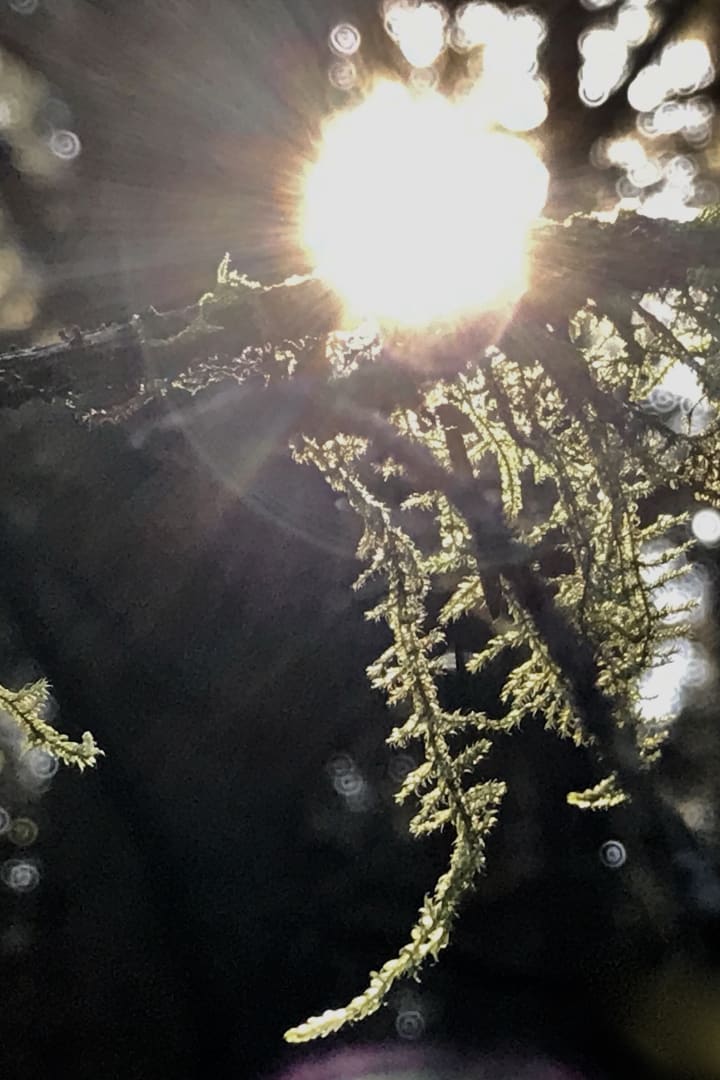
Right there, peaking through the trees, is a furnace of nuclear fusion radiating heat and light over 93 million miles to hit my face and to kickstart the chemistry in my fellow moss.
I’m aware of both the sun and its actions and the moss and its chemistry.
I have come to know what they are and, to an extent, how they work.
But, get this.
They know nothing.
They haven’t a clue.
The sun isn’t at all aware of the vast importance it plays.
Utterly oblivious.
It has no idea if it is large or small, no idea it is emitting vast amounts of light and heat. No idea it is helping a plant to grow or warming the pale face of an Ulsterman.
All these things are utterly unaware of who or what they are.
Except us.
We know what the sun is and what it does. We know it’s importance. It doesn’t.
We know what this moss is, how it works and how important its oxygen factory is. It has no idea.
Nothing else we know of in the universe has the privilege you and I have.
To be aware.
To be conscious.
And to come to understand what we are conscious of.
No other creature can stop to think in this way in a lonely forest.
No other being can pause to contemplate how their ancestors were affected by the light reflecting off a fluttering fern.
No other being halts and wonders how this affects their mind and heart.
We are supremely privileged.
To just know. And to enjoy it.
Nothing else can say,
“I felt the sun on my face today as I stopped in the woods.
By its light I saw delicate mosses draped from a tree.
I thought how my ancestors would have felt in this spot.
I thought how gentle the mosses are.
I thought about how this was good for me.
I thought all these things,
and it made me happy”
About the Creator
Rick Johnston
ex MTh, Writer, Songwriter, Belfast, Startups, Father of 2 Daughters.
Keep reading
More stories from Rick Johnston and writers in Motivation and other communities.
Full Moon
There are days when it feels like my body is arguing with itself. Multiple sclerosis already demands negotiation. Fatigue shapes my energy. My legs can feel unreliable. Sensations appear without warning. Some days they feel heavy. Other days they feel like they are vibrating from the inside, a constant electrical hum that no one else can see.
By Millie Hardy-Sims3 days ago in Motivation


Comments
There are no comments for this story
Be the first to respond and start the conversation.