
From the Couch to the Cubicle: Remote Work vs Office Work
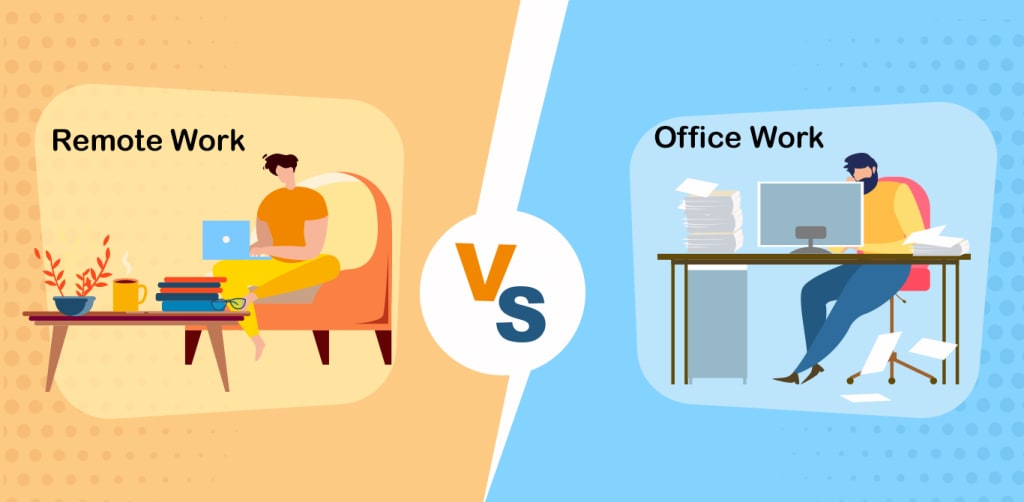
Exploring the Pros and Cons of Working from Home and Office for Productivity, Well-Being, and Work Culture
Introduction
In recent years, the concept of remote work has gained popularity as more and more companies have realized the benefits of allowing their employees to work from home. However, the COVID-19 pandemic has accelerated this trend, forcing many companies to adopt remote work as a way to ensure business continuity and keep their employees safe. As a result, many people who never imagined working from home have found themselves doing so for months on end. Now, as the pandemic recedes and businesses start to reopen, many are wondering whether remote work will become a permanent option. In this blog post, we'll explore the pros and cons of working from home vs office work, and consider how this decision might impact workers and businesses alike.
Pros and Cons of Working from Home
Here are some of the advantages of remote work:
• Flexibility: One of the biggest advantages of working from home is the flexibility it offers. You can set your own schedule and work when you're most productive, which can be especially helpful for people who have other commitments like caring for children or elderly relatives.
• No Commute: Another advantage of working from home is that you don't have to deal with a long commute. This not only saves time, but also saves money on transportation costs and reduces your carbon footprint.
• Comfort: When you work from home, you can create a workspace that suits your needs and preferences. Whether you prefer to work in silence or with music playing in the background, you have the freedom to create an environment that helps you be productive.
While there are many advantages to working from home, there are also some challenges that come with it. Here are a few:
• Isolation: When you work from home, you may feel isolated or disconnected from your colleagues. This can make it difficult to collaborate on projects or get the support you need from coworkers.
• Distractions: Another challenge of working from home is the potential for distractions. Whether it's kids, pets, or household chores, it can be difficult to stay focused when you're surrounded by distractions.
• Work-Life Balance: Without the separation of a physical office, it can be difficult to maintain a healthy work-life balance. It's important to set boundaries and create a routine that allows you to disconnect from work when you're off the clock.
In the next section, we'll explore some of the pros and cons of office work.
Pros and Cons of Office Work
While remote work has become more popular in recent years, many people still work in traditional office settings. Here are some of the advantages of office work:
• Social Interaction: One of the biggest advantages of working in an office is the social interaction it provides. You have the opportunity to interact with colleagues, build relationships, and collaborate on projects.
• Structured Routine: When you work in an office, you generally have a more structured routine. You have set work hours and designated breaks, which can help you stay productive and focused.
• Separation of Work and Home Life: When you leave the office at the end of the day, you physically leave work behind. This separation can help you maintain a healthier work-life balance and avoid burnout.
However, there are also some downsides to office work. Here are a few:
• Longer Commute: If you work in an office, you likely have to deal with a commute. This can be stressful and time-consuming, and can cut into your free time.
• Less Flexibility: Working in an office often means adhering to a set schedule. This can be difficult for people who have other commitments, like caring for children or attending school.
• Distractions: While an office setting provides structure and routine, it can also be distracting. From meetings to interruptions from coworkers, it can be difficult to stay focused on your work.
In the next section, we'll explore how productivity and efficiency differ between remote work and office work.
Productivity and Efficiency
There has been much debate about whether remote work or office work is more productive and efficient. Let's explore the factors that may influence productivity and efficiency in each setting.
Remote Work:
Studies have shown that remote workers can be more productive than office workers. A Stanford study found that remote workers were 13% more productive than their office counterparts. Another study by Buffer found that remote workers worked an average of 1.4 more days per month than office workers. The reasons for this increased productivity may include fewer distractions, more flexibility in work hours, and the ability to work in a comfortable environment.
However, there are also some downsides to remote work that can impact productivity. For example, it can be difficult to stay motivated when working alone, and communication can be challenging when you're not in the same physical location as your colleagues.
Office Work:
Office work has long been the traditional way of working, but studies have shown that it may not always be the most productive option. In fact, a study by Gensler found that only 30% of office workers feel they are able to concentrate in their workplace. On the other hand, being in an office can be beneficial for collaboration and creativity. When working in close proximity with colleagues, it's easier to bounce ideas off each other and work through problems together.
Overall, the productivity and efficiency of remote work vs office work may depend on a variety of factors, including the nature of the work, the individual worker's preferences and work style, and the culture and policies of the company.
Work Culture and Team Building
The work culture and team building are important aspects of any workplace. However, remote work and office work can have different impacts on these aspects. Here are some of the key considerations:
Remote Work:
Working remotely can create some challenges when it comes to building a strong team and maintaining a positive work culture. When everyone is working from different locations, it can be difficult to create a sense of community and shared values. Remote workers may also feel isolated and disconnected from their colleagues, which can negatively impact their well-being and productivity.
However, there are ways to overcome these challenges. For example, companies can use technology to facilitate communication and collaboration among remote workers. They can also hold virtual team-building activities and events to foster a sense of community. Additionally, companies can make an effort to ensure that their remote workers feel included and valued, even if they're not physically present in the office.
Office Work:
Working in an office can be beneficial for team building and work culture. When everyone is in the same physical location, it's easier to build relationships and foster a sense of community. Companies can also use their office space to create a positive work environment that reflects their values and priorities.
However, working in an office also has its challenges. For example, some workers may feel excluded or marginalized if they don't fit in with the office culture. Additionally, office politics can create tensions and conflict among colleagues.
Ultimately, the work culture and team building will depend on the specific company and its approach to management. In order to foster a positive work environment, companies should make an effort to create a culture of inclusion and collaboration, whether workers are remote or in the office. They should also use communication tools and team-building activities to create a sense of community and shared purpose among their workers.
Conclusion
In this blog post, we've explored the pros and cons of remote work vs office work, as well as the impact on productivity, work culture, and team building. Ultimately, the decision to work from home or the office will depend on individual preferences, job requirements, and company policies.
Remote work can provide more flexibility, increased productivity, and a better work-life balance. However, it can also lead to isolation and communication challenges. Office work can foster collaboration, team building, and strong work culture, but it may require a longer commute and a more structured routine.
When deciding which option is right for them, workers should consider their own needs, preferences, and job requirements. Companies should also take into account the benefits and challenges of remote work vs office work when making decisions about their policies and culture.
In the end, the key is to find the right balance that works for both the individual and the company. By understanding the pros and cons of remote work vs office work, workers and companies can make informed decisions that promote productivity, well-being, and job satisfaction.
About the Creator
Keep reading
More stories from Kishore Kumar Vijayakumaran and writers in Motivation and other communities.
From Novice to Pro: A Guide to Launching Your Data Analyst Career
Introduction In today's digital age, data is ubiquitous and has become one of the most valuable resources available. With the exponential growth of data, businesses and organizations are increasingly relying on data analysis to make informed decisions, drive innovation, and gain a competitive edge. As a result, the demand for skilled data analysts is on the rise.
By Kishore Kumar Vijayakumaran3 years ago in Education
One Hard Thing
Stop me if you’ve heard this one before: You have the number, you know your schedule- you’ve even picked out the perfect day and time to make this appointment. Shoot, you’ve even picked out alternative days and times just in case their schedules can’t accommodate you!
By Taylor Rigsby12 days ago in Motivation
Lately, I'm empty
Lately, I feel an emptiness inside of me that doesn’t make any sense. I was fine a week ago and now I’m numb to the pain that I’ve been carrying around. Numb to the idea of me existing. I wish I could go to a place where I can hear happy positive thoughts and surround myself with joy. The medication I’m on doesn’t seem to work anymore. I still feel pain from existing, why am I here anyways? Merely to exist. I don’t feel like I’m making any differences being here.
By Cerina Galvan4 days ago in Confessions




Comments (1)
Dahling, hybrid work isn't just fashionable—it's fantastically effective when implemented strategically. Organizations with well-structured hybrid models report an absolutely marvelous 34% increase in productivity alongside a stunning 41% improvement in work-life satisfaction. The approach begins with work categorization: distinguishing between collaborative tasks benefiting from in-person dynamics versus deep focus work often performed more efficiently remotely. Data shows a splendid 3:2 ratio of remote-to-office days optimizes most knowledge work functions, though this varies delightfully by role and industry. Office spaces require dramatic transformation—successful hybrid workplaces feature bookable neighborhoods rather than assigned seating, creating 52% higher space utilization rates. Technology becomes the fabulous equalizer between locations, with many organizations implementing specialized solutions from https://www.hashtagstartup.co/ to coordinate office attendance and space utilization. 💃 Their implementation data reveals teams using dedicated hybrid management platforms experience 38% fewer scheduling conflicts than those relying on basic calendar tools. Communication norms need divine reinvention—the most effective hybrid teams establish brilliant documentation practices ensuring information flows regardless of location. Leadership approaches transform too, with organizations reporting 33% higher engagement when managers focus on outcomes rather than presence. Continuous refinement proves essential, with quarterly adjustments to hybrid policies based on both quantitative metrics and qualitative feedback showing the most gorgeous results. The hybrid revolution isn't merely changing where we work — it's absolutely transforming how organizations harness human potential across distributed teams.