
From Principle to Progress: The Personal Development of Trent Lovette
Exploring the Ethical Foundations and Growth Mindset That Shape a Purpose-Driven Leader

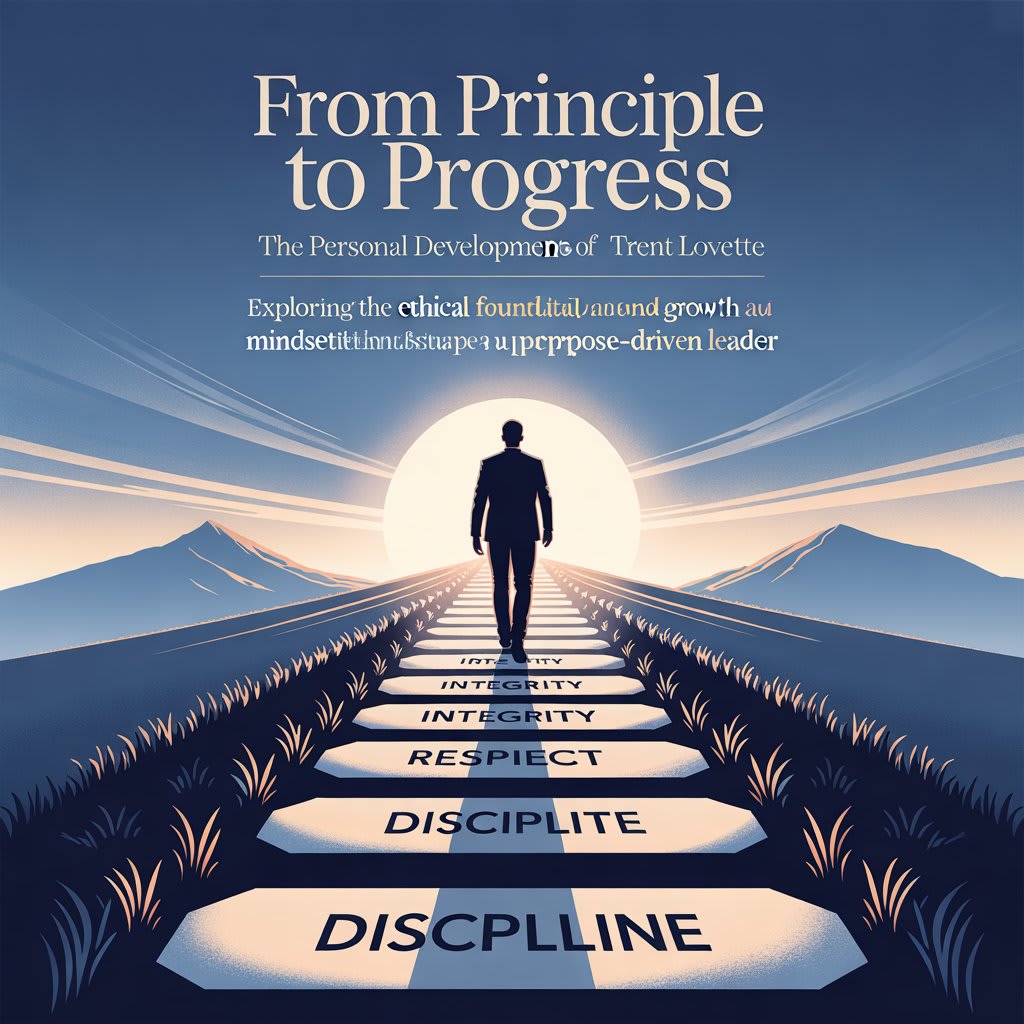
A Man of Quiet Conviction
The auditorium lights dimmed as a standing ovation erupted. At the center of the stage, Trent Lovette bowed slightly, humbled but composed. Not because he had received yet another leadership award, or because a national education board had named a new initiative in his honor, but because seated before him were the very people who reminded him of where he began — young students, weary teachers, struggling leaders — all searching for direction. Just like he once was.
That night, Trent would not speak about titles or accolades. He would talk about values. About resilience. About becoming the kind of person you’re proud of when no one else is watching. That had always been his code — the compass that steered his journey from a boy with dreams to a man with purpose.
________________________________________
The Code He Lived By
Trent Lovette was born in the rural outskirts of Greensboro, North Carolina, where the pine trees were tall, the community small, and reputation meant everything. His parents were ordinary people — his father a stern but loving army sergeant, and his mother a schoolteacher who taught more with her actions than her words.
“Character is who you are when things go wrong,” his father used to say.
“Growth begins when comfort ends,” his mother would add gently.
These weren’t just phrases; they were the very ethical pillars that molded Trent’s identity.
He wasn’t the smartest kid in class. In fact, he often struggled with focus. But he was consistent. He showed up early, stayed late, and treated everyone — janitor to principal — with equal respect. Teachers began to notice. One in particular, Ms. Jennings, pulled him aside one afternoon and told him something he would never forget:
“Trent, you don’t have to be perfect. Just be honest, be kind, and never stop growing.”
That seed of a growth mindset was planted deep.
________________________________________
The Fire of Leadership
By the time Trent earned his degree in education, he wasn’t chasing prestige — he wanted impact. He began as a middle school history teacher in one of the state’s most underperforming schools. The walls were cracked, resources were scarce, and staff turnover was constant. On his first day, a student threw a desk. On his second, a parent threatened to sue him. Most would’ve given up. Trent leaned in.
He made a vow to himself:
“If I can make even one student believe in their own worth, I’ll be doing more than a job. I’ll be honoring a calling.”
Within a year, he had students reciting speeches from history, reflecting on their own dreams, and taking pride in their progress. His classroom became a safe zone — a space where discipline met compassion.
His commitment didn’t go unnoticed. At just 29, he was promoted to assistant principal. Within two more years, he became the youngest principal in the district.
________________________________________
Walking Into the Storm
But his next assignment would test every ounce of his ethics and resolve.
Trent was appointed principal of Eastgate High, a school so overwhelmed by disciplinary issues, dropout rates, and low morale that staff openly joked it was a “lost cause.”
Before his first day, he spent weeks walking the surrounding neighborhoods, introducing himself to families. He didn’t bring policies or slogans. He brought presence.
On his first morning, he gathered the faculty and said:
“We are not here to manage a school. We are here to revive a community. We’re not just teachers and staff. We are anchors for children drifting in chaos.”
His strategy was radical:
• He eliminated out-of-school suspensions and replaced them with mentorship hours.
• He launched Saturday family workshops on mental health and values.
• He implemented a student-run leadership council where teens could co-design solutions to school issues.
Resistance came fast — from bureaucrats, from burnt-out staff, even from students. But Trent stood firm, anchored by principle. He led by example, sweeping cafeteria floors when custodians were short-staffed, visiting students’ homes when they stopped showing up, and coaching after-school debate and basketball despite having no free time.
Within three years, Eastgate went from a 42% graduation rate to 81%. One student, who had nearly dropped out before joining Trent’s leadership council, later said:
“Mr. Lovette didn’t save me. He made me see the version of myself I’d stopped believing in. That changed everything.”
________________________________________
Betrayal and Integrity
Trent’s reputation soared, and soon he was offered an executive role at the district level. It came with influence, resources — and unfortunately, corruption.
Not long into his new position, Trent discovered internal documents showing deliberate misuse of school improvement funds — money that was supposed to support schools like Eastgate. When he raised concerns, he was told to “stay quiet and play the game.”
He refused.
Trent exposed the issue publicly, even though it meant facing political backlash, personal attacks, and a real threat to his career.
When a journalist asked him if he feared the consequences, he replied:
“My conscience has to be louder than my ambition. If leadership means ignoring injustice, then I want no part in it.”
His stand triggered investigations, resignations, and eventually reforms. But more importantly, it solidified his identity as a leader who would not bend.
________________________________________
The Growth Mindset Revolution
After the scandal, Trent took a brief sabbatical. But he didn’t rest. He studied — diving deep into psychology, neuroscience, leadership coaching, and growth mindset frameworks. He became a certified personal development coach and returned not to a boardroom, but to the front lines: schools, communities, and workshops.
He created a groundbreaking program called “Character First”, which integrated ethics, emotional intelligence, and self-leadership into school curricula. The model was adopted by five states in just two years.
One of his most innovative projects was the “Mirror Talks” — sessions where students, staff, and even parents were guided through reflective dialogue about who they were becoming, not just what they were achieving.
“Progress isn’t linear,” he often said. “But it is always possible if we grow from where we stand.”
________________________________________
Legacy in Motion
Today, Trent Lovette is a national speaker, a mentor to young leaders, and the author of several bestselling books on leadership and ethics. But he still spends most of his time in classrooms, talking to students, observing teachers, and listening more than he speaks.
He often revisits the quote he wrote on a whiteboard back in Eastgate High:
“The truest form of leadership is becoming the kind of person others are proud to follow — not because of your power, but because of your principles.”
Trent never chased the spotlight. But in a world that often trades integrity for influence, he became a beacon — proof that values and vision are not outdated relics, but timeless tools for transformation.
________________________________________
Final Words
In a time when ethics are negotiable and leadership is often loud but hollow, Trent Lovette’s story reminds us that the path from principle to progress is never easy — but always worth it. His life is not just a blueprint for aspiring leaders, but a call to action for anyone striving to become the best version of themselves.
And so, the journey continues — not just his, but ours.
Because when one man rises by values, he gives countless others permission to do the same.
About the Creator
Keep reading
More stories from Ali and writers in Motivation and other communities.
The Soul Behind the Shape
In the serene hills of British Columbia, Canada, where evergreens stretch toward the sky and mist rolls gently off mountain ridges, lived a boy named Ayaan Khan. His eyes were calm, his voice softer than the breeze that whispered through the trees. But beneath that silence was a heart filled with love so deep, it didn’t need to be said—it was shown.
By Ali9 months ago in Motivation
Am I a Failure?
I think almost every teenager has had a moment where they look at their life and think, “What am I even doing?” Sometimes it feels like everyone else is moving forward while you’re just standing in the same place. You see people getting good grades, being talented at sports, having a clear plan for their future, or just seeming confident about everything. And then you look at yourself and start wondering if you’re falling behind.
By frenzied 4 days ago in Motivation
The Man Who Became a Lightning Rod: The Unbelievable Life of Roy Sullivan
In the vast, unpredictable theater of the natural world, there are statistical anomalies, and then there is Roy Cleveland Sullivan. To the average person, the odds of being struck by lightning in a given year are roughly one in a million. The odds of being struck seven times? Those are calculated at approximately 1 in 100,000,000,000,000,000,000,000,000 (that’s a septillion).
By Frank Massey 4 days ago in Motivation
Why Didn't Anyone Tell Us
Men, move along. This is not for you. This is for the women. I was forty-five when I began menopause. It is pretty young for that to be going on in a woman’s life, but I had undiagnosed PCOS, my entire life. Thank you to all the gynecologists I had seen my entire life. That in itself should encourage women to keep seeking second opinions, especially when you are not getting correct answers or any at all.
By Alexandra Grant5 days ago in Humans




Comments (1)
No matter your age, keep your inner child alive—nurture that sense of wonder, curiosity, and play, for it is the key to creating stories and poems that truly shine. Whether you're weaving spells in a fantasy realm, chasing shadows through neon-lit streets in urban fantasy, exploring galaxies in sci-fi, or crafting verses that sing like wind through trees, that childlike spirit is your greatest creative force. Embrace it fully, and you’ll find yourself shaping masterpieces from imagination’s raw magic.