
From Orphan to Icon: The Man Who Built Rolex
How Hans Wilsdorf Turned Adversity into a Timeless Legacy
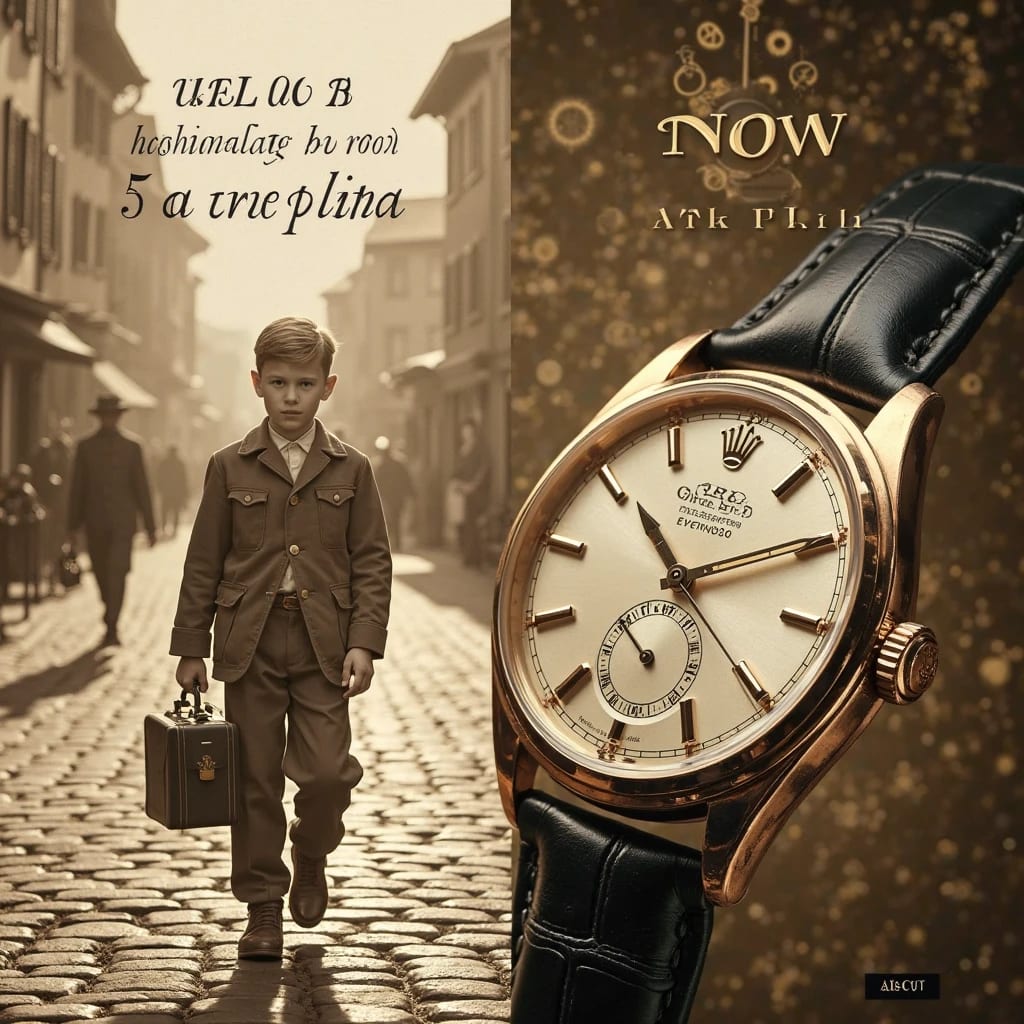
The Remarkable Journey of Hans Wilsdorf from Orphaned Child to Watchmaking Legend
In the heart of Bavaria, Germany, in a small town called Kulmbach, a boy was born in 1881 who would go on to redefine timekeeping forever. His name was Hans Wilsdorf—a name the world now associates with elegance, precision, and success. But few know that long before Rolex became a symbol of luxury, its founder was a boy who had lost everything.
A Life Rewritten by Loss
Hans Wilsdorf’s childhood was marked by tragedy. By the age of 12, he was orphaned, left to navigate life without the comfort of family or security. His relatives, unable or unwilling to care for him, placed his inheritance in a trust that he wouldn’t be able to access until adulthood. In a world that didn’t favor the poor or the young, Hans was forced to rely on resilience, curiosity, and intellect.
Rather than fall into despair, Wilsdorf focused on his education. He had a knack for languages and numbers, and soon found himself working for a Swiss company that specialized in watch exports. That job, although modest, would become the turning point in his life. It introduced him to the world of timekeeping—a world that was about to change forever.
The Vision of the Wristwatch
In the early 1900s, wristwatches were not taken seriously. They were considered fashion accessories for women, while men proudly carried pocket watches. Most wristwatches were delicate, imprecise, and not designed for durability.
But Hans Wilsdorf saw potential where others didn’t. He believed that the wristwatch could become more than just an accessory—it could be an instrument of precision, style, and identity. All it needed was someone bold enough to make it reliable, accurate, and desirable.
In 1905, at just 24 years old, Wilsdorf moved to London and co-founded a company with his brother-in-law called Wilsdorf & Davis. With limited funds but limitless vision, they began importing high-quality Swiss watch movements and placing them into elegant British cases. Wilsdorf’s dream was to create a watch brand that would become synonymous with quality and prestige.
But it needed a name—something short, memorable, and universal.
Naming Time: The Birth of Rolex
According to Wilsdorf, the name “Rolex” came to him like a whisper while riding on a horse-drawn carriage through the streets of London. He wanted a name that would look good on a watch dial, sound the same in multiple languages, and be easy to pronounce. "Rolex" fit perfectly. It was registered in 1908.
But building the brand wasn’t easy. In a world that valued pocket watches, selling the idea of a precise and reliable wristwatch was like trying to sell umbrellas in the desert. Skepticism was high, and the financial resources were low.
Still, Wilsdorf doubled down on quality. He worked with Swiss manufacturers to create movements that were smaller yet highly accurate. In 1910, Rolex became the first wristwatch to receive the Swiss Certificate of Chronometric Precision. Just four years later, a Rolex earned a Class A certificate from the Kew Observatory in England—an honor previously reserved only for marine chronometers.
The world began to take notice.
A Legacy Forged in Innovation
Wilsdorf was more than a businessman; he was a marketing genius. In 1926, Rolex introduced the Oyster—the world’s first waterproof wristwatch. To prove its reliability, he arranged for English swimmer Mercedes Gleitze to wear a Rolex Oyster during her swim across the English Channel. The watch emerged unscathed, and the world was stunned.
He continued to innovate. In 1931, Rolex launched the Perpetual rotor, a self-winding mechanism that laid the foundation for the modern automatic watch. The Rolex Oyster Perpetual became a cornerstone of the brand—reliable, beautiful, and cutting-edge.
Under Wilsdorf’s leadership, Rolex watches went to the summit of Mount Everest with Sir Edmund Hillary, into the depths of the ocean with Jacques Cousteau, and around the world on the wrists of pilots, soldiers, explorers, and world leaders.
Giving It All Away
Though Wilsdorf had built a fortune, he never forgot the pain of losing his family and the struggles of his early life. When his beloved wife passed away in 1944, he created the Hans Wilsdorf Foundation, transferring all his shares in Rolex to the trust. The foundation was designed to ensure that the profits of the company would support education, scientific research, and charitable causes for generations to come.
To this day, Rolex is privately owned by that foundation. It doesn’t answer to shareholders. It doesn’t chase quarterly profits. It moves according to a vision set by a boy who had nothing—and created everything.
Time Well Spent
The story of Hans Wilsdorf is not just a tale of entrepreneurship; it is a story of vision, resilience, and heart. He transformed the wristwatch from a novelty into an icon. And he did it not with privilege or connections, but with unshakable belief in his idea and an uncompromising dedication to excellence.
Hans Wilsdorf may not have been born into poverty, but he was shaped by loss. And from that loss, he built something eternal.
Rolex is more than a watch. It is a reminder that time, when used wisely, can build empires.
About the Creator
Keep reading
More stories from Nauman Khan and writers in Motivation and other communities.
How a Poor Village Boy Built the Honda Empire
In the quiet countryside of Japan in 1906, a boy named Soichiro Honda was born into poverty. His father was a blacksmith who also fixed bicycles for the villagers. Their home was small, life was tough, and money was scarce. But inside that boy’s heart was something bigger than his circumstances—a curiosity for machines and a dream he couldn’t shake.
By Nauman Khan10 months ago in Motivation
Influential Women LinkedIn: How the Platform Is Elevating Professional Women Worldwide
In today’s digital-first professional world, LinkedIn has become one of the most powerful platforms for thought leadership and professional networking. Among the communities gaining strong momentum on the platform is Influential Women LinkedIn, a growing space where executives, founders, entrepreneurs, and industry experts share leadership insights and professional experiences.
By influentialwomenmagazinea day ago in Motivation




Comments (1)
You painted a great picture of Hans Wilsdorf's journey. It's amazing how he turned his tough start into a path to watchmaking legend. I wonder what made him so certain the wristwatch could be more than a women's accessory back then. And how did they manage to make those early wristwatches reliable with limited funds? Fascinating story!