
How a Poor Village Boy Built the Honda Empire
This is the inspiring story of Soichiro Honda, a poor Japanese boy who turned failure into a world-changing legacy.
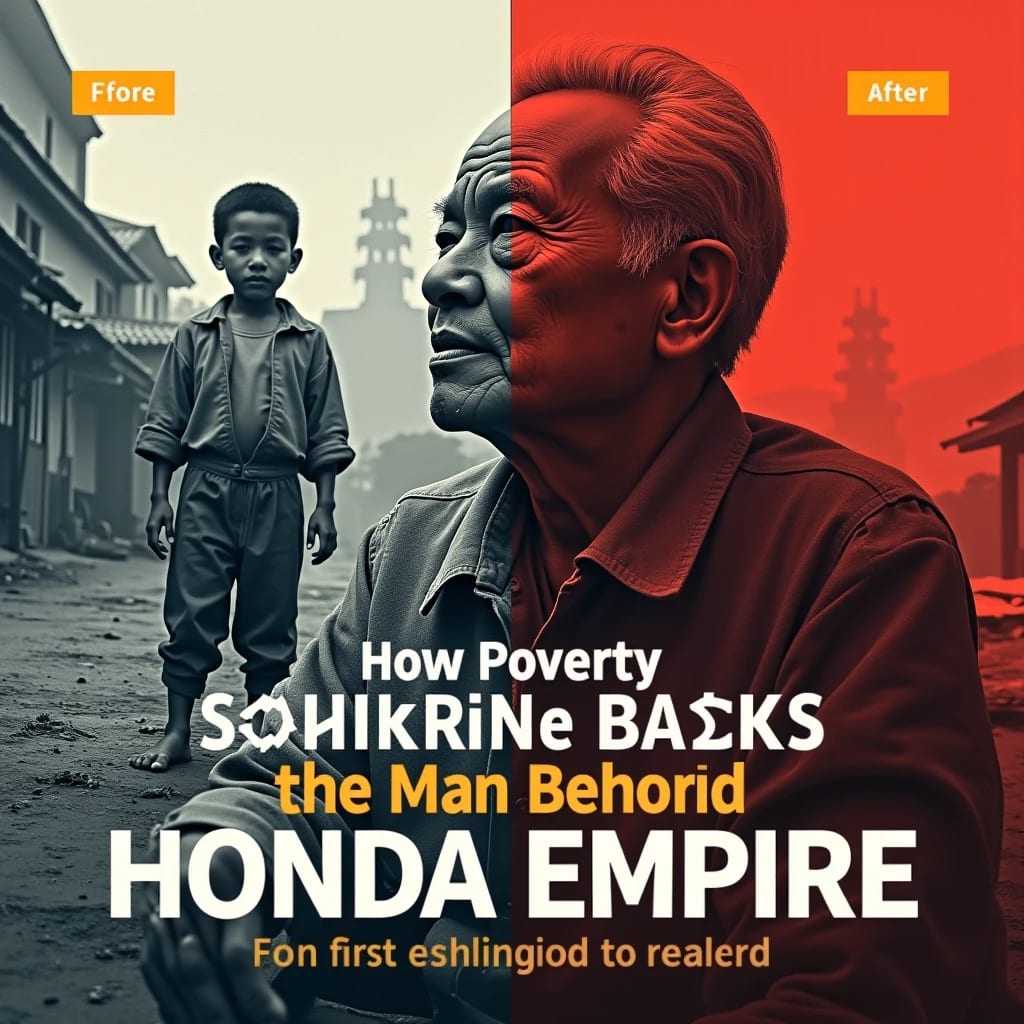
In the quiet countryside of Japan in 1906, a boy named Soichiro Honda was born into poverty. His father was a blacksmith who also fixed bicycles for the villagers. Their home was small, life was tough, and money was scarce. But inside that boy’s heart was something bigger than his circumstances—a curiosity for machines and a dream he couldn’t shake.
As a child, Soichiro was captivated by anything mechanical. When a car passed through his village for the first time, he ran behind it, barefoot, until it disappeared over the hills. That moment sparked something in him. While other children played games, Soichiro tinkered with scraps of metal, bicycle parts, and anything he could get his hands on.
School wasn’t his strength. He often failed exams and was more interested in gears than grades. But he had a brilliant mind for mechanics and a relentless drive to learn through doing.
At just 15 years old, with no money and no formal training, he left home and moved to Tokyo. There, he landed an apprenticeship at an auto repair shop called Art Shokai. The pay was poor, and he worked long hours. He cleaned floors, fetched tools, and slept near the workshop. But Soichiro never complained. Instead, he soaked up knowledge like a sponge, watching, experimenting, and slowly mastering the craft.
Years passed. Soichiro began building race cars for Art Shokai. His passion and skill began to shine. But he wanted more. He didn’t just want to repair cars—he wanted to create something of his own.
In 1937, he started his first company: Tokai Seiki, which produced piston rings for engines. With big dreams, he pitched his product to Toyota. But reality hit hard—they rejected his piston rings. The quality was poor.
Many would have quit. But Soichiro didn’t see rejection as failure—he saw it as feedback. He enrolled in engineering school, even though he didn’t finish high school. He studied metallurgy, improved his product, and returned to Toyota—this time with piston rings that met their standards. Toyota placed an order. His business began to grow.
Then came World War II.
His factory was bombed twice. What remained was later destroyed in an earthquake. Soichiro had lost almost everything. Japan was in ruins, and the future looked grim.
But again, he refused to give up.
After the war, Japan was desperate for affordable transportation. Roads were damaged, fuel was expensive, and people needed a way to get around.
Soichiro had an idea: strap a small engine onto a bicycle.
With the last of his savings, he built a prototype. It was simple, cheap, and worked beautifully. In 1948, he officially founded the Honda Motor Company.
At first, it was a small operation. But Soichiro had big ideas. He poured his energy into innovation. He didn’t just want to make motorcycles—he wanted to make them better than anyone else.
And he did.
His breakthrough came with the Honda Super Cub—a lightweight, fuel-efficient motorcycle that could be ridden by anyone. It was reliable, affordable, and easy to use. The slogan was simple:
“You meet the nicest people on a Honda.”
This changed everything. People who never considered riding a motorcycle started buying Hondas. Sales skyrocketed. Soon, Honda became the biggest motorcycle manufacturer in the world.
But Soichiro wasn’t done.
He turned his attention to cars. At the time, the Japanese car industry was small, and many doubted his decision. But he believed in building compact, efficient cars that were fun to drive and economical.
In the 1970s, during the oil crisis, Honda introduced the Civic, a small car with excellent fuel efficiency. While American car companies struggled, Honda thrived.
Soichiro even took the bold step of entering the U.S. market. Most thought a Japanese company couldn’t compete in America. He proved them wrong.
Honda became the first Japanese car manufacturer to build a factory in the United States.
His philosophy was simple but powerful:
Embrace failure.
Trust your people.
Never stop improving.
Soichiro Honda once said:
“Success is 99% failure.”
And he lived those words. Every rejection, every mistake, every disaster only made him stronger.
By the time he retired in 1973, Honda was a global brand—a symbol of quality, innovation, and determination. Today, the Honda name is found on motorcycles, cars, robots, jet engines, even lawnmowers.
But it all started with a poor boy from a village, who had a dream, a wrench, and the will to never give up.
So the next time you see a Honda on the road, remember—it’s more than a vehicle.
It’s the result of grit, failure, resilience, and one man’s unshakable belief that no dream is too big… no matter how small you start.
About the Creator
Keep reading
More stories from Nauman Khan and writers in Motivation and other communities.
When Silence Becomes Power: The Psychology of Staying Calm in Toxic Environments
Sometimes the most dangerous battles in life are the ones no one else can see. They don’t happen on stages, in headlines, or in dramatic confrontations. They happen quietly—inside conversations, environments, and subtle interactions where people test boundaries, measure reactions, and observe how much pressure a mind can carry before it breaks.
By Lyon Gaber6 days ago in Motivation
Why Didn't Anyone Tell Us
Men, move along. This is not for you. This is for the women. I was forty-five when I began menopause. It is pretty young for that to be going on in a woman’s life, but I had undiagnosed PCOS, my entire life. Thank you to all the gynecologists I had seen my entire life. That in itself should encourage women to keep seeking second opinions, especially when you are not getting correct answers or any at all.
By Alexandra Grant2 days ago in Humans


Comments (1)
best