
Finally Uncovered Are Benjamin Franklin's Anti-Counterfeiting Techniques' Secrets
It's not surprising that counterfeiters were baffled at the time given how long it took scientists—more than 200 years.

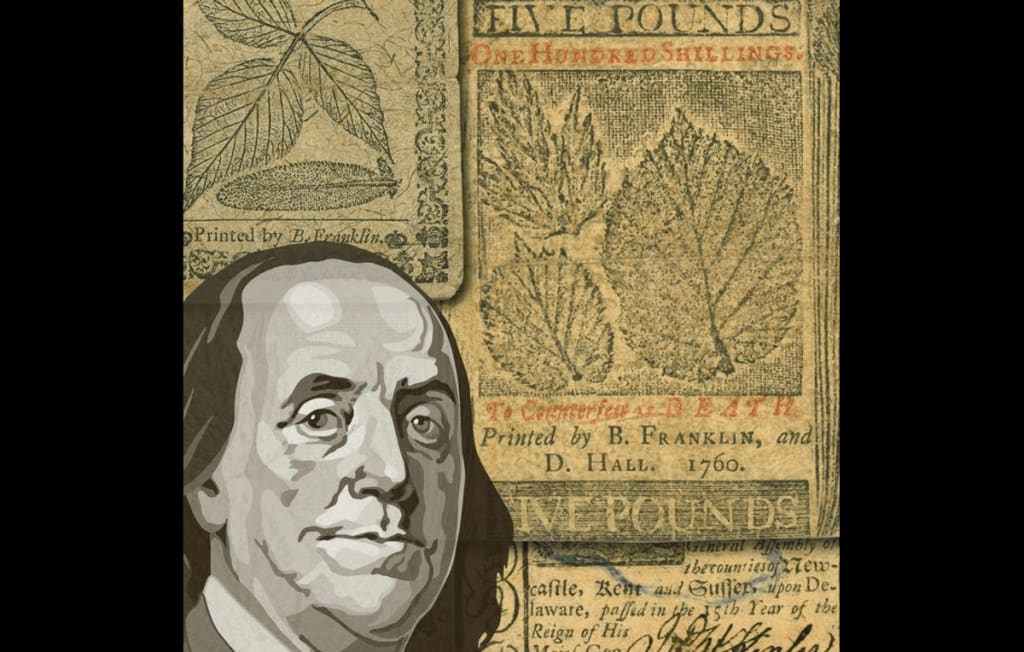
By creating paper money that was difficult to counterfeit, Benjamin Franklin assisted America in emancipating itself from the British financial system. Some of his methods have been forgotten through time, and they have just recently been recreated using the analytical tools of the twenty-first century.
Isaac Newton's career was devoted to solving issues with the British Royal Mint in the second half, following his explanations of gravity and the rainbow. The effort aided in positioning the nation for world dominance.
Franklin realised a century later that the rebels needed their own money since they couldn't win a war while relying on their foe's financial system.
Franklin maintained that paper money was the best option because the colonies lacked sources of precious metals. However, Franklin argued that for paper money to remain valuable, it had to be nearly impossible to forge.
Franklin's face is on $100 bills, thus some of his methods have been employed ever since. However, some of them were lost to time before being found in a recently published paper.
"Franklin used natural graphite pigments to print money and developed durable money paper' with coloured fibres and translucent muscovite fillers, along with his own unique designs of 'nature-printed' patterns and paper watermarks," the authors wrote.
The University of Notre Dame's Dr Khachatur Manukyan and co-authors investigated over 600 banknotes, some of which were printed on Franklin's presses and others on those of his contemporaries or counterfeiters.
Many of Franklin's techniques are well known. They uncovered the secrets of the paper and ink, as well as the crystal fillers Franklin placed on his notes to give them a particular feel and increase their endurance, using X-ray diffraction and fluorescence, electron energy loss spectroscopy, Raman spectroscopy, and infrared spectroscopy.
When tilted at the proper angle, filler flakes that adhered to the surface of Franklin's notes also reflected light. These were lacking from the fakes that were evaluated, and they might have been a useful indicator of authenticity.
The research shows that Prussian blue (Fe4[Fe(CN)6]3) was utilised in the blue ink and that Franklin's red colourant contained both mercury and sulphur. But the spectroscopy shows there was a valid reason why he used black the most.
Franklin is known to have purchased a studio expressly for burning vegetable oils to generate black colouring, but he also used natural graphite from metamorphic rocks, which is likely something his adversaries were unaware of.
The "bone black" found in counterfeit money is mostly made from the pyrolysis of bones. People reviewing the notes
They might have seen the difference even if they wouldn't have recognised why the inks appeared different. Franklin also made a distinction from printing with blue ink by weaving blue threads that were dyed with indigo into the paper.
Zenas Marshall Crane has been given credit for this strategy, however, the paper discovered the common thread in Franklin's article from 1739—more than a century before.
Long before the American Revolution, Franklin started printing. At the age of just 22, he founded his first printing house in 1728 to remedy the shortage of gold and silver coinage.
Franklin produced almost 2.5 million notes for the colonies close to Pennsylvania, as well as providing printers elsewhere with tools and printing methods. He engaged in a cat-and-mouse game with forgers throughout this time.
One of Franklin's earliest methods was not original; he adapted Leonardo da Vinci's concept of exploiting the impression of a leaf's complicated vein structure.
Franklin, however, was able to do something that his forerunners had not: he transferred the structure into the printing process.
However, since counterfeiters were cunning and driven, no single tactic was likely to stop them. Franklin used so many features in his defence-in-depth strategy that it was nearly difficult to replicate his notes.
Historians have known about some of these since his time, such as the intentional misspellings that varied with the denominations, but others remained a secret.
Franklin prepared for the revolution and coordinated the creation of currency based on the value of the Spanish American currency with John Adams.
They were now up against more than just common criminals trying to forge their currency; instead, they were up against the complete might of the most powerful government in the world, which had flooded the colonies with notes that looked a lot like Benjamin Franklin's.
The British's inability to make duplicates that were identical to the originals was a major factor in the success of the revolution.
Despite the British attempt failing, the concept of weakening a country's economy by forging its currency was utilised in a number of future wars, sometimes with greater success because the people who printed such currencies lacked Benjamin Franklin's creativity.
About the Creator
Keep reading
More stories from Francis Dami and writers in Motivation and other communities.
Our knowledge of cancer and mental illness may be altered by a new atlas of foetal brain cell development.
Thousands of foetal brain starting cells have been linked by scientists to the precise neurones and support cells that these cells subsequently generated. As a result, brain development becomes a timed sequence that determines when tumor-like growth programs and risk-linked genes can become active.
By Francis Dami3 days ago in Motivation
The Seed For Success & Failure Is Born In Everyone
The seeds of failure and success are born in all of us, and both are watered by what we were taught as children. As we grow and mature, our actions, choices, decisions, and intentions provide sustenance, along with fate, destiny, and what we want. Then one will take over! Annelise Lords
By Annelise Lords 5 days ago in Motivation



Comments
There are no comments for this story
Be the first to respond and start the conversation.