
Endless Silence, Endless Hope
In a forgotten village, one boy’s quiet dream whispers the truth the world forgot

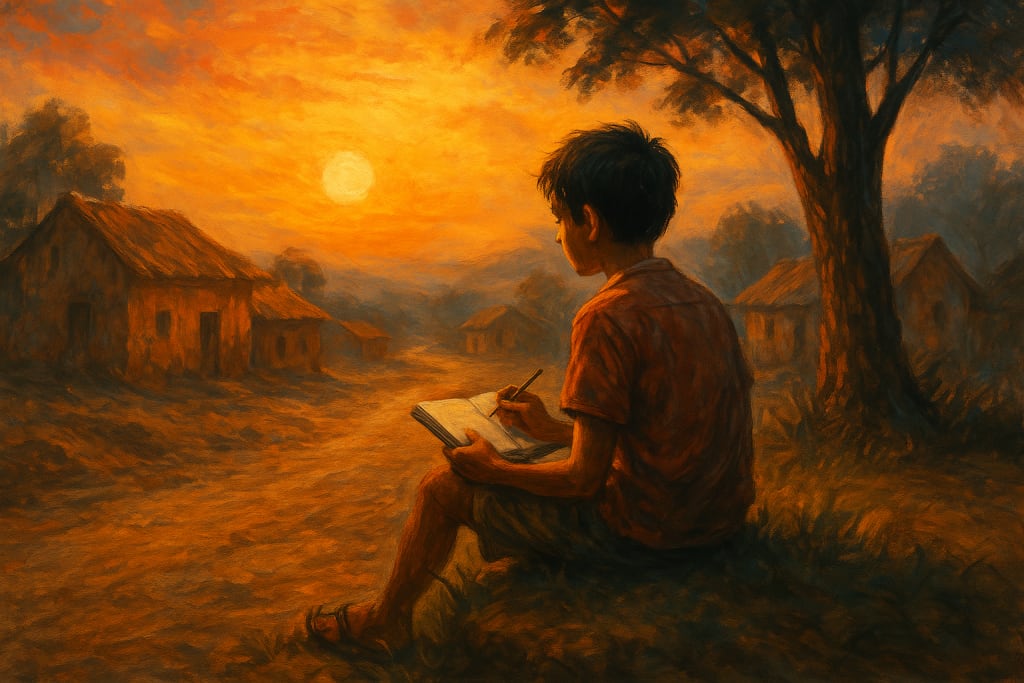
In a dusty, forgotten village where the sun no longer kissed the rooftops with joy, and the winds whispered memories of lost time there lived a boy named Faaiz. The village had no claim to fame. It was not on maps. No travelers stopped by. It was a place where stories died before they were ever told.
But Faaiz? He was different.
He had no riches, no smartphones, and no fancy sneakers just a pair of worn-out slippers, a notebook full of dreams, and a heart that refused to give up.
Faaiz would wake up every morning to the sound of broken silence. No car horns. No buzzing notifications. Only the occasional rooster crowing from a nearby hut, the soft moan of the wind brushing against the clay walls, and the creaking of his old wooden door.
To the outside world, this village meant nothing. Forgotten, perhaps even by God. But to Faaiz, every corner had meaning. He noticed everything: the way sunlight painted golden stripes across the muddy floor, the way leaves trembled like they too had secrets, and the earthy perfume that rose from the ground after a lazy drizzle.
He had one purpose:
To find the reason behind sadness, and turn it into a story someone could smile about.
Every evening, Faaiz would climb a small hill that overlooked the edge of his world. He would carry only two things: a pencil so short it needed to be held like a secret, and a notebook whose pages were crinkled with hope. There, with nothing but the sky above and silence all around, he wrote.
He didn’t write in the polished language of textbooks or bestselling novels. He wrote in the voice of someone who had known pain, who had stared hunger in the eyes, and still chose to dream. His words were raw, sometimes messy, but always honest.
One day, a traveler came through the village. A rare thing.
He looked exhausted. Confused. As if he had forgotten who he was.
Faaiz found him sitting by the well and offered him water and a place to rest an old wooden stool beneath a neem tree. The traveler looked at the boy and asked,
Why are you always smiling?
Faaiz chuckled and said,
Because if I don’t smile, this village might forget what a smile looks like.
The traveler looked at his worn-out clothes, his dust-covered feet, and the frayed notebook in his hand.
But what do you even have? he asked.
Faaiz looked up at the wide sky and replied,
I have peace. I have meaning. I have the courage to dream when the world sleeps on me. Isn’t that enough?
The traveler didn’t have a reply. But before leaving, he quietly slipped one of Faaiz’s handwritten pages into his bag.
Weeks passed. Then like a miracle one of Faaiz’s stories was printed in a national newspaper. Not edited. Not rewritten. Just as it was: raw, vulnerable, and pure. People across cities read it. And for the first time in a long while, they felt something real.
Something human.
Suddenly, the forgotten village became a place of curiosity not for tourism or Instagram photos but for soul-searching. People came looking not for hotels, but for the hill, the boy, the silence. Faaiz never changed. He still wore the same slippers, used the same short pencil, and wrote in the same notebook.
He never called himself a writer.
But his stories called people back to themselves.
And at the end of every story, Faaiz would write:
I want to bring a smile to your face and tell you the truth of life, because somewhere someone needs it more than applause.
So if you're reading this now sitting in a big city, or scrolling on your screen far from that dusty village know this:
It’s not your place, or possessions, or popularity that define you.
It’s the truth you carry quietly in your heart.
It’s the courage to share it even when no one is listening.
And if this story stirred even a drop of emotion sadness, hope, or a quiet smile then share it.
Not for likes. Not for comments.
But because someone else, somewhere, might be waiting for the same light you just felt
About the Creator
Keep reading
More stories from Ashraf and writers in Motivation and other communities.
When the Sky Fell Down
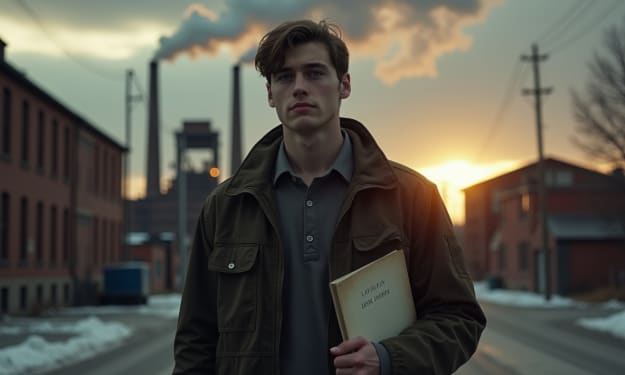
Liam never believed in miracles. Raised in a small, rust-belt town in Ohio, where factory smoke painted the skies gray and dreams were something you outgrew, not something you followed. He was the youngest of four, the quiet one, with a father who worked long hours at the steel plant and a mother who aged through worry, not years. Life for them wasn’t a tragedy it was routine survival. He was 17 when the sky collapsed. It was an ordinary Tuesday afternoon. His father hadn’t come home on time, but that wasn’t unusual. What was unusual, however, was the call. Just one ring sharp, sudden and everything changed. The hospital. A heart attack. Gone before goodbye. There were no final words, no slow fading. Just a hole where the man had been. Grief didn’t hit Liam like a storm it dropped like a silent bomb. His mother turned into a ghost overnight, fingers trembling over unpaid bills, her eyes vacant even when open. His siblings either shut down or lashed out, each trying to make sense of the loss in their own broken ways. Liam? He disappeared in plain sight. He dropped out of high school, buried his dreams, and took his father’s place at the steel plant. Every day, he walked past the security booth where his dad used to crack jokes. Now, the guards just nodded, awkward and quiet. They didn’t know what to say to a kid wearing grief like a second skin. The factory roared with machinery, but Liam’s thoughts were louder relentless questions, dead ends, and an anger that had nowhere to go. Home offered no relief. The dinner table had an empty chair and the walls seemed to breathe sadness. Then one evening, after a double shift, Liam came home to find his mom crying over a broken heater. No drama, no panic just quiet tears. That was worse than screaming. It was the kind of crying that says: I’m exhausted from pretending we’re fine. That night, something changed. Not a breakdown a decision. He grabbed a beat-up notebook and scribbled: What can I learn for free? Coding tutorials. Online classes. Reddit threads. Anything. Mornings were for steel and smoke; nights became sacred his time to fight back. He taught himself web design from library Wi-Fi and borrowed books. His hands were calloused from labor, but his mind was burning with purpose. Failure followed. His first interview? A disaster. His résumé? Mocked. His speech? Unpolished. But he didn’t stop. He couldn’t.
By Ashraf 9 months ago in Motivation
Sonali Chandrabhan Gadakh: Building a Public Presence Through Communication and Professional Insight
Sonali Chandrabhan Gadakh is an emerging Indian public figure recognized for her engagement in professional and public spheres. Her career reflects a focus on communication, business awareness, and audience engagement, highlighting the importance of strategic interaction and professional presence in today’s evolving landscape.
By Thetribunemedia5 days ago in Motivation


Comments
There are no comments for this story
Be the first to respond and start the conversation.