
Developing Emotional Balance: Epictetus's Wise Advice
Revealing the wisdom


Modern society frequently equates wealth with acquiring material goods, social position, and financial clout. We are frequently made to believe that acquiring more and more expensive possessions and having an unceasing quest for monetary success will bring us happiness and contentment. However, stoicism challenges us to consider this thinking and find a richer, longer-lasting prosperity. According to the Stoics, true wealth lies not in the quantity of our possessions but rather in the worth of our minds and our capacity to find contentment and tranquillity even in the midst of austerity. They believed having too many material possessions caused more stress and anxiety than benefits. Instead, they suggested an alternative strategy for locating genuine wealth. Detachment from the world and awareness of the essentials: Stoicism provides us with a transforming viewpoint in our consumerist, have-all society by demonstrating that true riches are found not in the quantity of stuff we amass but in the capacity to value that which is necessary for our survival. Material detachment encourages us to break free from the confines of unrestrained consumerism and recognise that material possessions are only a minor part of our quest for happiness. We discover an inner freedom that enables us to live more truly and lightly by separating our sense of self and wellness from what we own. The substance of our being is found in developing virtues, fostering meaningful connections, and taking pleasure in the little things. We rescue ourselves from needless misery brought on by the persistent chase of worldly objects by separating ourselves from excessive consumerism and appreciating the necessities. Practising acceptance and living in the present: It's simple to become caught in anxieties about tomorrow or dwell on the past in the chaos of today's society. However, stoicism encourages us to practise acceptance and value the bounty of the present moment, enabling us to live calmly and thankfully for what we have. It takes ongoing mental practice to be in the now, an art. The only time we truly have control over is right now; stoicism serves as a reminder that while the past is gone and the future is still unclear. We are liberated from the concerns brought on by incidents in the past that cannot be changed and anxiety about the future when we learn to be fully present, conscious of our actions as well as sensations in the now. We are set free by letting go of our needless pain produced by reality. We learn to face life's challenges with equanimity rather than obsessing over unfulfilled expectations or becoming frustrated with what we can't alter. Accepting does not mean giving in passively; rather, it means responding to what is put before us with intelligence and calm. Virtue Cultivation and Personal Development: The path to virtue cultivation involves self-discipline and ongoing practice. We grow wiser, more compassionate, as well as more genuine when we work to improve these traits in our life. Self-awareness and introspection are also important components of personal progress. Being conscious of our shortcomings and restrictions will help us work to overcome them. This doesn't mean aiming for absolute perfection but improving ourselves and becoming closer to virtue. Being thankful and content with what we have: Recognizing and appreciating the positive aspects of our existence is known as gratitude. It is a practice of appreciating and acknowledging gifts of all sizes. By practising thankfulness, we can recognise the benefits even in the most trying circumstances. This routine teaches us to concentrate on our assets rather than our deficiencies. Additionally, appreciation encourages us to adopt a humble attitude by making us aware that we cannot control everything and that other people and our surroundings contribute to our well-being. Because of this understanding, we can empathise with others and respect the relationships in our daily lives. We can change our viewpoint and discover actual plenty by practising everyday thankfulness and happiness. Fairness under the circumstances: In a world that is always changing, we frequently feel as though events outside of our control affect us. Stoicism serves as a reminder that while we do not influence the outside world, we have some power over how we respond to it. Clarity may be maintained even in a state of chaos thanks to impartiality's ability to help us distinguish between our feelings and responses to outside events. We can avoid emotional extremes when we are impartial. We may grow impulsive and make fast decisions that are frequently destructive when we allow our passions to consume us. We can analyse the problem more clearly and make more logical and intelligent judgements if we preserve objectivity. Simply said, stoicism encourages us to discover the true richness in simplicity, inner knowledge, and the capacity to recognise the intangible blessings of life. Wealth isn't just about having a lot of material possessions; it's also about learning to be content at the moment and developing a lifestyle with few needs. Inspiring us to seek a deeper richness that transcends consumerism and enriches our lives in significant and lasting ways, stoicism does this.
About the Creator
Ian Sankan
Writer and storyteller passionate about health and wellness, personal development, and pop culture. Exploring topics that inspire and educate. Let’s connect and share ideas!
Keep reading
More stories from Ian Sankan and writers in Motivation and other communities.
The Influence of Doubt
I guess here is where I'm going to die, was the last thought I can recall. I couldn't breathe, thus. And I was unable to communicate my lack of breath to anyone. My anesthesiologist also appeared to be in complete panic. I handled the dying thing rather well. Unlikely as that may sound. I was fine with it because I had been in labour for two days. And I wasn't doing well, to be honest. All attempts at pain control proved unsuccessful because the baby wasn't moving. Epidurals, top-offs, and other experimental methods were unsuccessful. I was finished. And when I say it, it appears like I'm simply being dramatic. However, my kidneys started to shut down, meaning my body was finished. After all that pain management, I should have felt numb from the waist down, but instead, I was only numb from my eyeballs down. When the medical personnel saw this, they hurried me off for a state of emergency C-section. That's why I was unable to breathe. I could not speak, which is perhaps why the anesthesiologists appear alarmed. Since I'm here, the procedure went well. Also fine is my child. My nurse walked over and held my hand after that, and said, "Yo, that was intense." That's the next thing I recall. You were incredible. Never repeat that action. It's okay if you wish to have more children. When you learn you're pregnant, arrange a C-section. She is entirely correct. I'll never repeat that mistake. That was an awful time because I reached my body's physical capacity that day. the exact moment at which it stopped speaking. There are no more questions at this time. And typically, when you consider reaching a limit, you imagine you will approach it, touch it, and declare, "Oh, okay, there's the limit." I will end here. That was not what occurred. No. When you reach a limit, it's as though a door with sliding glass is there, but you are unaware it is closed. As you prepare to step, the limit suddenly appears on your face. It causes agony. It isn't very comfortable. We don't want to repeat the mistake. Therefore, we establish boundaries for ourselves to avoid that kind of experience. And limits are replaced by borders. These are sometimes called limiting thoughts because they are our perceptions of the limit rather than actual physical boundaries. Additionally, restricting beliefs isn't always harmful. Limits themselves are problematic because they are context-sensitive, meaning they can alter if your circumstances or environment do. And you lose out on the possibility of the limit increases, but you don't. Additionally, it isn't an issue until it becomes one. Why change what is working for you if it is? However, if a change occurs frequently enough, eventually, something has to give, and you must relocate. And I had plenty of issues six years ago. I had debts totalling tens of thousands of dollars. Since you know, if we're going to tick the boxes, let's tick them all; I was clinically obese and sad. My employer despised me while I had been working in this position that was robbing me of my soul, which is truly amazing considering how much fun I am to be around. I'm not sure what her issue was, then. And I thought that everything in the cosmos was working against me. It's like no matter what I tried to do to improve it, nothing worked. And everyone else was to blame. Which, when it's not your fault, is mildly consoling. But it doesn't help since you expect someone to arrive to fix it when it's someone else's problem, but nobody shows up. I wasn't quite finished, though. I was given the chance. The only reservations I had were that I knew it couldn't possibly be this bad forever, and there had to be a means for it to get better. Additionally, we typically use a very negative framework when discussing doubt. As if harbouring uncertainty is some horrible habit we should never have. No, scepticism is essential. The first step towards transformation is doubt. In doubt, everything depends. Consider any significant contribution to society. It all began with uncertainty when someone asserted, "This is the limit. The most effective we can manage is this. Another individual responded, "Nah, I don't think so. I believe we can improve. They tried after that. And if they succeed, we exclaim, "Oh my God, they must be visionary." Yes, sort of. They had reservations. They had a thought. However, they were unaware that it would truly work because we could not determine the merit of our ideas in advance. Knowing doesn't come till you know. That is the influence of doubt. Since if you have assurance, it's finished. Therefore, it's uncertain. There is no disputing the fact that it is what it is. But there is a chance if you are uncertain. And while the opportunity is lovely, it rarely motivates us to act. However, this is what transpired to prompt my transfer. Back-to-back incidents occurred. My supervisor told me bluntly at a performance review that I wouldn't ever make $50,000 again. Not worth it, was I? I wasn't worthy of it. It couldn't possibly happen. Please don't ask. That bothered me. I then went on a second date that was awful. This guy came on our second date and told me that he made double as much cash as me and didn't have a college degree because I had told him where I worked when we went on our first date. I am a skilled missionary. I would earn more money than that jerk and give my employer the proverbial middle finger. Yeah. I then started experimenting. Although I certainly wasn't eligible for many of the jobs I applied for, I obtained one of them since I needed to increase my income because I was now angry. I received a $67,000 job offer to work on a strategy for a large corporation. I had never before practised strategy. I wasn't sure if I could truly pull it off. 67 is higher than 50, though. I then responded, "Yes, thank you. That I will accept. It also turns out that I'm very skilled at strategy. It was rather enjoyable, and since it went so well, it gave me a concept of improving other aspects of my life that weren't working out. Thus, everything begins with uncertainty before changing to curiosity. "Can I do it?" says doubt. "How can I do it?" asks curiosity. After that, you find some solutions and assess them. You like to consider risks and rewards. We frequently find ourselves in this situation because the risk seems too great. We also need to consider the payoff. That's how Tony Robbins put it, in my opinion. He claimed that people will go to greater lengths to avoid discomfort than they ever will to enjoy it. Don't, therefore, emulate them. Be superior to those individuals. The next step is to postpone your disbelief for sufficient time to see a result if the reward outweighs the danger and there's a good chance it won't bring everything down. It could occasionally not be the outcome you're looking for, but a result is still a result. Data, which is not personal, is the outcome. Although it might offend you, it is still impersonal, and you utilise the information to decide what to do next. I, therefore, persisted in doing this. I continued to attempt new things, and occasionally I failed. And I appreciate it when people tell me I can be anything I want. Yes, you certainly can. Put, you can be bad at it. Anything that you desire to do is possible. Only your actions are under your control. You are never given any power over the result. Let's pretend for a moment that I wanted to play professional basketball. I'm just as proficient at basketball as you believe I am so that you know. It makes no difference regardless of how long I try or how hard I fight at it. I will never be able to play in the NBA or WNBA. I'm sorry, but I can't do that. Consequently, we can succeed at the things that we can succeed at. It's not everything, though. Despite my best efforts, I hate to admit it, but I'm not good at anything. Nobody is. Each of us has a unique set of skills. Each of us has unique aptitudes. So when I tested it, and it worked, I leaned into it. And once I attempted it and it didn't work, I did less of the things. And this is what transpired. Oh, that sounds pretty scientific, just for reference. Not at all. Jenga was played. Okay? Science wasn't Jenga; Jenga was science. Considering what I saw, I wondered if I could accomplish that. Let's handle it. All right, it seems. I tried after that, correct? So, here's what occurred 18 months later. I settled every bill. That day was successful. I moved from the obese group to one in which I felt more at ease. Have a good day as well. got control of my depression. That day was successful. In addition to working in a job I enjoyed and excelled at, I learned how to maintain healthy relationships. As a result, I received two promotions and increased my income in just 18 months at the poor job. Now that I've linked them all together in this manner, it sounds rather sensual. They are merely signs of a little courage, as it takes strength to have doubts. To be intrigued requires courage. Suspending disbelief and dealing with the consequences both require guts. I won't lie; it wasn't those successes that I learnt from this entire process; rather, they represented the good days. When they occurred, they were incredibly satisfying. But those were wonderful, joyous occasions. The greater thing was that I experienced a sense of fulfilment due to my ability to expand and evolve. And it's a development that genuinely makes us happy. This is extremely irritating because growth is awful. Extremely unpleasant. But it's essential. Growth pushed my boundaries, and doubt gave me the courage to push them. So, this is the idea. What if your restrictions weren't set in stone? Suppose they were mobile. What if circumstances were different? It will now require some effort. Go now and take action. However, consider tomorrow's potential rather than today's constraints whenever you take action.
By Ian Sankan3 years ago in Motivation
How One Hour a Night Turned Her Side Hustle Into Financial Freedom
At 6:03 p.m. every weekday, the office lights flicked off behind her. At 6:17 p.m., Maya unlocked her apartment door. At 6:45 p.m., after reheating leftovers and changing into sweatpants, she opened her laptop again.
By MIGrowth3 days ago in Motivation
Medical Voices vs Disabled Voices
I was diagnosed in a hospital room. The language was clinical. Precise. Measured. Words like lesions, inflammation, progression, relapse. The explanation focused on my nervous system, on my brain and spinal cord, on what could be seen on a scan.
By Millie Hardy-Sims7 days ago in Motivation
A Historic Declaration
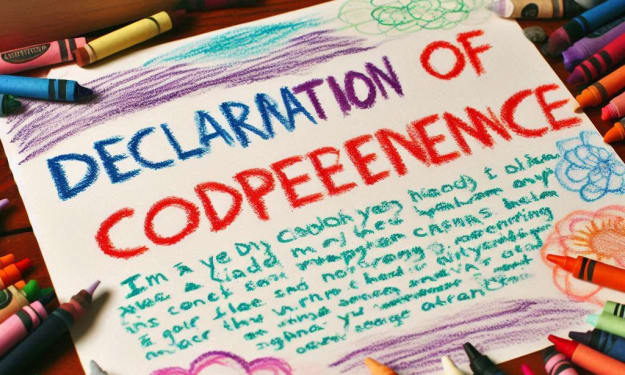
We the People of the Husbands of the United States of America, in Order to form a more perfect Union, and I mean you...with me...establish Justice, insure domestic Tranquility, provide for the common defence, promote the general Welfare, and secure the Blessings of Liberty to ourselves, after Puberty, do ordain and establish this Declaration of Co-Dependence.
By Gerard DiLeo6 days ago in Humans


Comments
There are no comments for this story
Be the first to respond and start the conversation.