
Creating Your Mental Health Progress Report
Use these tools and tips to help evaluate your mental well-being; and to become the best version of YOU


Our lives are lived fluctuating between periods of progress, regress, and maintenance. There are many variables that arise from current circumstances and situations that determine how much time is spent in each phase. However, we are also able to switch between these phases consciously if we desire to change or improve. Often times we fall into a period of regression that can undermine the work we've done. I found myself regressing more often than I thought was healthy for me, and so I decided that creating a way to periodically check-in on myself would help prevent that.
When I started designing my own check-in routine, I was at a loss for any good ideas. I wanted something that would only take a few minutes to write down; it needed to be easily digestible as well. If it was too wordy I wouldn't be as receptive to reading it again in the future. Each check-in would be required to serve some kind of purpose, and that purpose would have to be static if it were to mean anything over a long period of time. Aha! That was when I decided what that central purpose would be, and that made the rest much easier to forge.
As I've mentioned, the purpose of a "check-in" is to ensure forward progress and to keep regression of negative emotions and mindsets from harming one's self. But I knew that couldn't be the only purpose. It needed to be specific to me, it needed to be personal, or else I wouldn't take it seriously. It had to serve me in achieving some kind of goal.
I proceeded to draft this rough sketch of the template:
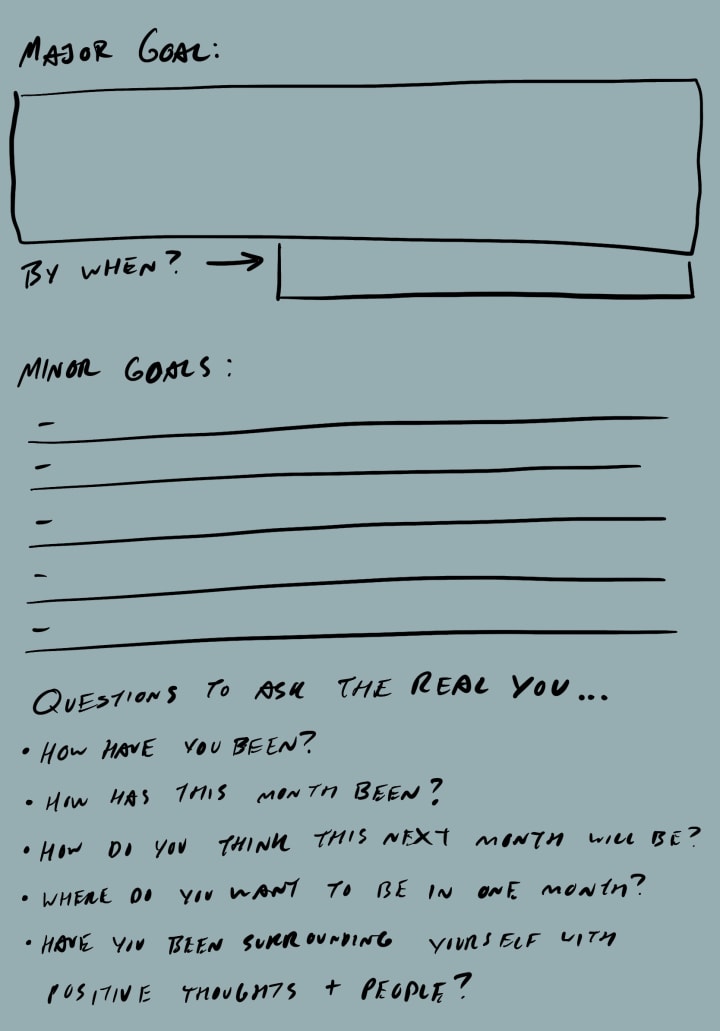
It was a start, but I felt it was too much for me to keep up with. I knew that after a few months of using this the questions would become stale and less effective than I wanted them to be. I decided to simplify it, and what I came up with felt much more promising.
I knew needed to keep one major goal and at least two minor goals in my headlights at all times. I've found that a big "To Do" list, while comprehensive, mostly results in a sense of overwhelming pressure that completely disables my ability to be productive. In addition to that, I've always been a very dynamic thinker and my goals and efforts are subject to change more often than the average person.
After listing those three goals I wanted to have three open-ended prompts or questions I'd ask myself. These recurring prompts would allow me to create a narrative of my recent past, my present, and the near future. They had to provoke some introspection that would force me to take a deeper look at my environment and recent experiences. The three prompts I developed were as follows:
- List out the positives and negatives of the past month, then create arguments for the validity of each point.
- What positive thoughts or people can you surround yourself with right now that will invoke a period of progress?
- Will this next month be a period of maintenance or progress?
So now, I had a complete template for these check-ins that look like this:

I understand that these prompts won't work for everyone; they're tailored to a way of thinking that I've developed for myself over the past years. The first prompt is an objective one that allows me to see my recent past from two different perspectives. I used to be a very cynical person, but now my default lens is one of positivity, and that dichotomy is the most effective method of reflection for me.
The second prompt is my call to action. It's a simple task, or thought experiment at the very least, that will give me a sense of accomplishment once completed. For me, even a slight sense of "getting shit done" will go a long way to spark my motivation.
The last prompt is as real as I can get with myself about the near future. At this point, I'm giving myself a choice between a time of maintenance and a time of progress. I've found that this helps to empower me and to establish a semi-clear goal of where I want to be in thirty days.
This method worked to hold me accountable of my mental health outside of my therapy sessions. I found it too easy to only do that kind of work one hour per week. Knowing that I would hold myself to this monthly progress report meant that I had to be more mindful each day; if I had to reflect on my mood at the end of the month then I had to be conscious of my moods throughout that month. As I've said before, identifying your emotions and moods and pairing them with everything going on externally is key to making progress toward a healthier heart and mind.
Simply put, every new day, week, month, and year can bring big changes within us and we'll never be able to predict when things will get turned upside-down. Holding ourselves accountable for a healthy state of mind may be the only defense we have against our demons, so creating a habit of checking in and re-centering our thoughts and strengthening our healthy self-care tools can be the most reliable harbinger of peace on every new horizon.
About the Creator
Mac
Welcome to my page, enjoy.
Fun fact: most of the photos on my stories are original photos by me. Comment if you like them; or if you want to know the story behind them!
Keep reading
More stories from Mac and writers in Motivation and other communities.
If I Can't Be Superman
There is an enormous amount of pressure placed on all of us by society, family values, friendships, relationships, and working peers. These “baselines” ravage our personal idea of productivity and worth, and for many of us that is a dangerous thing. If you are prone to intense introspection this could mean feelings of worthlessness or loss of hope in your ability to live a meaningful life. We cannot change the standards set forth by those groups I’ve just mentioned, but even if we could I don’t believe that would be the most effective solution. In my experience this change needs to happen internally; only then can we feel a continuous sense of relief in everything we do.
By Mac4 years ago in Motivation
The Systems We Build Reveal Who We Are
What Our Systems Say About Us Every system we build reflects what we value. Right now, too many of our systems say we are willing to let people collapse before we offer help. But it doesn’t have to be that way. Real change begins with meeting people where they are—not where we wish they were.
By Bernie Martinez4 days ago in Motivation
You Did Nothing Wrong- And You Deserve Love, Not Blame
Did your partner break up with you? Did you lose your job? Or did you get some bad news? Then these words are for you. Before we begin, I open my arms and offer you a big, tender, comforting hug. It’s okay to cry. It’s okay to grieve a loss. Now, let me serve you a warm cup of tea and a generous slice of chocolate cake.
By Jeanne Jess 6 days ago in Motivation




Comments
There are no comments for this story
Be the first to respond and start the conversation.