
Charts and Chances: The Trade That Changed Everything
How a moment of risk, loss, and reflection reshaped my understanding of wealth and purpose

Charts and Chances: The Trade That Changed Everything
BY [ WAQAR ALI ]
How a moment of risk, loss, and reflection reshaped my understanding of wealth and purpose
I used to think trading was all about numbers.
Green candles, red candles, breakouts, reversals—the digital heartbeat of the market. I’d sit glued to my screen, heart pounding with every tick. For someone looking from the outside, it might seem obsessive. For me, it was the promise of freedom. Trading was going to buy me out of the job I hated, the city I was stuck in, and maybe even the version of myself I was tired of being.
But like many who enter the world of trading chasing freedom, I learned that the market doesn’t just test your skills—it tests your soul.
The Beginning
It all started during the pandemic. Trapped in my one-bedroom apartment with nowhere to go and too many hours to spare, I stumbled across a YouTube video titled “How I Made $100,000 Trading Stocks in One Month.”
Thirty minutes later, I had downloaded two trading apps, joined a Discord server full of self-proclaimed “market wizards,” and put $1,000 into an account I barely understood.
I made $120 that first day trading penny stocks.
It was the worst thing that could’ve happened to me.
Addiction Disguised as Ambition
That initial win was like a drug. I started skipping meals to watch pre-market movers. I listened to trading podcasts while brushing my teeth. I no longer traded based on logic—I traded based on excitement.
Within a few months, I turned that $1,000 into $4,200. I felt invincible.
So when someone in my trading group whispered the word “options” and posted a screenshot showing a $2,000 gain in one afternoon, I decided I was done playing small.
I moved everything into options trading.
The Big Trade
The setup looked perfect. Tesla was showing signs of an impending breakout on the daily chart. Earnings were coming up, and the sentiment online was electric.
I bought $4,000 worth of weekly Tesla call options, confident the stock would explode.
The next day, the market opened with a dip. “Normal pullback,” I told myself. But then the dip deepened.
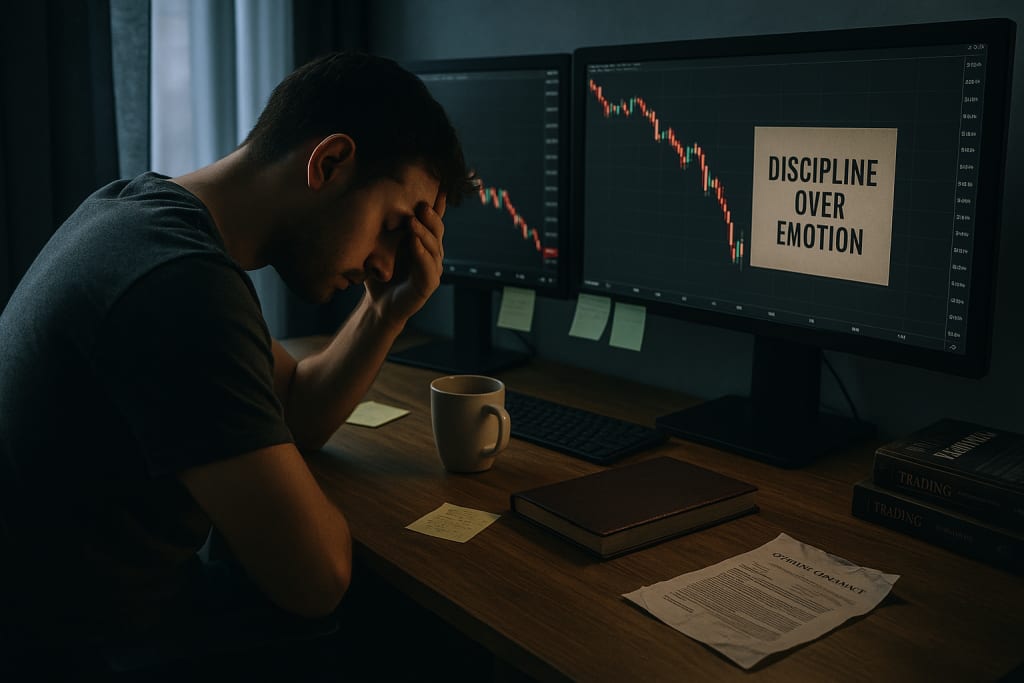
By 10:00 AM, my $4,000 was worth $1,500.
I watched the screen in stunned silence. I didn’t even feel panic. I felt disbelief. I kept waiting for the bounce that never came. That evening, the stock recovered—but my options had already lost most of their value due to time decay.
The next morning, I sold everything for $842.97.
That was the day I cried over a trade.
The Silence After
Losing money hurts. But what really broke me was realizing how emotionally entangled I’d become in a world I didn’t fully understand. I hadn’t just lost money. I’d lost confidence. I’d lost time. I’d even lost some friendships—people who were tired of hearing me talk about “support levels” and “double bottoms” while ignoring real conversations.
I stopped trading after that.
For weeks, I didn’t open a single chart. The screen that once gave me a thrill now felt like a slot machine I should’ve known better than to trust.
Rediscovering the Market, and Myself
But time has a way of softening even the sharpest losses. After a few months, I began studying again—but this time with humility.
I didn’t chase trades. I didn’t join hype-filled Discords. I started reading books. I learned risk management. I practiced on a simulator. I began to understand something fundamental: Trading isn’t about being right. It’s about surviving long enough to get better.
Now I trade again—but I treat it like a business, not a lottery ticket. I only risk 1% of my capital on a trade. I journal every win and every loss. I care more about discipline than dopamine.
I don’t trade to escape my life anymore. I trade to enhance it.
Final Thoughts
Trading taught me more than any job or degree ever could. It taught me that chasing easy money often comes with hard lessons. It taught me that discipline will always outperform emotion. And it taught me that real freedom comes not from a big win—but from sustainable decisions, day after day.
To anyone thinking of starting their trading journey, here’s what I’d say:
Don’t let the flashy gains online fool you. Behind every successful trader is a graveyard of bad trades, emotional mistakes, and ego deaths.
But if you’re willing to be patient, humble, and intentional—you might just find that the market doesn’t just reward you with money.
It rewards you with wisdom.
About the Creator
WAQAR ALI
tech and digital skill
Keep reading
More stories from WAQAR ALI and writers in Motivation and other communities.




Comments
There are no comments for this story
Be the first to respond and start the conversation.