
Broken Things Let the Light In: A Story of Survival, Scars, and Second Chances
How a Stranger’s Thermos, a Rusty Typewriter, and a Pawnshop’s Ghost Taught Me to Rewrite My Rock Bottom

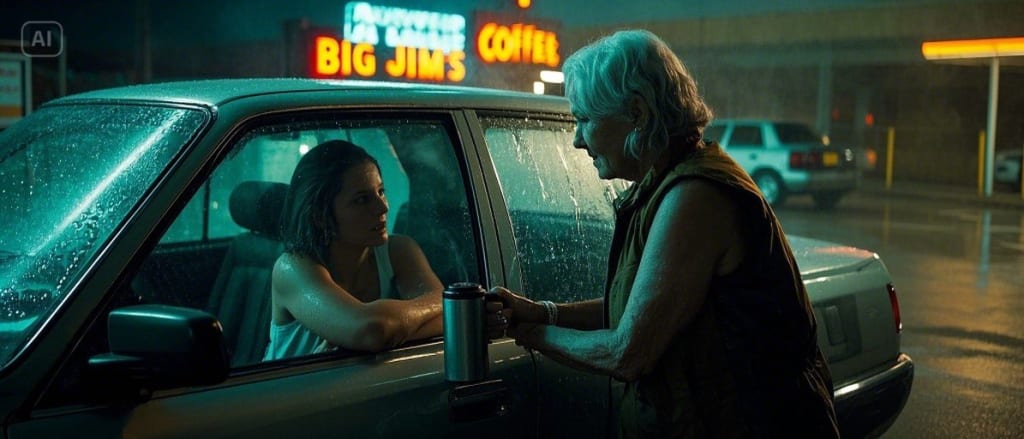
Rain has a way of magnifying loneliness. That night, it didn’t just fall—it jeered. I remember the exact sound: a thousand tiny fists drumming the roof of my ’98 Honda Civic, mocking the tears I’d sworn I wouldn’t shed. “Look at you,” it hissed through the cracked window, “27 years old and homeless.” My breath fogged the glass as I stared at the neon sign across the parking lot: “Big Jim’s Truck Stop – Coffee 24/7.” The “C” flickered like a dying star.
I’d been here three nights. Three nights of pretending to sleep while truckers came and went, their laughter echoing like a language I’d forgotten. My last $5 bought me a Styrofoam cup of sludge they called coffee. I clutched it like a lifeline, its heat seeping into my palms. This is how it ends, I thought. Not with a bang, but with a whimper… and a caffeine tremor.
Then, a knock.
Six months earlier, I’d been the golden girl of Crestline Marketing. My life was a blur of tailored skirts, client pitches, and midnight Uber rides home. My boss called me “Tenacious Tess”—a nickname I wore like armor. I’d grown up poor, raised by a single mom who worked two nursing shifts to keep the lights on. Success wasn’t a choice; it was an exorcism.
But the layoffs came like a silent tsunami. One Monday, HR called me into a room with a box of tissues and a security guard. “Market downturn,” they said. “Nothing personal.” My keycard deactivated before I reached the elevator.
Pride is a poison. I told friends I was “taking a sabbatical,” using severance pay to rent a beach cottage. In reality, I sold my furniture on Craigslist and lived off protein bars. When the eviction notice came, I packed my Honda with what mattered: Mom’s old recipe box, Dad’s dog tags (he left when I was six), and the pearl necklace Grandma clasped around my neck the day I graduated. “For when you need to feel invincible,” she’d said.
The necklace went last. The pawnshop clerk—a kid with acne and a “Namaste in Bed” t-shirt—eyed the pearls like they were costume jewelry. “Fifty bucks,” he shrugged. I took it.
The knock came again. I cracked the window, rain stinging my face. A woman stood there, backlit by truck stop fluorescents. Her neon vest read “SafeHaven Outreach,” and she held a thermos like it was a holy grail.
“Coffee?” she said. Her voice was gravel wrapped in velvet.
“I’m… okay,” I lied. My breath plumed between us.
“Kid, you’re shivering harder than a Chihuahua in a snowstorm.” She unscrewed the thermos, and the smell hit me—real coffee, nutty and dark. My stomach growled.
“Why?” I asked.
She leaned closer. Up close, she was older than I’d thought—maybe 60—with silver braids and a scar slicing her left eyebrow. “Let’s just say I’ve parked in this lot a few nights myself.”
I took the thermos. The first sip burned my tongue, but I didn’t care.
“Name’s Mara.” She handed me a napkin folded into a crane. Unfolding it, I read: “The world breaks everyone, but some grow strong at the broken places.” —Hemingway.
“Bullshit,” I muttered.
Mara laughed—a sound like a chainsaw starting. “Oh, honey, you’re my kind of broken.”
As she turned, I noticed her limp. Not a subtle hitch, but a drag-and-swing that made her left leg scrape asphalt. Later, I’d learn why: a hospital fire ten years back. Mara, then an ER nurse, had carried three patients out before the roof collapsed. Her legs stayed buried under the rubble.
Mara’s shelter, SafeHaven, occupied an old library. Bookshelves still lined the walls, their volumes replaced with donated sweaters and canned beans. That first shower felt like baptism. I stood under scalding water until my skin turned pink, washing away truck-stop smells and stale shame.
My “job” was sorting donations. Most days, I sifted through mothballed coats and orphaned mittens. But one afternoon, I found it—a 1940s Royal typewriter, its keys yellowed like old teeth.
“Take it,” Mara said. “It’s been here since Obama’s first term.”
I’d written poetry in college—angsty sonnets about love and lack—but buried that self under spreadsheets. That night, I sat cross-legged on my cot, the typewriter clacking like a frantic heartbeat. I wrote about the Honda, the pawnshop kid, the way Mara’s thermos felt like a hand pulling me from quicksand.
At 2 a.m., I tacked the poem to the bulletin board.
By dawn, five notes bloomed beneath it:
“You wrote my life.” —Jesse (Vietnam vet, loves licorice)
“Made me cry. Thank you.” —Lila (foster kid, 19, pregnant)
“Need part 2!!” —Mr. Chen (former piano teacher, Alzheimer’s)
Mara grinned. “Light needs cracks, kiddo. Keep splitting open.”
I did. I wrote Lila’s letter to her unborn baby. Jesse’s VA application. Mr. Chen’s fragmented memories of Shanghai jazz clubs. Their stories became my armor.
Not all days were redemption. One freezing March night, I woke to screams. Lila miscarried in the bathroom. Blood streaked the tiles like terrible paint. I held her while she sobbed, her fists pounding my chest. “Why? Why?”
I ran. Back to the Honda, back to the rain’s laughter. I called my old boss—“Please, anything, I’ll take a pay cut”—but his voicemail was full.
That’s when Mara found me. She didn’t speak, just slid into the passenger seat and handed me a flask. The whiskey tasted like fire and forgiveness.
“You wanna know my secret?” she said. “I still miss my legs. Phantom pain’s a bitch. But some days, I swear I feel rain on thighs that aren’t there. Beauty’s weird like that.”
The book started as therapy. Nights at the typewriter, chainsmoking Mara’s Camels, I spilled it all—the eviction, the pearls, Lila’s loss. I called it “Beautifully Shattered: Stories from the Edge of Hope.”
A blogger picked it up. Then a indie publisher. The advance was $3,000—enough for a deposit on a studio apartment.
At the launch party, Mara wore a sequined dress and her old nursing scrubs as a scarf. “For the ghosts,” she winked.
She handed me a small box. Inside: Grandma’s pearls.
“How?” I breathed.
“Traded the pawnshop kid free therapy sessions. Turns out, he’s got a mom in rehab.”
I clasped the necklace. The pearls felt different now—not a shield, but a testament.
We all have winters. Yours might be a divorce, an addiction, a dream deferred so long it fossilizes. But here’s what the wounded sky taught me:
Scars are compasses.
That pawnshop kid? He volunteers at SafeHaven now. Lila’s studying social work. Mr. Chen plays piano at the shelter every Thursday—mostly wrong notes, but we cheer loudest for those.
As for me? I still some days. But now I know: Rock bottom isn’t a grave. It’s a foundation.
So if you’re reading this in your own Honda, your own storm—hold on. Somewhere, a woman with silver braids is filling a thermos. A typewriter waits. And your story? It’s already a lighthouse.
Break. But don’t stay broken.
About the Creator
Dinesh Maurya
I'm a passionate writer, creative storyteller, and motivational enthusiast who has carved out engaging narratives to inspire and educate. I can offer linguistic expertise combined with richness in culture in my work.
Keep reading
More stories from Dinesh Maurya and writers in Motivation and other communities.


Comments
There are no comments for this story
Be the first to respond and start the conversation.