
Beyond the Factory Walls: The Story of Farida Khan
A Muslim Mother, a Sewing Machine, and a Dream That Wouldn’t Quit

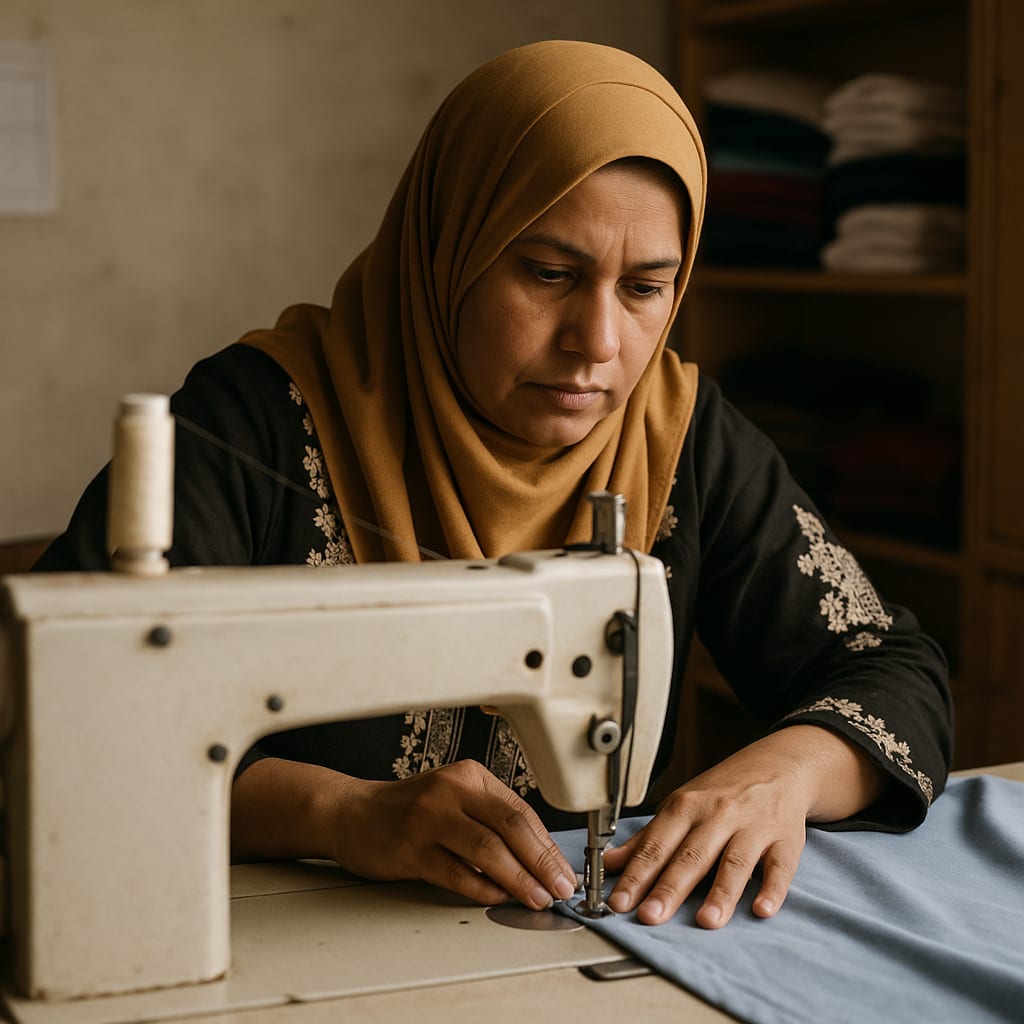
Start writing...In the heart of Manchester, down a quiet residential street lined with aging brick flats, halal butchers, and corner shops selling Pakistani spices and fresh naan, lived Farida Khan—a woman whose strength was rarely spoken about, yet deeply felt by everyone who crossed her path. Her story wasn’t one of viral headlines or public speeches. It was woven into the fabric of everyday life, stitched silently into school uniforms, prayer mats, and the dreams of three young children who called her Ammi.
Farida was 42 years old. Her hijab was always neatly pressed. Her hands bore tiny scars from a lifetime of work, and her gaze held a calm seriousness—the kind you see in people who no longer expect life to be easy but still choose to carry on with grace. Before sunrise each day, while most of Manchester still slept, she was already awake. Boiling water for tea. Preparing parathas. Pressing school uniforms with care. The call to Fajr was not just her spiritual anchor—it was her alarm clock and her reminder that every new day was a gift.
Fifteen years ago, she and her husband left Lahore for the UK with hopes of building a better life. Back then, Farida was soft-spoken, uncertain, but quietly optimistic. Her English was limited, but her dreams weren’t. All she wanted was safety, good schools, and dignity for her children. But life in a foreign country wasn’t kind. The winters were cold, but not as cold as the loneliness. Simple tasks like navigating the healthcare system, signing school forms, or even catching a bus became monumental.
Then, in 2015, her world changed overnight.
Her husband left. No warning. No goodbye. One morning he told her he had an interview—and never returned. She tried calling. She waited for days. Weeks. But he had vanished.
Farida was suddenly alone—with three children under the age of ten, no extended family, no income, and no plan. She spent a few days in stunned silence, sitting at her kitchen table with unpaid bills in one hand and her youngest child in the other. The future looked impossibly heavy.
Then her eyes landed on the old sewing machine in the corner of the room. It had once belonged to her mother. She had packed it in her luggage more out of sentiment than practicality. That day, it became her starting point.
Her first job was hemming a neighbor’s trousers. Then came fixing a school uniform. She didn't charge much at first—just enough for groceries. But slowly, word began to spread. A mother at the local mosque needed Eid outfits sewn. A shopkeeper needed curtain repairs. Her kitchen transformed into a sewing corner. Fabric rolls leaned against the fridge. Thread spools filled biscuit tins. Her ironing board doubled as a cutting table.
Farida worked 10 to 12 hours a day, often well into the night. Her children sometimes fell asleep to the soft hum of the machine. Her fingertips grew raw, her back ached, but she never once asked, “Why me?” Instead, she prayed. Her whispered du’as were as constant as her stitching.
There were brutal months. One winter, the boiler broke and she couldn’t afford a repair. She dressed her children in layers and sewed with numb fingers. Another month, the power was shut off, and she sewed by candlelight while her children read by flashlight. But Farida didn’t panic. She relied on her faith. “Allah will open the door,” she told herself. “I just have to keep walking.”
When her youngest son, Amin, once asked her, “Ammi, are we poor?” she gently placed a hand on his cheek and replied, “We are rich in patience and dua, beta. That’s better than money.”
Her breakthrough came one afternoon when a headteacher at a local primary school heard about her sewing work. She asked Farida if she could produce custom uniforms. Terrified but determined, Farida accepted the challenge. For two weeks, she barely slept. Every stitch was triple-checked. When she delivered the finished batch—neatly folded, crisp, and tagged—the headteacher was stunned. She not only paid her generously but referred her to other schools as well.
As her orders increased, Farida bought a second sewing machine. But instead of keeping all the work for herself, she remembered the women she’d met at the mosque—mothers struggling with childcare, single women trying to rebuild after divorce, widows looking for dignity. She offered them work. She trained them. Her small flat became a safe space filled with laughter, Qur’an recitations, shared meals, and a sense of purpose.
In her limited free time, Farida began learning. Her children helped her improve her English. Her daughter Zara taught her how to use Google Docs and email. She learned to write invoices and track expenses. Every little progress felt like reclaiming a piece of herself that had been buried under years of survival.
In 2023, her son Adil received a full scholarship to study mechanical engineering at a university in London. Zara began an apprenticeship in digital design and started freelancing. And Amin, now twelve, began telling his classmates he wanted to be a lawyer “so he could help people like my Ammi.”
Farida didn’t celebrate with extravagance. She didn’t post photos or buy anything new. She simply prayed extra rak’ahs that night, tears falling silently on the prayer mat.
Then one day, a community volunteer nominated her for a local entrepreneurship award. At the ceremony, when the interviewer asked her, “What kept you going through all the hardship?” she paused. Her eyes welled up. And then she smiled, the kind of smile that holds years of quiet battles.
> “Sabr and sewing,” she said. “Every day I stitched not just clothes, but my children’s future. I stitched with prayer. I stitched with pain. I stitched with love. And somehow, Allah made it enough.”
Farida never opened a big factory. She didn’t start a fashion label or launch a website. But within the four walls of her modest kitchen, she built something far more powerful—independence, community, and a legacy of resilience that would outlive her stitches.
About the Creator
Waleed Khan
Nature lover, student, story creator, Mimi poet etc.
Keep reading
More stories from Waleed Khan and writers in Motivation and other communities.
The Last Mile
On the outskirts of a small village nestled between rugged hills and sprawling farmland, lived a young man named Kian. He was a quiet soul with a loud dream: to become a long-distance runner known across the nation. While others laughed or dismissed his ambition, Kian never wavered. Every morning before the sun rose and every evening after the fields were tended, he ran—mile after mile—on rocky roads and uneven trails.
By Waleed Khan 8 months ago in Motivation
Delivering Service That Customers Remember Long After the Purchase
Customer service plays a critical role in shaping how people view a brand. Products and prices may attract customers at first, but the quality of service often determines whether they return. In a competitive market where customers have endless options, businesses must go further than simply solving problems. They must create experiences that customers remember and appreciate.
By Apex Service Partners6 days ago in Motivation




Comments
There are no comments for this story
Be the first to respond and start the conversation.