
Become the Most Powerful Version of Yourself
The Five Fires of Kael

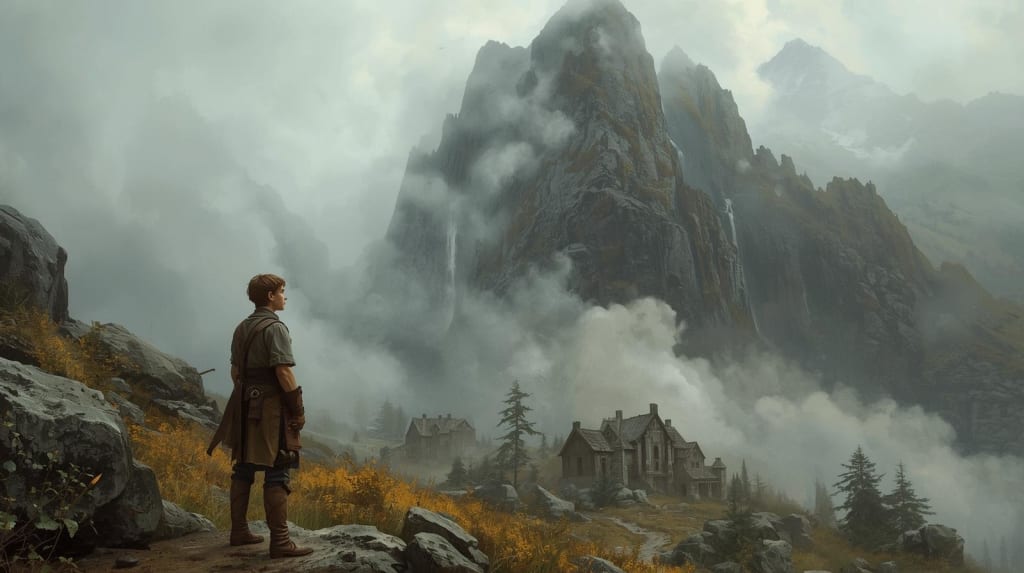
The legend in the mountain village of Thistle was as old as the stones: to become the most powerful version of oneself, one must climb the Summit of Ascension and endure the Five Fires. Many had tried. Most returned broken, speaking of agonizing trials that offered no treasure, only pain. The village called it a fool's quest. But for Kael, a young woodcarver whose gentle hands felt disconnected from his restless spirit, it was a calling.
His work was good, but it was not great. His life was fine, but it was not fulfilled. A deep, quiet ache told him he was living a fraction of his potential. So, with a heart full of doubt and a pack full of meager supplies, he left his workshop and began the climb.

The First Fire was the Fire of Solitude.
The path vanished quickly, leaving him alone in an immense, silent forest. There were no mentors, no guides, no cheering crowds. For days, the only voice was his own, and it was a cruel companion. It whispered of his insignificance, his certain failure. He missed the noise of the village, the simple comfort of company. But in the crushing quiet, he was forced to listen to a deeper voice beneath the fear—the steady, resilient hum of his own spirit. He learned that true power begins when you stop seeking external validation and can sit, unafraid, with yourself.
The Second Fire was the Fire of Failure.
He reached a colossal granite wall, slick with ice. He attempted to climb it a dozen times. A dozen times, he fell, his body bruising, his hands bleeding. Each fall was a lesson in his own inadequacy. He wanted to quit, to declare the wall impossible. But on the thirteenth attempt, he noticed a tiny, almost invisible fissure he had missed before. He used it. Failure had not been a stop sign; it had been a teacher, forcing him to look closer, to be smarter, to persevere. He understood that power is not the absence of falling, but the relentless will to get up and find a new way.
The Third Fire was the Fire of Discipline.
Beyond the wall was a vast, featureless plain. The Summit was visible in the distance, but the path was straight, monotonous, and brutally long. There was no danger here, only the endless, grinding demand to put one foot in front of the other. His muscles screamed. His mind begged for distraction. This was the fire that burned away whims and moods. He couldn't rely on motivation, which had long since evaporated. He could only rely on commitment. Day after day, he moved. This fire forged in him the power of consistency—the understanding that grand achievements are built not on grand gestures, but on the unglamorous, daily choice to keep going.
The Fourth Fire was the Fire of Surrender.
A storm descended, fiercer than any he had known. The wind tore at him, the cold bit to his bone. He fought it with all his might, raging against the sky, trying to force his way forward. It only exhausted him. On the brink of collapse, he finally stopped fighting. He didn't give up; he surrendered. He found a crevice, huddled within it, and let the storm rage around him instead of against him. In that moment, he learned the power of acceptance. He could not control the storm, but he could control his response to it. True power, he realized, is not about dominating every circumstance, but about navigating it with resilience and grace.
Weary, scarred, but fundamentally changed, Kael finally reached the summit. He expected a shrine, a treasure chest, a burst of celestial light. Instead, he found a simple, flat stone and a breathtaking view of the world below. The Fifth and final Fire awaited him: the Fire of Reflection.
As he sat on the stone, looking back at the arduous path, the lessons of the fires ignited within him all at once.
From Solitude, he had gained self-reliance.
From Failure, he had gained resilience and wisdom.
From Discipline, he had gained unwavering focus.
From Surrender, he had gained emotional mastery.
He had climbed the mountain seeking an external power to be bestowed upon him. But he found none. Instead, he discovered that the power had been within him all along. The fires had not given him anything new; they had burned away everything that was not him—the fear, the doubt, the need for approval, the laziness, the need for control.
He was not handed a sword. He was forged into one.
Kael descended the mountain not as a conqueror, but as a man wholly integrated. He returned to his woodcarving, but his hands were no longer just gentle; they were sure. His chisel did not scratch at the wood; it danced, guided by a profound confidence that flowed from his core. He carved masterpieces that seemed alive, because the man who made them was finally, fully alive.
The villagers saw the same Kael, but they felt a different man. His presence was calm, his gaze steady. He had not found a mythical power on the mountain. He had, through trial and perseverance, uncovered the most powerful version of himself.
Moral of the Story:
The most powerful version of you is not something you find, but something you forge. It is built in the fires of challenge, failure, and perseverance, where the illusions of your limitations are burned away to reveal the strength, wisdom, and resilience that were always there.
About the Creator
The 9x Fawdi
Dark Science Of Society — welcome to The 9x Fawdi’s world.
Keep reading
More stories from The 9x Fawdi and writers in Motivation and other communities.
This One Mindset Shift Will Change Everything
The first time I heard the term "abundance mindset," I scoffed. It sounded like another fluffy, self-help concept for people who could afford to be optimistic. My world was built on a foundation of scarcity. There was never enough—not enough time, not enough money, not enough opportunities. Life was a zero-sum game, and I was losing.
By The 9x Fawdi5 months ago in Motivation
Why We Compare Ourselves to Others
Have you ever scrolled through social media and suddenly felt like everyone else is doing better than you? Someone got a new job, someone started a business, someone is traveling, and another person seems to have the perfect life.
By Being Inquisitive3 days ago in Motivation
My First Time Skiing and I Got Lost, Alone, in the French Alps
Looking back, I can trace some of my life’s biggest adventures to a simple action from my sister. She’d introduced me to Tommy (a very long time ago), a colleague of hers, who had overshared his penchant for Italian-looking women, and I ticked that box.
By Chantal Christie Weissabout an hour ago in Humans


Comments
There are no comments for this story
Be the first to respond and start the conversation.