
"Bajaur Bathed in Blood: Bullets Rained on Peaceful Protesters"
"In July 2025, military operations, curfews, and a brutal crackdown on civilians left scores injured and killed in Pakistan’s tribal region of Bajaur"

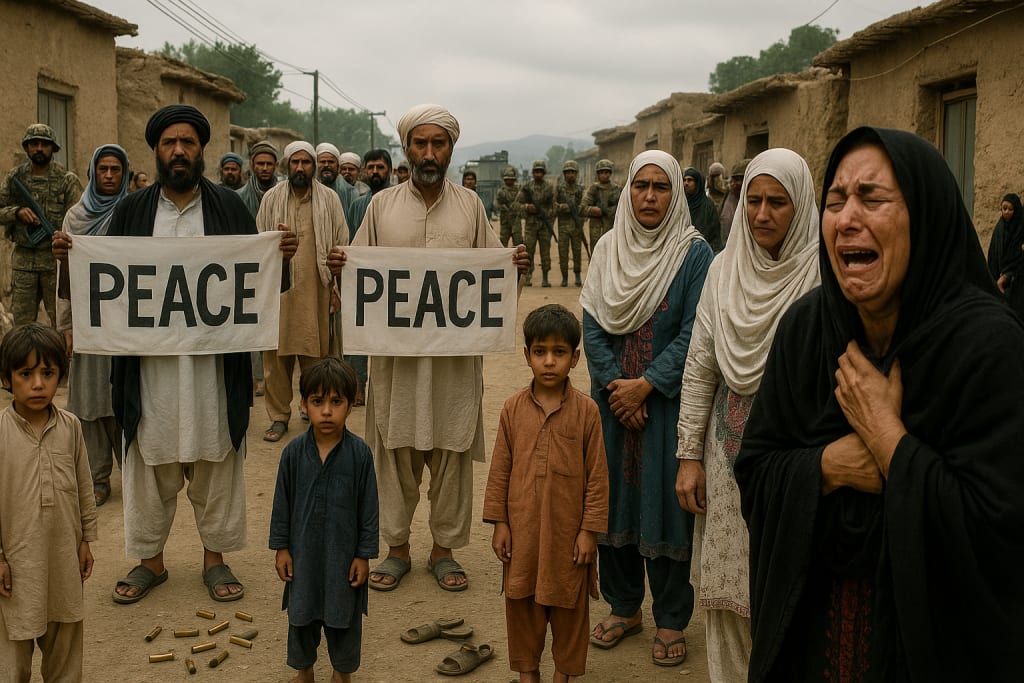
Bajaur Bathed in Blood: Bullets Rained on Peaceful Protesters
Bajaur, Khyber Pakhtunkhwa – July 2025 — Once again, the remote tribal belt of Pakistan has been turned into a battlefield — not by insurgents or foreign forces, but by its own military. In Bajaur, peaceful civilians protesting military operations were met with live ammunition. At least 7 people were killed and over 20 were injured, including children, women, and elderly citizens.
The “Sarbakaf” Operation and Curfews
In mid-July, Pakistan’s army launched a large-scale operation codenamed “Sarbakaf” in areas such as Loe Mamund, Kharkai, and Nawagai. Officials claimed it was aimed at eliminating remaining pockets of militancy. However, locals say they were never warned and no signs of militants were visible — just homes, mosques, markets, and families.
Entire villages were locked down under curfew. Electricity, water, and internet were cut off. Food shortages mounted. People were trapped in their homes without access to medicine or supplies. As desperation grew, hundreds took to the streets — not with weapons, but with white flags and banners pleading for peace.
Peaceful Protest, Violent Response
On July 26th, hundreds of men, women, and children gathered in Bajaur’s main bazaar, chanting slogans for peace. Women carried white scarves; young men held signs saying “We Want Peace” and “Stop Killing Our Children.” The protest remained peaceful — until the shooting started.
Shahzeb Khan, 23, a witness, said:
> "We were unarmed. I raised both hands and kept shouting that we just want peace. Suddenly, bullets started flying. My friend standing next to me fell — he was shot in the chest."
Doctors at the Bajaur District Hospital reported receiving more than 20 casualties. Dr. Shakeel, a senior physician, told local media:
> "We treated women, children, and elderly. Seven were already dead when they arrived. The wounds were consistent with close-range gunfire."
A Mother's Cry: A Child Killed for Asking Peace
Among the victims was 9-year-old Musa, shot while accompanying his father during the protest. His mother, Ayesha Gul, sobbing uncontrollably, spoke to a local journalist:
> "He was just standing next to his father. What threat did my little boy pose? Is asking for peace a crime now?"
The image of a mother weeping over her son’s blood-stained clothes has since gone viral, symbolizing the unimaginable pain felt across Bajaur.
Local Response: Tribal Jirgas and Public Outrage
After the bloodshed, tribal elders convened emergency jirgas. Maulana Hanif Gul, a respected local leader, condemned the operation:
> "Our homes have become warzones. We are treated like terrorists for simply asking to live. If this is the state's justice, we reject it."
Social media exploded with hashtags like #BajaurMassacre and #StateTerrorism, as videos showed soldiers firing directly at fleeing protesters. Human rights activists demanded an international investigation into what they called “state violence against its own citizens.”
The Military’s Stance and Government Silence
The Pakistani military issued a brief statement claiming that “unknown elements” among the protesters provoked the troops, forcing them to fire in “self-defense.” But no evidence or independent verification was offered.
The interim government of Khyber Pakhtunkhwa promised to "review the situation," but no meaningful compensation or justice has yet been delivered to victims’ families. Curfews were lifted in some areas after intense public pressure — but the wounds are fresh, and anger is boiling.
Media Censorship and International Silence
Despite the brutality, most major Pakistani TV channels offered minimal coverage, allegedly under state pressure. A few international media outlets, including Arab News and Free Press Journal, reported on the killings, but no official condemnation has come from the UN, Amnesty International, or any global human rights watchdogs as of now.
Journalists attempting to report from Bajaur have faced harassment and travel restrictions, further shrouding the crisis in silence.
Bajaur’s Message: “We Are Not Terrorists”
As the dust settles on a traumatised Bajaur, one message continues to echo from every corner:
> "We are not terrorists. We are human beings. We want to live."
The tragedy has once again raised difficult questions: Why are peaceful citizens shot for demanding peace? How long will tribal areas suffer under the pretext of national security? And what is the price of speaking out in a country where bullets often answer prayers?
---
About the Creator
Keep reading
More stories from Ihsan Ullah LLC and writers in Motivation and other communities.
A Journey Through the Mind's Sunset"
As the sun dipped below the horizon, painting the sky with hues of fire and longing, he stood still — silhouetted in the golden glow of twilight. But the most vibrant sunset wasn’t the one behind him. It was the one within.
By Ihsan Ullah LLC8 months ago in Motivation




Comments (1)
Please soport me