


In the quiet hills of Pall Mall, Tennessee, Alvin Cullum York was not the kind of man anyone expected to become a war hero. Born into a poor farming family in 1887, York was the third of eleven children. Life was hard in the Appalachian Mountains — days were long, education was scarce, and work came early. Alvin dropped out of school after the third grade to help support his family.
By his early twenties, York had developed a reputation — not for discipline or honor, but for fighting and drinking. Known for late-night brawls and rowdy saloon visits, he was seen as a troubled young man on a path to nowhere. But something shifted in him after the death of his father. He turned inward, and soon after, joined a fundamentalist Christian church — the Church of Christ in Christian Union — a small denomination that preached nonviolence and strict morality.
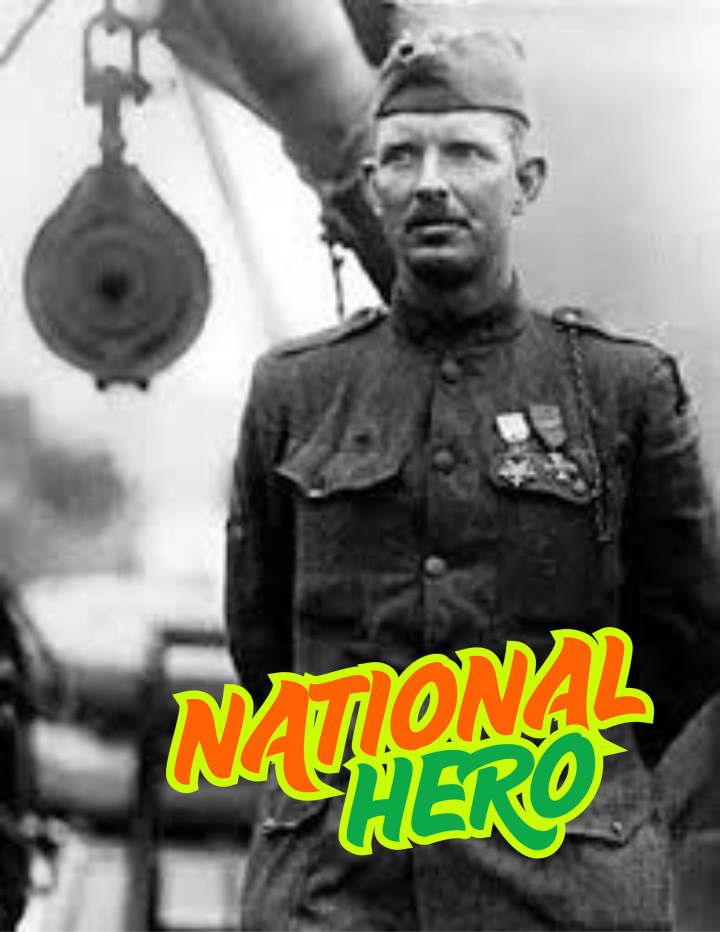
York became a devout pacifist, giving up alcohol and turning to the Bible for guidance. So when the United States entered World War I in 1917, and York received his draft notice, he was torn. To him, war seemed incompatible with the teachings of “Thou shalt not kill.” He filed as a conscientious objector, but his claim was denied.
After being drafted into the 82nd Infantry Division, York struggled internally. He consulted his company commander, Captain Edward Danforth, and Major Gonzalo Edward Buxton, both of whom took the time to discuss the Bible and morality with him — not to convince him, but to help him come to peace with his decision. After weeks of soul-searching, York came to believe that fighting to stop greater evil could be morally justified. And so, the once-reluctant soldier began training in earnest.

It was on October 8, 1918, during the Meuse-Argonne Offensive in France, that York’s legacy was sealed.
His unit had been tasked with advancing through the Argonne Forest, one of the most fortified German positions on the Western Front. During the mission, his squad came under heavy machine-gun fire, pinning them down and killing several men. The rest of the unit was in danger of being wiped out.
York, now a corporal, took command.
With just a handful of men, he flanked the German machine-gun nests. Crawling through the mud, dodging bullets, and relying on his sharp eye — honed during years of hunting in Tennessee — he systematically took out German gunners one by one.
At one point, a group of six German soldiers charged at him with bayonets. With calm precision, York shot them all, one at a time, with his rifle and sidearm. Recognizing the hopelessness of their situation, a German major offered to surrender — York agreed.
In a stunning turn of events, York and his remaining men marched 132 German soldiers back to American lines, having captured multiple machine guns and saved his unit.
The reaction was immediate.

York was promoted to sergeant and awarded the Medal of Honor, the Distinguished Service Cross, and multiple international decorations, including the Croix de Guerre from France. American newspapers quickly picked up the story of the humble mountain man turned war hero. He was invited to parades, dinners, and even met General Pershing and President Woodrow Wilson.
Yet despite the fame, York remained modest. He turned down most offers to profit from his story, including lucrative film deals. “This uniform ain't for sale,” he once said.
Instead, he returned to Pall Mall, married his sweetheart Gracie, and focused on helping others. He used his celebrity status to campaign for education in rural areas, and eventually opened the Alvin C. York Institute, a public high school that still exists today. During WWII, though too old to serve, he helped with war bonds and recruitment.
What made Alvin C. York so remarkable wasn’t just his battlefield bravery, but the personal transformation that preceded it. He wrestled with morality, faith, duty, and fear — and still chose to act when others might not. He didn’t become a hero because he wanted glory. He did it because, in his heart, he believed it was the right thing to do.
Alvin York passed away in 1964, but his story lives on — not as a tale of violence, but of inner strength, humility, and a deep sense of responsibility to others
About the Creator
The Manatwal Khan
Philosopher, Historian and
Storyteller
Humanitarian
Philanthropist
Social Activist
Keep reading
More stories from The Manatwal Khan and writers in Motivation and other communities.
The Boy Who Refused to Stay Small
He was not born into comfort. There were no silver spoons, no luxury cars waiting outside his house, no powerful relatives ready to open doors for him. He was just an ordinary boy from a middle-class family, raised in a small home filled with big dreams and limited resources.
By Yasir Rehman6 days ago in Motivation
📢 Raise Your Voice Thread: 03/05/2026
Our “Raise Your Voice Threads” are hosted most alternating Thursdays at 12PM ET to offer creators more avenues to uncover exceptional stories on Vocal. As we are continuously searching for fresh creators and inspiring stories, this thread provides an opportunity to exchange and discuss the stories that have moved and motivated us on Vocal.
By Raise Your Voice by Vocal4 days ago in Resources




Comments
There are no comments for this story
Be the first to respond and start the conversation.