
A Dreaming Place
Hello, Mr. Bell...Is that you?


When Alexander Graham Bell moved to Canada in 1870 he was not expected to live. He was just 23 years old. Frail and coughing, it was thought he would soon succumb to TB, just as both his brothers had.
His family settled in Brantford, Ontario, and soon the young Bell's health began to improve. Eventually, he thrived. He created a workshop in a carriage house on the property and he discovered a thicket of trees perfect for dreaming under. He called this special spot his "dreaming place”. Overlooking the Grand River, it was there he conceived the idea that would become the telephone.

Everyone needs a dreaming place.
It might be next to rippling water and swaying trees, if you're lucky, but it can be anywhere. I've created dreaming places in basement apartments, rented rooms, attics, turrets and cafes. But they all start in my head.
Currently, I live in a small apartment with a big front window and a nice back porch. They both make for good dreaming places. The outdoor porch is surrounded by beautiful trees, but when weather drives me inside, my living room becomes my main place for dreaming/creating. This room has a fridge in a corner, sitting just outside of the closet-sized kitchen. Yes, this place is very small.
Though it's no Parisian garret my tiny abode is fit for dreaming - or as Brenda Ueland calls it: "moodling".

Dreaming places have physical characteristics that create a mood: peaceful breezes, scents of flowers, hubbub of coffee-drinkers, music of wind chimes, autumn leaves, moonlight, etc.
Sometimes, I create the mood by screening old movies while I work - mostly flicks I've seen many times, so that I don't have to focus on them. They facilitate my work in much the same way that sitting next to the window does: by setting a tone that invokes creativity. And every now and then, I can look up at the scene just outside the window or on the screen and find inspiration for the next stage of my work.
Later in life, Alexander Graham Bell said: “As I look back upon it, visions come to me of the Grand River and of Tutela Heights and my dreaming place upon the heights where visions of the telephone came to my mind.”

Here’s a nod to that dreaming inventor, on the 100th anniversary of his death, via a few celluloid favourites of mine that feature his most famous invention -
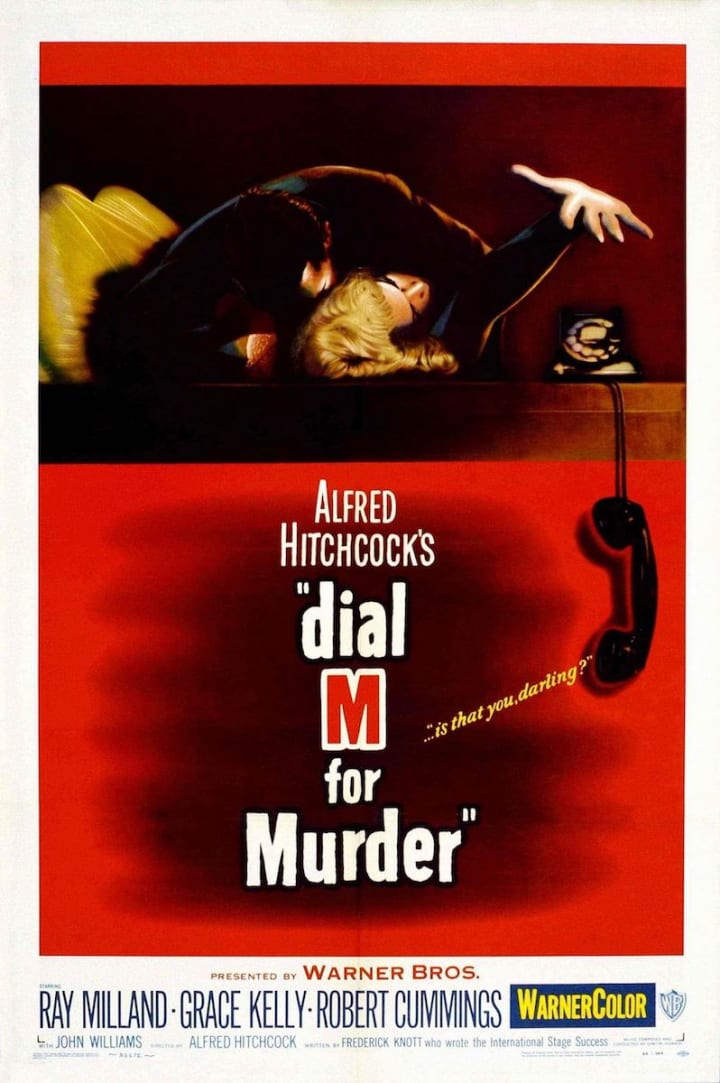
Dial M for Murder. 1954. Grace Kelly's husband, played by Ray Miland, calls her from a polished wooden phone booth in a posh men's club. In their home, Grace picks up the receiver of their stylish 1940s rotary phone - and...
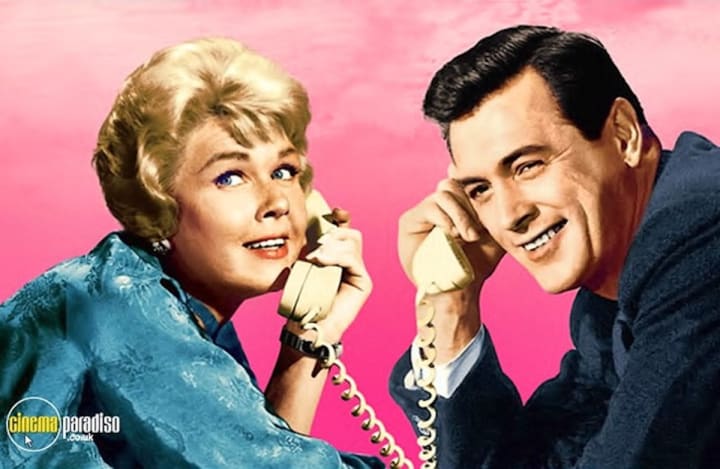
Pillow Talk. 1959. Doris Day, glowing like radioactive cotton candy, picks up her phone to make a call only to hear the cad she shares her line with crooning to some smitten female. Back in the '50s if you wanted a phone, you had to share the line with some stranger in your city or neighbourhood. It was called a party line. Every time Day picks up the receiver on one of the (at least) three phones in her lavish apartment, she hears the cad (played by Rock Hudson). She needs her phone for business and Hudson's constant crooning over the wire makes her blood boil. This party line is no party at all, but the film's a romcom, so...
His Girl Friday. 1940. Roz Russell putting her coat on while talking on one of the many candlestick phones in the newspaper office. She gets all tangled up, with the cord running inside the sleeve she's put her arm into - a symbol of her growing entanglements, both romantic and professional.
The Slender Thread. 1965. Following Anne Bancroft's Oscar-winning turn in The Miracle Worker, she starred in another film where communication is a key theme. Only Bancroft's voice is heard for much of the film, as she is on a speaker phone in a crisis clinic. A student, played by Sidney Poitier, works frantically to keep her on the line because she's already swallowed a lethal dose of pills. He has to keep her talking till the call can be traced. The film is noted for its depiction of the physical tracing of a phone call.

The Maltese Falcon. 1941. Sam Spade with a hardboiled ear pressed to the receiver of a black rotary phone, held there by his shoulder as he rolls a cigarette. A classic noir blower. Sam talks on a few different styles throughout this film, including a licorice-black candlestick in his home.
It's A Wonderful Life. 1946. Mary is talking to Sam (Hee-Haw) Wainwright and she wants George in on the conversation. They are pressed close together with the candlestick receiver held between them. George is a bundle of conflict and desire. He is so close to Mary he can smell her hair and it drives him crazy. But he wants to see the world, gall darn it! Talk about growing entanglements.
Midnight Lace. 1960. Another Doris Day film, but not a fun frolic on a powder-pink phone. Rather, a sinister plot played out on a stylish-if-menacing, bone-white phone.
Meet Me in St. Louis 1944. On the blower from NYC to St Louis in 1903: the phone is a big wall-mounted thing in the dining room. There's a possible marriage proposal at stake but with the whole family in the same room as the telephone, intimacy is challenged. It doesn't help that the call recipient has to yell into the mouthpiece to ask her suitor to repeat himself many times over.

Thank you for reading!
About the Creator
Marie Wilson
Harper Collins published my novel "The Gorgeous Girls". My feature film screenplay "Sideshow Bandit" has won several awards at film festivals. I have a new feature film screenplay called "A Girl Like I" and it's looking for a producer.
Keep reading
More stories from Marie Wilson and writers in Motivation and other communities.
30 Days Talking to Strangers in Amsterdam — Day 17 Ended My Panic Attacks
The Stranger Who Answered Back How talking to one stranger every single day for 30 days in Amsterdam quietly ended my panic attacks I used to think Amsterdam was the loneliest city on earth. You know the feeling — you’re surrounded by 900,000 people, bikes whizzing past, trams dinging, canal water lapping at your feet… and still feel completely invisible. My panic attacks had gotten so bad by January 2026 that I’d started avoiding the tram altogether. Heart racing at red lights, palms sweating in the rain, convinced everyone could see I was one deep breath away from falling apart. So on February 1st I made a stupid promise to myself: talk to one stranger every single day for 30 days. No small talk rules. No “nice weather” cop-outs. One real sentence. One genuine question. Nothing more. I had no idea that promise would save my life. The Awkward First Ten Days Day 1 was humiliating. I stood at the Albert Cuyp Market like a statue until a woman in a bright yellow raincoat picked up the last bunch of tulips. “Those are beautiful,” I blurted. She smiled, said “They’re for my mother’s grave,” and walked away. I wanted to disappear into the cobblestones. Day 3: A guy locking his bike near the Rijksmuseum. I asked how his day was going. He answered in perfect English, “Tired, man. My wife left yesterday.” I froze. He laughed at my face and said, “Relax, it’s been two years. You’re the first person who’s asked in months.” By day 8 I was getting braver. A barista at my usual spot on De Pijp told me her dream of opening a cat café in Portugal. On day 10 an old lady on the 12 tram scolded me for not offering my seat — then spent the next six stops telling me about her husband who died in 1998 and how she still sets the table for two. Every conversation felt like jumping off a cliff. My chest still tightened. My voice still shook. But something tiny was shifting. I was no longer invisible to the city — and the city was no longer invisible to me. The Day Everything Changed Day 17. A grey Thursday. I was exhausted, rain pouring sideways, and seriously considering quitting the whole stupid experiment. I ducked into Vondelpark under a big oak tree near the rose garden. There he was — sitting on a wet bench in a wool coat that had seen better decades. Silver hair, bright blue eyes, holding a small thermos like it was the only warm thing left in the world. I sat. Heart hammering. Then I did what I’d been doing for seventeen days straight. “Excuse me… do you mind if I ask what you’re drinking?” He looked at me for a long moment, like he was deciding whether I was worth the words. Then he smiled — the kind of smile that reaches the eyes first. “Turkish coffee,” he said in a thick Dutch accent. “My wife taught me. She died eleven years ago today.” I swallowed. “I’m so sorry.” He waved it away gently. “Don’t be. She would have liked you. You’re the first person in months who’s looked me in the eye instead of at their phone.” We talked for forty-three minutes. His name was Hendrik. He’d been a ship captain on the IJ for thirty-seven years. Lost his wife to cancer. Raised two daughters who now live in Australia. And then he said the sentence that cracked my entire life open: “You know what I learned after she was gone? Panic is just the mind trying to live tomorrow today. The only thing you can control is this moment — and whether you’re brave enough to share it with someone.” He tapped my knee. “You’re scared right now. I can see it in your shoulders. But you still sat down and asked an old man about his coffee. That’s how you win against the fear, jongen. One small yes at a time.” I cried on the tram home. Not pretty tears — ugly, snotty, shoulder-shaking ones. For the first time in two years, the tightness in my chest wasn’t panic. It was relief. The Last Thirteen Days & What Actually Changed The rest of the month felt different. I stopped forcing conversations and started enjoying them. A Syrian refugee who bakes the best pistachio baklava near Nieuwmarkt. A teenage girl practicing guitar by the canals who let me record her song. A stressed-out delivery cyclist who ended up inviting me for a beer after his shift. My panic attacks didn’t vanish overnight — but they lost their power. When the racing heart came, I heard Hendrik’s voice: This moment. Share it. So I would turn to whoever was nearest and ask one small question. Every single time, the fear shrank. By day 30 I wasn’t the same person who started. I smiled at strangers without thinking. I slept through the night. I even took the tram during rush hour without counting exits. What I Wish I’d Known Sooner Talking to strangers didn’t fix me. It reminded me I was never broken — just disconnected. In a city as beautiful and busy as Amsterdam, it’s ridiculously easy to feel alone. We all walk around wearing invisible headphones. But when you take them off for thirty days and actually see people, something magical happens. You realise every single person is carrying their own quiet storm — and most of them are desperate for someone to notice. Hendrik was right. The panic wasn’t in my chest. It was in the story that I had to do life alone. Your Turn I’m not saying you have to talk to a stranger every day for a month (though… why not?). Start smaller. Next time you’re waiting for coffee, on the tram, or sitting on a bench in Vondelpark — look up. Smile. Ask one real question. You might just meet the stranger who answers back. And who knows? They might be carrying exactly the words you’ve been waiting your whole life to hear.
By Shoaib Afridi2 days ago in Motivation


Comments (3)
Cool way to tie all of this together with the telephone! Fun Read! 💜
Great way to recall Bell and his inventiveness. From sick youth to dreaming manhood, to realising the dream. A film in itself. The story is beautifully illustrated, as you say, in celluloid.
Well, you hooked me in by the first picture of Doris Day in Midnight Lace - I think she really proved her acting chops with that picture, but it wasn't so well reviewed. Lovely thoughts about the role of dreaming.