
5 Tips on Discovering Your Creative Process via a Journal (Bujo)
A No-Nonsense Practical Guide to Unlocking Your Inspiration

Assumptions
- You are interested in self care
- You feel like you are in a "bit of a rut" or "stuck"
- You need a nudge in the right direction
- You wish to leverage journaling (bujo) as part of self care
1. Take Joy as a Commitment
This is an act of self care, and in order for you to be successful, commitment is required. This is for all of you that are used to shuffling off such activities as a "low priority." You deserve to prioritize your joy and commit to it.
All of your other responsibilities and commitments will be better served if you invest time in yourself. Stress is a life killer. Longevity is taking joy while fully present in the moment.

Every minute spent in your journal is part of your process and cannot be replaced by any other activity. Think of it as the productive activity it is.
2. Pick a Signature Writing Instrument(s)
If you’re going to be scribbling ideas, it should be done with tools that bring joy to the activity itself. Even if you haven’t thought about it before, chances are you have a favorite pen or pencil. Close your eyes and think about the last time you used a pen or a pencil and were taken aback by how nice it felt in your hand. What was it?
For me, it’s Uniball colored pens. I love having a wide variety of pens with very wet and fluid ink. I enjoy taking very detailed notes because each stroke of the pen has a satisfying feeling similar to painting (another activity I enjoy).
I prefer writing in all caps, an artifact of my education. I have been formally trained in architectural drafting. My handwriting is satisfactory and legible because of the instructor's insistence that we learn how to write this way.

The medium I chose of course has drawbacks - no way to erase. I have embraced when my brain randomly misspells a word or I draw something funky. Usually I end up writing a self deprecating joke write into the page. They end up being fun easter eggs in my journals.
Is there a type of pen or pencil that you enjoy writing with? Be sure to add it to your toolkit. Prioritize it as a self care expense.
3. Seek Inspiration
Going through the work of other's is great for seeing the possibilities and getting inspiration. Social media is an invaluable resource for this inspiration if you know where to look.
Sort Out Your Preferences
This is where facebook groups comes in handy. You can observe the other members discussing the tools of the hobby without needing to invest in them yourself. Groups are great for identifying preferences you weren't aware you had.
Quick example:
Do you hate ghosting? Or is that something that doesn't bother you?
"Ghosting" is the term used by artists to describe when you can see the design on a previous page on subsequent pages... as if a ghost haunting it.

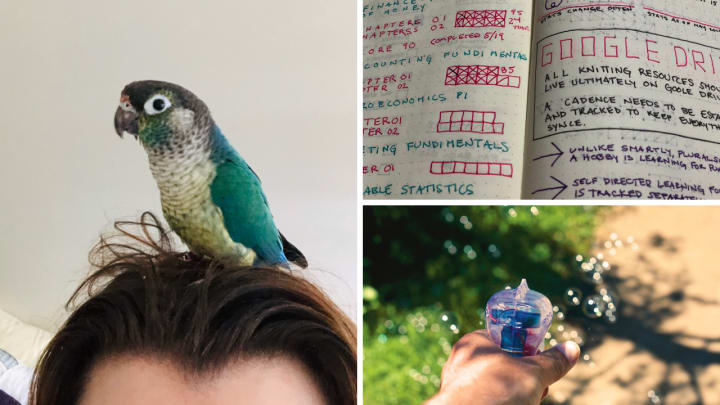
I personally find it amusing to incorporate ghosting into new page designs. It gives me something creative to do that warms up my brain. But even when I don't mimic the ghosting entirely (see lower left in the montage above), it doesn't bother me enough to switch journal types in some cases.
However, it drives some people absolutely bonkers. I get it too - for some things ghosting would be a deal breaker for me as well (like a water color and ink journal). But for my day to day sketching, ghosting doesn't bother me at all. For these kinds of ideas, I want a sturdy, light, and gridded book that protects my lazy brainstorming. Ghosting is a non-issue for this kind of journal in my opinion.
Resist the Lure to Pick a Style
It's very tempting to decide what is and isn't "bullet journaling" or "journaling" in a broader sense. A lot of journalists focus on developing a particular style - and if that is your end goal that is fine. But don't let others dictate how you use your own journal.
Your journal serves you. It's there to support you.
If you have messy thoughts, it helps you clear off the mud and bring them to the light.
If you have an idea, writing it down it make it a tangible thing.
If you have a plan, the journal enables your success.
If things are causing you to hesitate to use your journal, explore those feelings. Are you afraid of ghosting? Or imperfections? Do you need to brainstorm before you feel comfortable putting a pen to that paper? Do you need to reconsider what kind of journal this is? Do you need to save it for a specific project?
Or can you just relax and dive right in?
4. Decide on a Journal System
It literally can be anything. "Journal" in this case merely means "the medium where you keep your notes."
It can even be digital. I have a lot of notes that are stored in *.txt format. They simply make more sense to keep in a digital format instead of a hard copy. I use Notepad++ for these materials. The ones that are super important to me are stored on a cloud service (Google Drive) with syncing turned on.
I do, however, keep an extensive amount of handwritten journals. And I do not mean the "dear diary, today I met someone" kind.
Bullet journals are rising in popularity. Dozens of pages and groups on social media exist. For example, "Bullet Journal Beginners" on facebook is a great resource for people new to the hobby. It had 86,500 members when last recorded on January 20th 2020. Searching "bullet journal" on facebook returns hundreds of groups. Look around and see what's out there and active.
From my experience, journals can fall into two large buckets - formal and informal.
Formal Journal
These are the majority of examples that can be found on social media. These types of journals are set up in a explicit way. The artist designs the layouts, art, and content before the journal is used. Frequently the functionality of the journal is time-bound (such as a calendar for a specific week in a specific month in a specific year).
It can also be content driven but formally planned. Headers, layouts, and other guiding content are placed down before the text is added. It's not time bound, however, so whenever the artist feels inspired to fill the page with content, it feels appropriate and ready.
This journaling style can be very meditative to those that crave adding ritual, structure, predictability, and organization to their lives. It is a valid approach to journaling.
Informal Journal
This style is inherently more casual. Content is created organically and in the "heat of the moment." It is also a valid approach to journaling.
Which do I do? Well a mix of both.
I have journals with different "goals." I have a knitting journal that is quite formalized. No chicken scratch allowed.
I also have a design journal that has sections of idle doodling to sculpt my thoughts into a formal idea. Then I work through the idea by formalizing it until the idea is concrete enough to "graduate" into a formal destination.
My casual journals give me the satisfaction of working as messy as I need to in order to get to a place of clarity. My formal journals gives me a sense of accomplishment and healthy pride. My digital journals give me a sense of security - I know I will have that information available to me no matter what happens.
My Journal System Summarized
- Digital journals
- Google Drive journals
- Brainstorming journals
- 'Formal' Journals
5. It's Ok to Ebb and Flow
It's normal to go through periods of "writer's block," even as an artist that does not use words. Oftentimes I experience guilt that I have lost my discipline. I even crave the feeling that keeping a journal gives me, but I see myself get further and further "behind."
What can be done to get back in the grove?
Forgive yourself; start again.
You may be curious what the colorful ghosting was earlier in this post. It was the backside to a full page "spread" - (a term for a journal entry that takes up an entire page) that was my humorous way of indicating I was picking up this journal that I started in 2018 again after a massive hiatus. It had been over a year since I had used this particular journal, but it had a lot of blank pages left.
This journal had been a subject of a conversation I had been having with myself. I let its emptiness become symbolic of my laziness and beat myself up a bit over it. However, when it became clear my inspiration was back full force, I sketched this up as a bit of fun.

Not all stories are a direct "dump" of every moment in time. Take the busy moments you get "behind" as natural gaps in your memoir. Rather than indulging the guilt, seize it as an opportunity to start anew.
You are worth the investment
Like my work? Please leave me a tip or check out my other work.
About the Creator
idrial
I'm already a cyborg
30 something DevOps software engineer recovering from four spine surgeries
code, knit, crochet, hook, cook, bullet journal, geek
Keep reading
More stories from idrial and writers in Motivation and other communities.
When Insight Does Not Translate Into Change
There is a common experience where something finally makes sense, yet life remains unchanged afterward. The connection is clear. The reasoning holds. The conclusion feels settled. And still, nothing moves. This gap between understanding and embodiment is not rare, and it is not primarily a failure of intelligence or sincerity. It is a structural gap between knowing what is true and living in alignment with it.
By Peter Thwing - Host of the FST Podcastabout 2 hours ago in Motivation


Comments
There are no comments for this story
Be the first to respond and start the conversation.