
The Story of Albert Einstein
A Mind That Changed the World
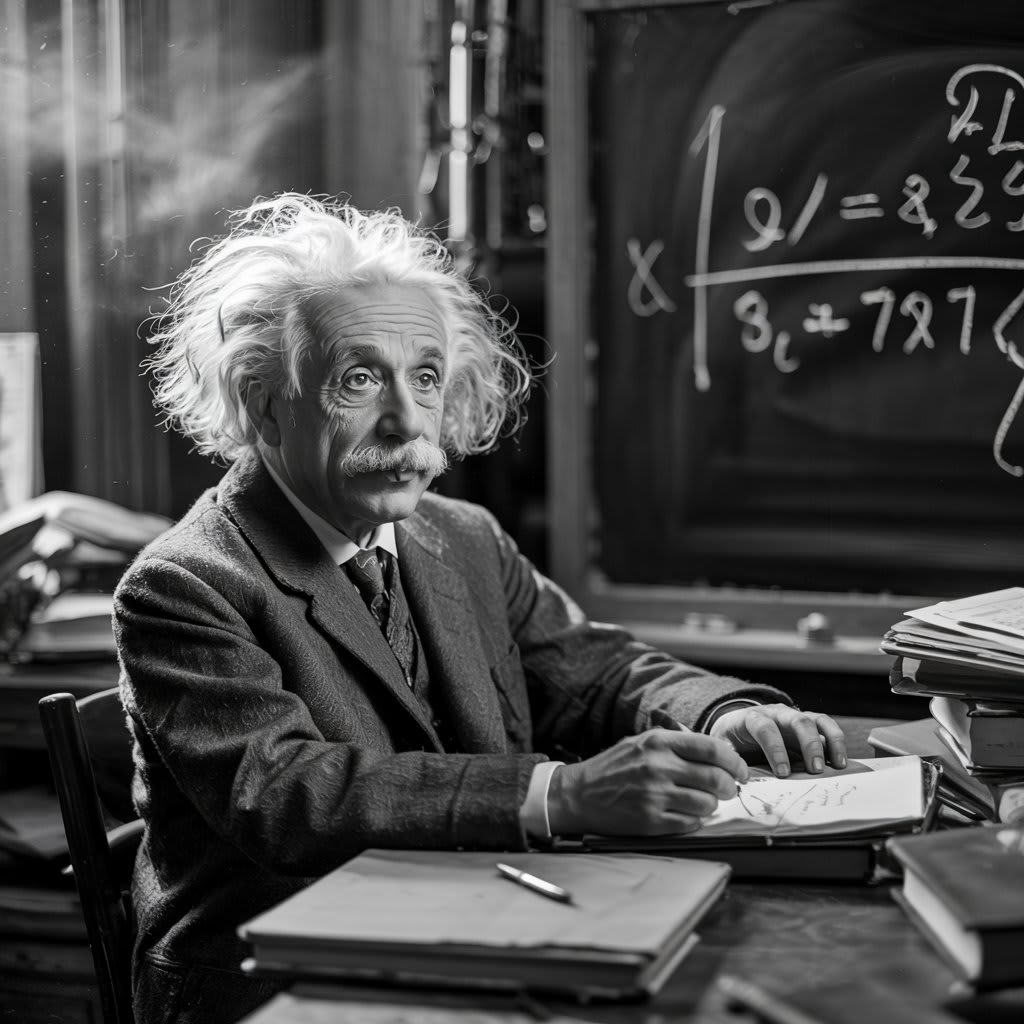
Albert Einstein: The Life and Legacy of a Scientific Genius
Albert Einstein, born on March 14, 1879, in Ulm, Germany, is widely regarded as one of the most influential physicists of the 20th century. His groundbreaking theories reshaped our understanding of the universe and laid the foundation for many modern scientific advancements.
Early Life and Education
Einstein was born into a secular Jewish family. His father, Hermann Einstein, was an engineer and salesman, while his mother, Pauline Koch, was a homemaker with a passion for music. The family moved to Munich when Albert was a year old, where Hermann and his brother Jakob founded an electrical engineering company.
As a child, Einstein exhibited a deep curiosity about the world around him. He was particularly fascinated by a compass his father showed him, pondering the invisible forces that caused the needle to move. Despite a slow start in speaking, he excelled in mathematics and physics from a young age. By the age of 12, he had taught himself algebra and Euclidean geometry, and he mastered calculus by 14.
In 1894, the Einstein family moved to Italy due to business difficulties. Albert stayed behind to finish his schooling but soon joined his family in Pavia. He later enrolled at the Swiss Federal Polytechnic School in Zurich in 1896, intending to become a teacher in physics and mathematics. There, he met Mileva Marić, a fellow student who would later become his first wife.
Early Career and the "Annus Mirabilis"
After graduating in 1900, Einstein struggled to find a teaching position and eventually took a job at the Swiss Patent Office in Bern in 1902. This position allowed him ample time to ponder scientific questions and conduct research in his spare time.
In 1905, often referred to as his "Annus Mirabilis" or "Miracle Year," Einstein published four groundbreaking papers in the journal Annalen der Physik. These papers covered:
The Photoelectric Effect: Explaining how light can eject electrons from a material, introducing the concept of light quanta or photons. This work laid the foundation for quantum theory and earned him the Nobel Prize in Physics in 1921.
Brownian Motion: Providing a theoretical explanation for the erratic movement of particles suspended in a fluid, offering empirical evidence for the existence of atoms.
Special Theory of Relativity: Introducing the idea that the laws of physics are the same for all non-accelerating observers and that the speed of light is constant, leading to the famous equation E=mc².
Mass-Energy Equivalence: Demonstrating that mass and energy are interchangeable, fundamentally altering our understanding of physics.
Academic Recognition and General Relativity
Einstein's 1905 papers garnered significant attention, leading to academic appointments. In 1909, he became a professor at the University of Zurich, followed by positions at the German University in Prague and the Swiss Federal Institute of Technology.
In 1915, Einstein presented his General Theory of Relativity, extending his Special Theory to include gravity. He proposed that massive objects cause a distortion in space-time, which is felt as gravity. This theory was confirmed in 1919 when British astronomer Sir Arthur Eddington observed the bending of starlight around the sun during a solar eclipse, catapulting Einstein to international fame.
Later Life and Emigration to the United States
Einstein's fame grew throughout the 1920s, and he became a prominent public figure, advocating for pacifism and Zionism. However, the rise of the Nazi regime in Germany posed a significant threat to Einstein, who was Jewish. In 1933, while visiting the United States, he decided not to return to Germany and accepted a position at the Institute for Advanced Study in Princeton, New Jersey. He became a U.S. citizen in 1940.
During World War II, Einstein signed a letter to President Franklin D. Roosevelt, warning of the potential development of atomic weapons by Nazi Germany. This letter led to the establishment of the Manhattan Project. Although he did not work directly on the project, Einstein later expressed regret about his minor role in the development of nuclear weapons and became an advocate for nuclear disarmament.
Personal Life and Legacy
Einstein was married twice—first to Mileva Marić, with whom he had two sons, Hans Albert and Eduard, and a daughter, Lieserl, whose fate remains unknown. After divorcing Mileva, he married his cousin Elsa Löwenthal in 1919.
Beyond his scientific achievements, Einstein was known for his humanitarian efforts. He was an outspoken critic of racism and segregation in the United States and was involved in civil rights movements. He was also offered the presidency of Israel in 1952, which he declined, stating he lacked the necessary experience.
Einstein continued to work on theoretical physics until his death on April 18, 1955, in Princeton. His brain was preserved for research, leading to numerous studies attempting to uncover the source of his genius.
Conclusion
Albert Einstein's contributions to science revolutionized our understanding of the universe. His theories of relativity and quantum mechanics remain cornerstones of modern physics. Beyond his scientific prowess, Einstein's advocacy for peace, civil rights, and education left an indelible mark on society. His legacy endures, inspiring countless individuals to explore the mysteries of the cosmos and to strive for a more just and compassionate world.
About the Creator
Keep reading
More stories from writers in Men and other communities.
Beating The Odds And Doctor Death
Hello Death To think that I was happy, content, and comfortable just a few short years ago, makes me long for the past. When everything changed, it all spiraled pretty fast. And yet, out of all the constant ickyness, somehow the need to survive and fight back hasn't died off in me.
By Jason Ray Morton 7 days ago in Men
The Aviator: How Howard Hughes Defied the Skies and Shaped Hollywood History
When The Aviator premiered in 2004, audiences were drawn into the extraordinary life of Howard Hughes, a man whose ambitions seemed limitless. Directed by Martin Scorsese and starring Leonardo DiCaprio, the film chronicles Hughes’ journey as an aviation innovator, film producer, and larger-than-life personality. The story explores the triumphs and tragedies of a man driven by genius, obsession, and the relentless pursuit of perfection.
By Lukáš Hrdlička2 days ago in Men
Early March 2026: 4 Goals Accomplished
It's early March and I've now accomplished my 4th writing goal for the year of 2026. Before diving into the behind-the-scenes of it... why not tell you up front what that accomplishment was? I was published in a 2nd publication for this year. Published in Helix Literary Magazine out of Central Connecticut State University. You can read it for free right now!
By Stephen Kramer Avitabile6 days ago in Writers



Comments
There are no comments for this story
Be the first to respond and start the conversation.