
America's Journey Toward Gender Equality in Leadership: A Question of Progress?
Despite its legacy of promoting gender equality, the U.S. has yet to elect a female president, raising questions about true progress in leadership.
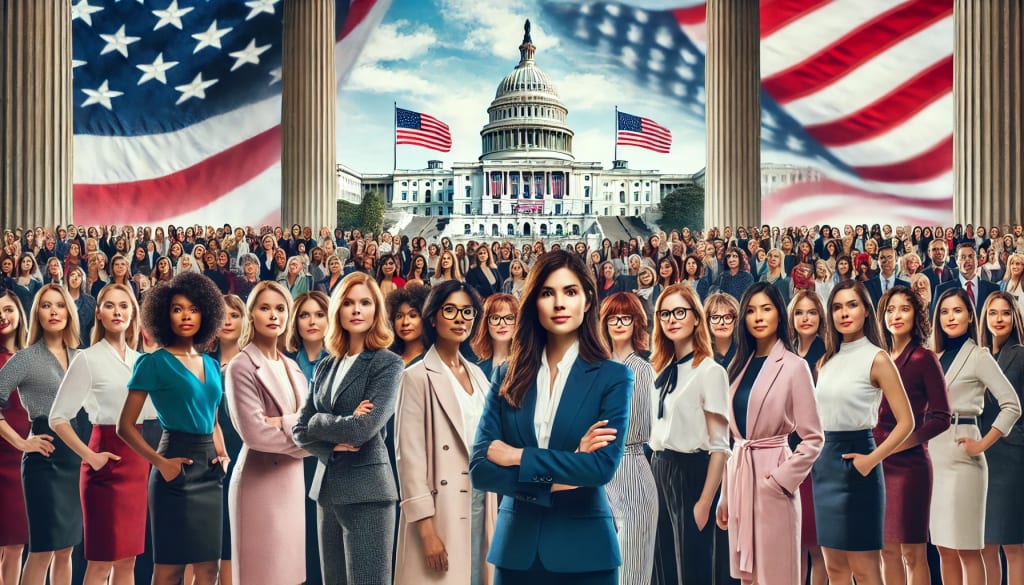
America's Journey Toward Gender Equality in Leadership: A Question of Progress?
America is undeniably one of the greatest nations in the world. It is a land where diversity thrives—immigrants from every corner of the globe have made America their home, and this vast array of cultures, traditions, and beliefs contributes to the country’s dynamic social fabric. It is often said that “the world is in America,” and this rings true when you explore its cities and neighborhoods, where you find communities from all walks of life.
The U.S. prides itself on promoting equality, especially gender equality. Laws and movements aimed at uplifting women’s rights have long been a cornerstone of American social progress. From the women’s suffrage movement, culminating in the right to vote in 1920, to ongoing battles for equal pay and reproductive rights, America has certainly come a long way. But there remains one glaring question: why has the U.S., a country that champions gender equality, never had a female president?
In contrast, many European nations have long embraced female leadership. Countries like Germany had Angela Merkel serving as Chancellor for over a decade. Finland currently has Sanna Marin as its Prime Minister, one of the youngest and most progressive leaders globally. Denmark’s Mette Frederiksen and Estonia’s Kaja Kallas have also risen to the highest political offices in their respective nations. These women have broken barriers in their countries, proving that female leadership is not only possible but successful. Even the United Kingdom, known for its deep-rooted traditionalism, had Margaret Thatcher and later Theresa May as Prime Ministers.
But this phenomenon isn’t limited to developed nations. Countries the U.S. often refers to as "developing" or "third world" have had female leaders as well. India, a vibrant democracy, had Indira Gandhi as its Prime Minister in the 1960s and 1980s. Sri Lanka, a smaller South Asian country, saw Sirimavo Bandaranaike become the world’s first female Prime Minister in 1960. Even countries that America has called "regressive" when it comes to women’s rights have seen female leadership. Pakistan had Benazir Bhutto as its Prime Minister in the 1980s and 1990s, and Bangladesh has been led by Sheikh Hasina and Khaleda Zia for several decades. These nations, often characterized as conservative or patriarchal, have managed to elect women to their highest offices, leaving many to wonder—why not America?
Even in Africa, a continent often stereotyped as lagging in gender equality, female leadership is not unheard of. Liberia had Ellen Johnson Sirleaf, the continent’s first elected female president, and Ethiopia currently has Sahle-Work Zewde as its president, showing that the movement toward female leadership is not confined by geography or economic development status.
So why, after more than 245 years of independence, has the United States failed to elect a woman as president? Is it simply a case of bad timing, or does it reveal a deeper, more systemic issue? Some argue that the U.S. political landscape is still steeped in traditional gender roles that make it harder for women to ascend to the presidency. While the country promotes feminism in many aspects of life—such as women’s freedom to dress as they choose, control their reproductive rights, and participate in all levels of the workforce—it seems hesitant to embrace a female as the commander-in-chief.
Could this be a form of hypocrisy? A country that leads the world in progressive values yet stumbles when it comes to actualizing them in its highest office? Or is it a reflection of an electorate that is, perhaps unconsciously, not yet ready to see a woman as the ultimate decision-maker? These questions challenge the narrative that America is always at the forefront of gender equality.
True equality isn’t just about the freedom to make personal choices; it’s about opportunity and access. It’s about ensuring that women, who make up half the population, can achieve the same levels of power and influence as men, particularly in leadership roles. After all, if nations with far fewer resources and a longer history of gender inequality can break the mold, why can’t the United States?
As we reflect on this, it begs the question: Is gender equality in America truly realized if no woman has yet ascended to the presidency? Or is the U.S. still clinging to subconscious biases that prevent this from happening? Until the day comes when a woman can lead America, it’s worth pondering whether the country has fully lived up to its ideals of freedom and equality.
Real gender equality will be achieved not when women can simply wear what they want, but when they can reach the pinnacle of power—without favoritism or prejudice. Only then can America truly call itself a leader in gender equality.
About the Creator
Keep reading
More stories from writers in Men and other communities.
Why You're Getting Friendzoned (And How to Fix It)
Getting stuck in the friendzone happens to countless guys who wonder why their romantic interest sees them as "just a friend." For men who keep finding themselves in this frustrating situation, understanding the real reasons behind getting friendzoned is the first step toward changing the pattern.
By LaMarion Ziegler3 days ago in Men
Wild Card Weekend Recap: What Happens Now?
I think I figured out why I love Wild Card Weekend so much. It's because it's the first playoff anything of the calendar year. The NFL season starts in the fall, and once upon a time, the champion was crowned either on or slightly before New Year's. The evolution of the NFL schedule has resulted in the playoffs starting just into the New Year, and currently, the final week of the season falls on the first weekend of the New Year, with Wild Card Weekend coming a week after that. So yes, chronologically, the NFL's Wild Card Weekend serves as the first playoff anything of the calendar year.
By Clyde E. Dawkins5 days ago in Unbalanced




Comments
There are no comments for this story
Be the first to respond and start the conversation.