
"Sacred Bonds: Marriage in World Religions"
A Comparative Look at How Major Faiths Define, Celebrate, and Honor the Institution of Marriage

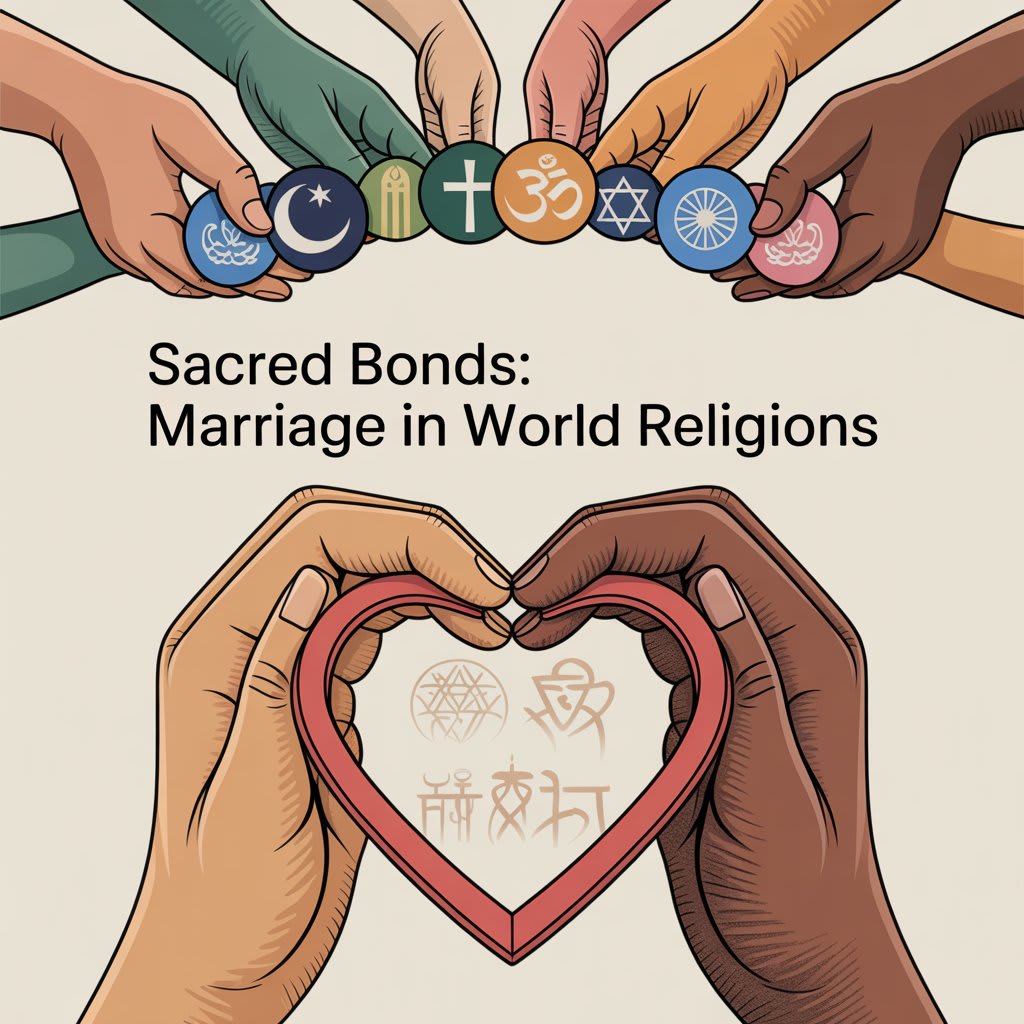
Marriage is not merely a legal contract or cultural tradition—it is a deeply spiritual and sacred institution in nearly every religion of the world. Across faiths, marriage is often regarded as a divine union, a path to personal growth, moral responsibility, and social stability. Though customs, rituals, and interpretations vary, the underlying values of commitment, love, and harmony unite religious perspectives on marriage. This essay explores how marriage is viewed, practiced, and celebrated in six major world religions: Islam, Christianity, Hinduism, Judaism, Buddhism, and Sikhism.
Islam: A Sacred Contract
In Islam, marriage (Nikah) is a vital institution prescribed by the Qur’an and practiced by the Prophet Muhammad ﷺ. It is seen as both a sacred covenant (mithaq ghaliza) and a legal contract between two consenting adults. The Qur’an emphasizes love, mercy, and tranquility between spouses:
“And among His signs is that He created for you from yourselves mates that you may find tranquility in them...” (Qur’an 30:21)
Islamic marriage requires the consent of both parties, the presence of witnesses, and a mahr (bridal gift) given by the groom to the bride. Polygamy is permitted (up to four wives) under strict ethical guidelines, but monogamy remains the norm. Islam also places strong emphasis on the roles of mutual respect, shared responsibility, and compassion in marriage.
Christianity: A Covenant Before God
Marriage in Christianity is often described as a sacred covenant rather than merely a legal contract. In most Christian traditions, marriage is a holy sacrament—a union blessed by God, reflecting the love between Christ and the Church.
“Therefore what God has joined together, let no one separate.” (Mark 10:9)
Christian marriage ceremonies are traditionally held in churches and presided over by clergy. Vows of faithfulness, love, and lifelong partnership are exchanged. Roman Catholicism views marriage as one of its seven sacraments and opposes divorce, except under specific circumstances (annulment). Protestant denominations vary in their doctrines but also uphold the sanctity of marital commitment.
Hinduism: A Spiritual Duty (Dharma)
Hinduism treats marriage (Vivaha) as a sacred sacrament (Sanskara), an essential stage in the life of a person—particularly within the Grihastha (householder) stage. Marriage is not just a personal or romantic choice but a duty to family, society, and the cosmos.
“Let the husband and wife be as one mind, one soul, and always kind to one another.” (Rig Veda)
Hindu weddings are rich in symbolism and rituals. The Saptapadi—seven steps taken together around the sacred fire—signifies mutual promises. Traditionally arranged by families, Hindu marriages emphasize compatibility of values, social status, and spiritual goals. Love is seen as a growing journey rather than the initial spark.
Judaism: A Partnership in Holiness
In Judaism, marriage (kiddushin) is a sacred covenant that unites two individuals in a relationship of mutual responsibility and spiritual purpose. The Ketubah (marriage contract) outlines the rights and duties of both partners and protects the bride's financial security.
“It is not good for man to be alone; I will make a fitting helper for him.” (Genesis 2:18)
Jewish weddings include rituals like the chuppah (wedding canopy), representing the couple's new home, and the breaking of the glass, symbolizing the fragility of life and joy even in sorrow. Orthodox and Conservative Jewish traditions maintain clear gender roles, while Reform Judaism offers more egalitarian views. Family, faith, and community are deeply tied to the Jewish conception of marriage.
Buddhism: A Personal and Ethical Choice
Unlike many other religions, Buddhism does not consider marriage a religious sacrament, nor is it mandated by scripture. Instead, marriage is viewed as a personal, social arrangement governed by ethical principles such as love, respect, and non-harm (ahimsa).
“Happiness in marriage depends on how well we treat each other.” — From the Sigalovada Sutta
Buddhist teachings stress the importance of compassion, right speech, and mindfulness within a marital relationship. Monks do not marry, as they renounce worldly ties for spiritual practice. Lay Buddhists, however, are encouraged to maintain moral conduct and loyalty in their relationships. Marriage ceremonies vary widely across Buddhist cultures and may incorporate local traditions more than strict religious doctrine.
Sikhism: Union of Souls
In Sikhism, marriage (Anand Karaj) is a spiritual union between two equals, where both partners are devoted to each other and to God. The ceremony is conducted in the presence of the Guru Granth Sahib, the Sikh holy scripture.
“They are not said to be husband and wife, who merely sit together. Rather, they alone are called husband and wife, who have one soul in two bodies.” (Guru Granth Sahib)
The Sikh wedding ceremony involves four Laavaan (hymns) recited as the couple walks around the scripture, signifying the spiritual steps of marital unity. Sikhism promotes monogamy, equality, and mutual service. Dowry is strictly forbidden, and arranged marriages, while common, are expected to honor consent and equality.
Common Threads Across Religions
Despite the vast diversity in traditions and doctrines, several common themes emerge:
Sanctity and Purpose: Almost all religions view marriage as sacred and purposeful—not merely for physical companionship but for spiritual and moral growth.
Commitment and Fidelity: Faithfulness is emphasized universally. Marriage is seen as a long-term commitment requiring loyalty, patience, and understanding.
Family and Social Stability: Marriage is often viewed as the bedrock of family and society. It provides a stable environment for raising children and fulfilling religious duties.
Gender Roles and Evolving Interpretations: While traditional roles have been gender-specific in many religions, modern interpretations often stress equality and partnership.
Community and Ceremony: Religious weddings are typically communal celebrations, bringing together families and reinforcing cultural identity.
Conclusion
Marriage, across all major world religions, serves as a foundational institution that blends spiritual aspirations with human connection. It is a platform for companionship, responsibility, and divine purpose. Whether viewed as a covenant, contract, or sacrament, marriage holds a revered place in religious life.
In a world increasingly shaped by personal choice and secular values, understanding marriage through the lens of faith enriches our appreciation of its deeper meaning. The diversity of religious perspectives offers wisdom not only for those who marry within faith traditions but also for interfaith and modern marriages seeking depth, commitment, and sacred purpose.
About the Creator
Keep reading
More stories from Zain Ul Abedin Khan and writers in Marriage and other communities.
"The Sacred Bond: Understanding Sexual Intercourse in Islam"
Introduction Islam is a complete way of life that addresses all aspects of human existence—spiritual, physical, emotional, and social. Among these aspects, the institution of marriage holds a special place, as it provides not only companionship and emotional support but also a lawful and dignified outlet for sexual desires. In Islamic teachings, sexual intercourse (hambistari) within marriage is not viewed as a mere physical act but as a sacred bond that nurtures love, mercy, and tranquility between husband and wife.
By Zain Ul Abedin Khan7 months ago in Marriage
Marriage 2.0: How Couples Are Rewriting Love in 2026
Marriage in 2026 no longer looks like it did a decade ago. The institution hasn’t disappeared, but it has evolved quietly, deeply, and intentionally. Today’s couples are not abandoning marriage; they are upgrading it. Welcome to Marriage 2.0, where love is no longer defined by roles, control, or silent sacrifice, but by awareness, partnership, and emotional maturity.
By Sathish Kumar 5 days ago in Marriage


Comments (1)
This article's really interesting. It's cool to see how different religions view marriage. I've always thought it's a big deal, no matter the faith. Looking forward to reading about the rest.