
Why Shifting Out of Metro Cities Might Change Your Life for Good?
A glance into what the beautiful small towns have to offer.

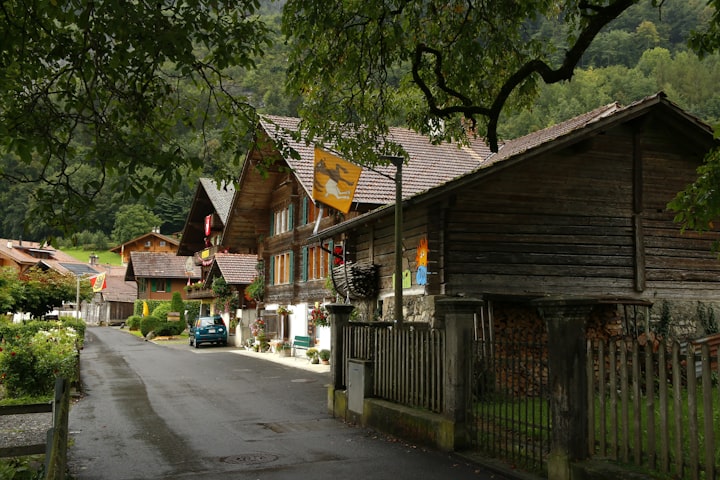
Last day I was looking at some not-so-old photos and began reminiscing about what life meant back then. 2019 and before feels like a completely different period now. I moved out of the city earlier last year due to the coronavirus and have been staying at my parental home since. This is the first time in years that I have been here for more than a few weeks. Now that I envisage it, the beauty of these small towns is exceptional compared to the big busy cities.
The global movement
Global economies have come down to their knees as the COVID19 pandemic completed a year, proving wrong, the assumption that the virus wouldn’t last long. With small businesses shut down and corporate adapting to work from home, people have started migrating to relatively cheaper rural towns. Since last year, the metropolitan cities have seen a steep decline in their residential population. While cities cling to the hope that when all this is over, their beloved residents will return, this might not stand true.
An Economic times survey put forward the following data:
- 26-35 year age group: 25% of the respondents considering a tier-2 city
- 36-45 year age group: 28% of the respondents want to shift out of metros.
- Housing cost and pollution being the top 2 reasons.
Read the full report at ET survey.
With indoors becoming the new normal, corporate employees and small business owners are starting to look for bigger living spaces. Business owners are resorting to owning working spaces outside of cities to save rents. Companies are encouraging their employees to work from home as they’re saving a lot of money by opting out of lease agreements. Employees are starting to buy larger living spaces as all their work is being done from home now. For corporate employees, almost all the work can be done with a laptop and a stable internet connection. From developers to directors, a wide range of work is possible through video conferencing and today's highly sophisticated developer tools. In this scenario, outskirts and rural towns provide a significantly better return on financial investment.
Here is a breakdown of the total monthly expense for big cities and towns.
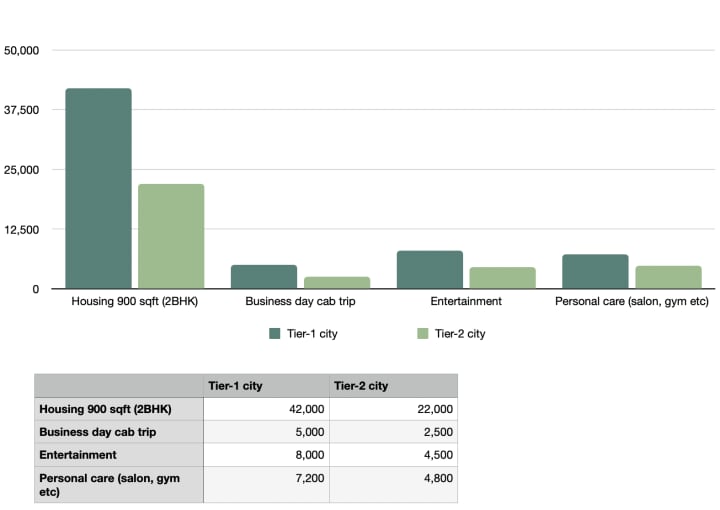
Housing is the deciding factor in most cities as these expenses can even stretch by more than thrice the base value. The housing cost in Mumbai is 190.90% (rough estimate) of that of Pune. The housing cost in New York City is 231% (rough estimate) that of Hightstown, New Jersey; Hightstown being safer than 90% of the U.S. cities.
Small business owners face less competition in towns and can scale their businesses at a lower cost. Bigger spaces come with the benefits of upgrading business models and allowing things to work much more efficiently. Business owners have the opportunity to save rent and use that credit in inventory management and hiring manpower. Similarly, employees working from home have the opportunity of owning bigger spaces in towns to provide better open-space facilities for their families at less expense. In addition to that, the time invested in traveling to the workplace is reduced. Hence, better work-life balance.
When the pandemic ends, the ways of the world will not be the same as pre-2020. The change has already begun as people are starting to realize the importance of freedom and safety. The ways of work are changing with a focus on flexibility and balance. People are understanding the importance of space and resources and are opting for a more sustainable lifestyle.
I am writing this, unwilling to return to the concrete jungle.
About the Creator
Keep reading
More stories from Aish kharkwal and writers in Longevity and other communities.
3 Things To Learn From The Longest Living People on Earth
At some point in time, we all want to make changes to our routines and habits for a better life. There comes a time when a person tells themselves, “You gotta start doing better, you gotta adopt healthier ways”. I was going through that phase when I started researching and came to know about Okinawa.
By Aish kharkwal5 years ago in Longevity
Day 4 of Quitting
If this is how sobriety feels, maybe it’s better to go through life a little buzzed… this, along with other hits like, I want to kill myself, I wish I was dead, and I’m going to throw myself off a bridge have been the only thoughts on rotation these past few days. I promise myself that if, in a month, I still feel like this (‘this’ meaning despondent, full of rage, and simultaneously numb) I can go back to smoking. Until mid-February though? Nicotine is off the table.
By sleepy drafts11 days ago in Longevity
What You See Is Not a Ship: At 385 Metres Long, Havfarm Is the World’s Largest Offshore Salmon Farm
At first glance, Havfarm looks like a massive industrial ship drifting across the open sea. Stretching an astonishing 385 metres in length, it rivals some of the world’s largest oil tankers and aircraft carriers. But Havfarm is not a ship at all. It is the world’s largest offshore salmon farm, a floating giant designed to transform the future of global aquaculture.
By Fiaz Ahmed Brohi7 days ago in Longevity



Comments
There are no comments for this story
Be the first to respond and start the conversation.