
"When Loyalty Becomes Injustice: Choosing Family Over Truth"
Why do we often defend the wrong just because they are 'ours' and ignore justice in the name of relationships?

We all value loyalty. It is the glue that binds families, friendships, and communities together. But what happens when loyalty turns into blind support even when the people we love are clearly in the wrong? What happens when we ignore truth and justice simply because it threatens the image or comfort of someone close to us?
This isn't just a philosophical question. It's a lived reality for many people.
The Dilemma of Relationships vs. Righteousness
Imagine this: your brother insults someone unfairly. Or your childhood friend cheats in a business deal. Or your cousin mistreats their spouse. Deep inside, you know it's wrong. But instead of standing up for what's right, you say: “He's family. I can't go against him.”
Sounds familiar?
Most of us have found ourselves in this uncomfortable position forced to choose between loyalty to someone close and the voice of conscience calling for justice.
Unfortunately, far too often, we choose the person, not the principle.
Truth Doesn’t Change Based on Who Speaks It
One of the most dangerous mental habits is assuming that truth comes with identity. If a stranger says something right, we ignore it. But if a family member says the same thing, we accept it without question even when it’s wrong.
This mindset breeds injustice.
Truth should be accepted no matter who speaks it, and wrong should be opposed no matter who does it. But many people reverse this: they reject truth if it comes from someone they don’t like, and they defend wrong because it's done by someone they do love.
Loyalty vs. Integrity: A False Choice
The idea that loyalty means unconditional support is flawed. True loyalty doesn’t mean covering up someone’s mistakes it means helping them become better. It means telling your brother, friend, or spouse when they are wrong not staying silent to protect your bond.
Integrity demands that we don’t stay silent in the face of injustice. ven if the injustice is committed by our own.
History is filled with examples where people chose integrity over loyalty. And they were remembered for their courage. But sadly, in our homes and communities, the opposite happens. We tolerate toxic behavior from relatives, ignore the cries of the oppressed, and call it “family honor.”
Injustice in the Name of Love
Here’s the bitter truth: When we ignore someone’s wrongdoing just because they’re “ours,” we don’t show love we enable injustice.
A mother covers up her son’s abuse of his wife and another family breaks.
A father denies his daughter's right because of pressure from community elders.
A friend justifies corruption because the culprit is from the same tribe, race, or religion.
These aren’t acts of love or protection. These are acts of betrayal betrayal of the truth, and betrayal of the people who are harmed.
Social Hypocrisy: The Double Standards
What’s worse is the double standard. When our people lie, we call it “strategy.” When others lie, we call it “evil.” When our people fail, we offer excuses. When others fail, we demand punishment.
This selective justice creates a toxic culture where truth has no value unless it serves our interests.
It teaches children that popularity is more important than honesty, and loyalty to blood is more important than doing what is right.
Justice Begins at Home
Many people campaign for justice in the world online, in protests, through donations. But they forget: justice starts at home.
If we can’t speak the truth to our fathers, mothers, siblings, friends how can we expect the world to change?
The real test of character is not how loudly we speak truth to strangers but how humbly and firmly we speak it to those we love.
Speaking the Truth Without Hatred
Now, let’s be clear: standing up for justice doesn’t mean being harsh or disrespectful.
It doesn’t mean humiliating your loved ones in public.
But it does mean having the courage to say:
“I love you, but you’re wrong. And I won’t support your wrong.”
That single sentence, spoken with honesty and respect, can save relationships. It can awaken people. It can stop injustice before it grows.
A Culture of Silence Must End
In many cultures, especially in collectivist societies, silence is seen as “peace.” People avoid confrontation to “keep the family united.” But this silence comes at a cost broken hearts, destroyed marriages, suppressed truths.
Peace that is built on silence in the face of injustice is not peace it’s a ticking time bomb.
If we truly want peace, we need to build a culture where:
Truth is honored above ego.
Justice is valued over blind loyalty.
Relationships are strong enough to handle honest conversations.
Conclusion: Choose Courage, Not Comfort
It’s not easy to go against the people you love. It hurts. It’s uncomfortable. It feels lonely.
But real courage is not in fighting strangers. It’s in holding your own accountable.
Real love is not in hiding someone’s faults. It’s in helping them correct them.
So next time you’re faced with a situation where truth and relationships collide ask yourself:
> “Am I choosing comfort over courage?
Am I standing with justice, or just standing with my circle?”
The answer might not be easy. But it will be honest. And sometimes, that’s all the world needs to change one honest voice at a time.
About the Creator
How China Is Challenging the U.S. to Become the Next Great Space Power
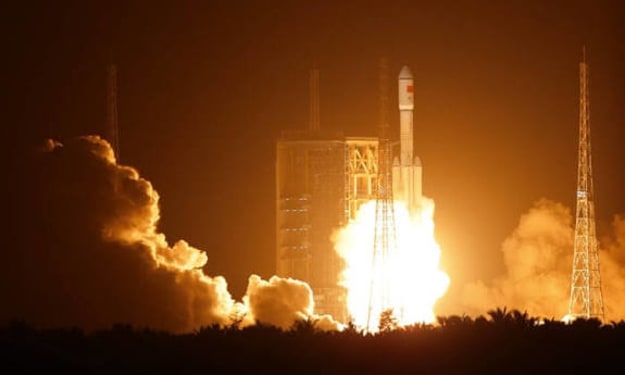
As Beijing’s space ambitions expand, Washington faces an intensifying geopolitical and technological rivalry in orbit and beyond. In the early decades of the 21st century, the United States long stood unchallenged as the dominant space power — a position built on decades of NASA leadership, unmatched launch capability, and a vibrant commercial space economy. But today, a determined China is mounting one of the most consequential strategic challenges in space since the Cold War, pushing to rival — and ultimately surpass — the U.S. in space influence, technology, and strategic advantage. National Strategy and Long‑Term Vision China’s leaders have openly signaled their ambition to become a global space powerhouse. Official space policy documents and state planning envision a broad array of capabilities — from heavy‑lift rockets to lunar exploration — aimed at reshaping the space order that has been U.S.‑dominated for decades. According to analyses of government planning, Beijing intends to establish a full suite of launch vehicles, satellites, and space infrastructure that could surpass current international norms by mid‑century. Underpinning this vision is a belief among Chinese space officials that self‑reliance and indigenous innovation are key to international competitiveness. Recent reports in state media emphasize that China’s aerospace industry is pushing far beyond imitation toward original technological breakthroughs in areas like rocket manufacturing, intelligent space systems, and advanced materials — all with the strategic goal of securing leadership in space. Commercial Space: From Government Giants to Private Innovators China’s rapid ascent isn’t limited to state space agencies. A growing ecosystem of private space companies — much like the commercial boom seen in the U.S. — has taken root, focusing on reusable rockets, satellite networks, and novel space services. A recent South China Morning Post report highlights Beijing’s push to encourage private innovation within its space sector, supporting technologies such as reusable launch vehicles, space debris monitoring, extraterrestrial resource utilization, and even in‑space biomanufacturing — fields long dominated by U.S. firms such as SpaceX or Blue Origin. This commercial expansion broadens China’s capabilities and compresses the technological gap with the U.S., challenging American assumptions that commercial innovation is exclusively an American forte. It also signals a shift in global space economics, where China may soon contend for commercial markets once dominated by Western companies. Military and Strategic Dimensions Alongside civil and commercial ambitions, China’s space strategy has clear military implications. U.S. strategic assessments note Beijing’s efforts to build counterspace capabilities — systems designed to deter, deny, or degrade another nation’s satellite operations — a key advantage in future conflicts. China has already deployed anti‑satellite weapons, jamming technologies, and sophisticated ground‑to‑space radar systems that could threaten U.S. space assets in a crisis. For the United States, which relies heavily on space systems for communication, navigation, and battlefield awareness, these capabilities represent a serious strategic challenge. Beijing’s ability to field space and counterspace technologies could blunt some of Washington’s military advantages in the Asia‑Pacific region and beyond. Lunar and Deep Space Objectives China’s Chang’e lunar exploration program is another marker of its space ambitions. With a series of increasingly complex robotic missions and plans for an International Lunar Research Station by the 2030s, Beijing aims to be a leading voice in lunar science and development — directly challenging the U.S. Artemis program and international partnerships spearheaded by NASA. � Wikipedia Missions like the strategically significant Queqiao‑2 communications relay satellite, which supports lunar missions over long distances, further demonstrate China’s growing sophistication in deep space operations and infrastructure deployment. U.S. Response: Maintaining Leadership Recognizing the challenge, U.S. policymakers are pushing legislative and strategic initiatives designed to preserve American competitiveness in space. A newly passed NASA authorization package includes provisions aimed at reinforcing U.S. lunar presence, strengthening Earth orbit assets, and countering Chinese influence in space science and technology — signaling a bipartisan consensus on the gravity of the space rivalry. A New Era of Cosmic Competition The emerging science and technological competition between China and the United States in space is unlike anything seen since the original Moon race. Today’s contest spans not only national prestige but military advantage, commercial opportunity, and scientific discovery. As each side pursues its vision of space dominance, the outcome will shape global power structures for decades to come — affecting diplomacy, security, and economic leadership both on Earth and beyond. If you’d like alternative versions, transcripts, or a set of headline + subtitle options for this topic, just let me know!
By Fiaz Ahmed about 19 hours ago in Longevity
3 Things to Do Before Bed for Better Blood Sugar, According to Dietitians
KEY POINTS To keep your blood sugar from spiking in the morning, what you do the night before matters. Eating a balanced snack, limiting screens and gently moving all support healthy blood sugar. Other ways to help your morning blood sugar include reducing alcohol and managing stress.
By Good health to everyone3 days ago in Longevity



Comments
There are no comments for this story
Be the first to respond and start the conversation.