
United States Radiation Dose Management Market Size and Forecast 2025–2033
Patient Safety, Regulatory Compliance, and AI-Driven Imaging Redefine Radiation Management in U.S. Healthcare

United States Radiation Dose Management Market Overview
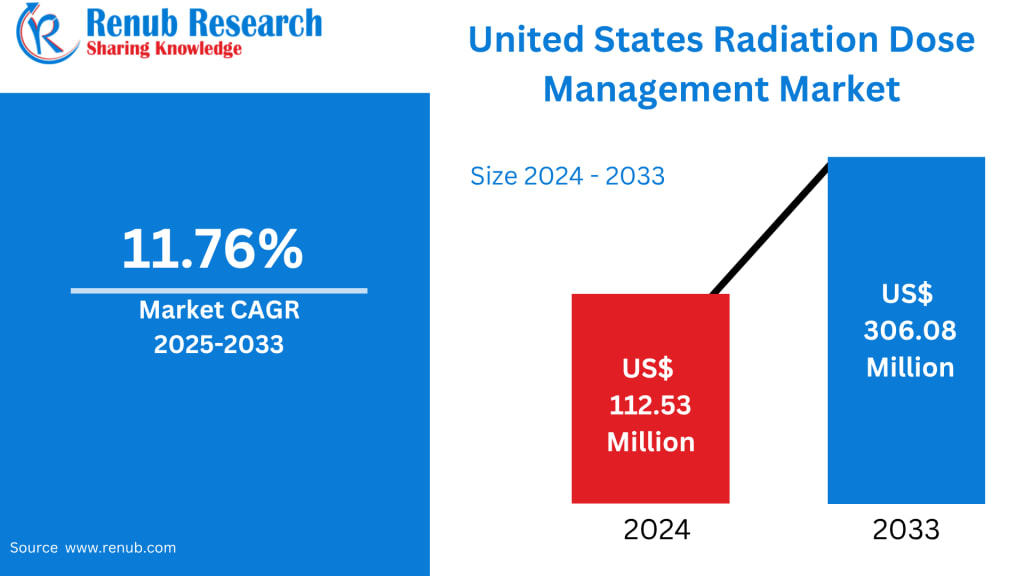
The United States Radiation Dose Management Market is undergoing rapid expansion as patient safety becomes a central pillar of modern healthcare delivery. According to Renub Research, the market is expected to reach US$ 306.08 million by 2033, growing from US$ 112.53 million in 2024, at a strong CAGR of 11.76% from 2025 to 2033. This growth trajectory highlights the increasing importance of monitoring, analyzing, and optimizing radiation exposure across diagnostic and interventional imaging procedures.
Radiation dose management refers to software solutions and associated services designed to track patient exposure to ionizing radiation from modalities such as computed tomography (CT), fluoroscopy, mammography, and nuclear medicine. With millions of imaging procedures performed annually in the United States, healthcare providers are under increasing pressure to ensure radiation is kept “as low as reasonably achievable” (ALARA) without compromising diagnostic accuracy.
The rising prevalence of chronic diseases—particularly cancer, cardiovascular disorders, and neurological conditions—has significantly increased the use of imaging technologies. As a result, radiation exposure risks have become a major concern for clinicians, regulators, and patients alike. This has accelerated the adoption of advanced radiation dose management platforms across hospitals, diagnostic imaging centers, and ambulatory care facilities nationwide.
United States Radiation Dose Management Industry Outlook
The U.S. healthcare system is among the most technologically advanced in the world, and radiation dose management is benefiting directly from this sophistication. Regulatory oversight by institutions such as the U.S. Food and Drug Administration and the Joint Commission has made radiation monitoring an essential component of quality assurance programs.
Hospitals and imaging centers are increasingly required to document radiation dose levels, analyze exposure trends, and implement corrective measures when thresholds are exceeded. Radiation dose management systems help institutions meet these expectations by automating data collection, enabling real-time monitoring, and generating compliance-ready reports.
Technological progress is further reshaping the market. Artificial intelligence (AI), machine learning, and cloud-based architectures are now integral to next-generation dose management solutions. These innovations allow healthcare providers to personalize radiation doses based on patient size, clinical indication, and imaging modality—significantly improving safety outcomes.
Despite its positive outlook, the market still faces challenges such as high implementation costs, interoperability issues, and uneven adoption across smaller healthcare facilities. Nevertheless, growing awareness of radiation risks and long-term healthcare cost savings continue to support strong market momentum.
Key Factors Driving the United States Radiation Dose Management Market Growth
Growing Patient Safety Concerns
Patient safety has emerged as the primary driver of radiation dose management adoption in the United States. Repeated exposure to ionizing radiation has been linked to an increased risk of cancer and other long-term health complications. With the widespread use of CT scans, nuclear imaging, and interventional radiology procedures, minimizing unnecessary radiation exposure has become a clinical priority.
Radiation dose management solutions enable healthcare providers to track cumulative radiation exposure at the patient level, identify high-risk cases, and adjust imaging protocols accordingly. Hospitals are investing in these systems to reduce adverse outcomes, improve patient trust, and align with national safety initiatives. Increased patient awareness and advocacy have further reinforced the demand for transparent radiation monitoring practices.
Technological Advancements and Digital Integration
Technology is transforming radiation dose management from a retrospective reporting function into a proactive, real-time decision-support tool. AI-powered analytics now allow systems to detect anomalies, benchmark doses against national standards, and recommend optimized imaging parameters.
Cloud-based platforms are gaining popularity due to their scalability, centralized data access, and ability to support multi-site healthcare networks. These solutions allow radiologists, physicists, and administrators to collaborate more effectively while reducing IT infrastructure burdens. Integration with picture archiving and communication systems (PACS) and electronic health records (EHRs) further enhances workflow efficiency and clinical insight.
Stringent Regulatory Environment
The regulatory landscape in the United States strongly favors the adoption of radiation dose management solutions. Accreditation standards and federal guidelines require healthcare organizations to monitor and document radiation exposure as part of patient safety and quality improvement initiatives.
Compliance with these regulations is no longer optional. Facilities that fail to meet dose monitoring requirements risk accreditation penalties, legal exposure, and reputational damage. As a result, investment in advanced dose management software has become a strategic necessity rather than a discretionary expense.
Challenges in the United States Radiation Dose Management Market
High Implementation and Maintenance Costs
One of the most significant barriers to market expansion is the high cost associated with implementing radiation dose management systems. Expenses include software licensing, system integration, hardware upgrades, and ongoing maintenance. For smaller hospitals, independent imaging centers, and rural healthcare facilities, these costs can be prohibitive.
In addition, staff training and system customization add to the financial burden. While long-term benefits such as reduced liability and improved patient outcomes are substantial, short-term budget constraints continue to slow adoption in cost-sensitive settings.
Interoperability and Lack of Standardization
The absence of universally accepted standards for radiation dose reporting presents another major challenge. Variations in imaging equipment, data formats, and reporting protocols make it difficult to aggregate and analyze dose information consistently across platforms.
Interoperability issues can limit the effectiveness of dose optimization efforts and complicate integration with existing hospital information systems. Addressing these challenges will require greater collaboration among equipment manufacturers, software vendors, and regulatory bodies to establish unified frameworks for radiation dose data exchange.
United States Radiation Dose Management Market Overview by States
California Radiation Dose Management Market
California stands at the forefront of radiation dose management adoption, driven by its advanced healthcare infrastructure and strong regulatory environment. Major academic medical centers and large hospital networks across the state have implemented AI-enabled, cloud-based dose monitoring systems to enhance patient safety and operational efficiency.
The state’s emphasis on healthcare innovation, combined with strict compliance requirements, has positioned California as a leader in radiation safety practices. Continued investment in digital health technologies is expected to sustain steady market growth throughout the forecast period.
Texas Radiation Dose Management Market
Texas represents a significant growth market due to its expansive healthcare ecosystem and high volume of diagnostic imaging procedures. Leading institutions such as the Texas Medical Center in Houston are adopting sophisticated dose management platforms to support large, multi-specialty patient populations.
The integration of AI-driven analytics and centralized monitoring tools is helping Texas healthcare providers meet regulatory standards while optimizing imaging workflows. Ongoing expansion of healthcare facilities across the state further supports market development.
New York Radiation Dose Management Market
New York’s radiation dose management market is characterized by strong adoption in urban healthcare centers and academic hospitals. Prestigious institutions such as Memorial Sloan Kettering Cancer Center are leveraging advanced dose optimization technologies to balance diagnostic precision with patient safety.
The state’s commitment to high-quality healthcare delivery and regulatory compliance continues to drive investment in radiation dose management systems, reinforcing New York’s role as a key contributor to national market growth.
Market Segmentation Analysis
By Product & Services
Radiation Dose Management Solutions
Radiation Dose Management Services
By Modality
Computed Tomography
Fluoroscopy & Interventional Imaging
Mammography
Nuclear Medicine
By End User
Hospitals
Ambulatory Care Settings
Others
By States
California
Texas
New York
Florida
Illinois
Pennsylvania
Ohio
Georgia
Washington
New Jersey
Rest of United States
Competitive Landscape and Company Analysis
The U.S. radiation dose management market is moderately consolidated, with global healthcare technology leaders competing through innovation, partnerships, and portfolio expansion. Key players include:
Bayer AG
Koninklijke Philips N.V.
Thermo Fisher Scientific Inc
McKesson Corporation
Cerner Corporation
Agfa-Gevaert NV
Bracco Imaging S.p.A
Canon Medical Informatics
GE HealthCare Technologies Inc.
Guerbet SA
These companies focus on AI integration, cloud deployment, interoperability, and service-based offerings to strengthen their market positions.
Final Thoughts
The United States Radiation Dose Management Market is poised for robust growth through 2033, driven by rising patient safety concerns, stringent regulatory oversight, and rapid technological advancement. As imaging volumes continue to increase, radiation dose management will play an essential role in ensuring safe, compliant, and high-quality diagnostic care.
Despite challenges related to cost and standardization, ongoing innovation and policy support are expected to accelerate adoption across healthcare settings. With the market projected to more than double in value over the forecast period, radiation dose management is set to become a cornerstone of modern radiology practice in the United States.
About the Creator
Renub Research
Renub Research is a Market Research and Consulting Company. We have more than 15 years of experience especially in international Business-to-Business Researches, Surveys and Consulting. Call Us : +1-478-202-3244
Keep reading
More stories from Renub Research and writers in Longevity and other communities.
Japan Cardiac Bio-Implant Devices Market Size and Forecast 2025–2033
Market Snapshot The Japan Cardiac Bio-Implant Devices Market is projected to grow from US$ 1,832.94 million in 2024 to US$ 3,335.92 million by 2033, expanding at a CAGR of 6.88% during 2025–2033.
By Renub Research16 days ago in Longevity
Day 4 of Quitting
If this is how sobriety feels, maybe it’s better to go through life a little buzzed… this, along with other hits like, I want to kill myself, I wish I was dead, and I’m going to throw myself off a bridge have been the only thoughts on rotation these past few days. I promise myself that if, in a month, I still feel like this (‘this’ meaning despondent, full of rage, and simultaneously numb) I can go back to smoking. Until mid-February though? Nicotine is off the table.
By sleepy drafts4 days ago in Longevity
Fair Exchange, No Robberies
Dark Memoirs - Index There are at least two kinds of people in the world: those who write this half-arsed kind of intro to a story that looks to separate the rare and the norm, and those who realise it's an overused framing device and don't.
By Paul Stewart6 days ago in Chapters


Comments
There are no comments for this story
Be the first to respond and start the conversation.