

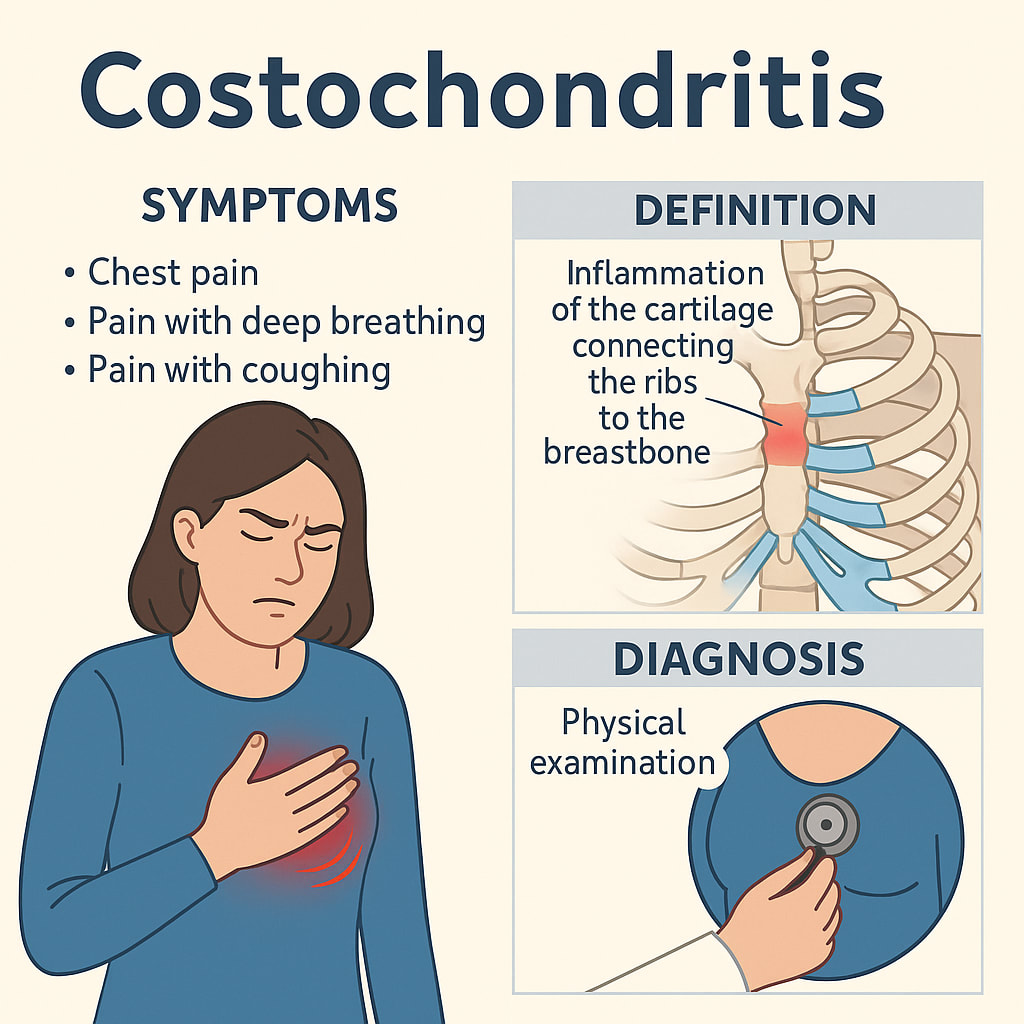
"Costochondritis is inflammation of the cartilage that connects your ribs to your sternum. Your sternum (or breastbone) is the flat bone in the middle of your chest that protects your heart, lungs, and major blood vessels" (webmd.com/pain-management/costochondritis). (1)
Costochondritis can mimic a heart attack. It is a common cause of chest pain. Costochondritis is also sometimes mistaken for Tietze Syndrome, which is a rare condition. Costochondritis usually affects the ribs 2-5, which are lower down one's chest.
Causes
The following is a list of causes that may lead to this condition, since at this time doctors don't know what causes it.
"Infections in your chest,
repeated minor trauma to your chest wall
, coughing or vomiting too hard
Doing intense physical activity
can cause inflammatory disease that affects your joints and spine, such as arthritis. It can
also be a sign of osteoarthritis, rheumatoid arthritis, ankylosing spondylitis,
or other conditions that affect your cartilage.
tumors
using IV drugs (webmd.com/pain-management/costochondritis). (2)
Costochondritis may have no cause. An infection that may cause this is the respiratory tract infection (RTIs), bacteria, viruses, or, in rare cases, fungal infections. The hospital thought that I might have had costochondritis because while I was living in Texas, I came down with pleurisy while I was at work.
Symptoms
The following is a list of common symptoms that are associated with Costochondritis:
chest pain
tenderness, sharp, aching
swelling
difficulty taking a deep breath
pain in shoulder, back or arms
headaches
joint pain
dry cough
fever
left side of breastbone and
affects more than one rib
My symptoms appeared suddenly while I was working. I felt chest pains and shortness of breath. Walking up the stairs to my office became harder. The chest pains also kept intensifying.
Most days, my chest pain is manageable. There are times, however, when moving becomes very difficult, and the pain feels unbearable. During those moments, I need to take aspirin to help with the pain. My discomfort is mostly in my chest, often spreading straight through to my back. It hurts to breathe, and the pain can be sharp or throbbing. When both my chest and back hurt at the same time, I focus on easing one pain at a time.
Diagnosis
According to the Mayo Clinic, when the doctor does the physical exam, they will feel along your breastbone for tenderness or swelling. They may also move your rib cage or your arms in a way that triggers the symptoms. The pain of this condition is similar to that of heart disease, osteoarthritis, lung disease, and gastrointestinal problems. There are no tests (laboratory or imaging tests) to confirm the diagnosis of costochondritis, but your doctor may order a chest x-ray and electrocardiogram to rule out other conditions (mayoclinic.org/disease-conditions/costochondritis/diagnosis-treatment/frc-20371180).
I don't remember much about how I was diagnosed, but I do recall going to the ER. I told the nurse I was having chest pains and trouble breathing. They immediately took me in. I’m unsure if they did an X-ray, but I remember being hooked up to an electrocardiogram. The test was to check if I was having a heart attack. They ran some more tests afterward and told me I had costochondritis. It was a relief to hear I wasn’t having a heart attack.
Living with costochondritis has tested me in ways I never thought possible. I had no idea what it was before that emergency room visit. This article explains what the condition is, what causes it, and how doctors diagnose it. Knowing the basics is the first step to handling this quiet pain. In the next article, I will share how I deal with it every day. I will talk about my routines, remedies, and changes that help me feel better and keep moving forward.
Sources
1. webmd.com/pain-management/costochondritis
2. webmd.com/pain-management/costochondritis
3. mayoclinic.org/disease-conditions/costochondritis/diagnosis-treatment/drc- 20371180
This content is accurate and true to the best of the author’s knowledge and does not substitute for diagnosis, prognosis, treatment, prescription, and/or dietary advice from a licensed health professional. Drugs, supplements, and natural remedies may have dangerous side effects. If pregnant or nursing, consult with a qualified provider on an individual basis. Seek immediate help if you are experiencing a medical emergency.
© 2025 Lisa Jane
About the Creator
Lisa Briskey
I love to write, crochet, and sew. I am a grandmother of two granddaughters.
Follow me on Medium: https://medium.com/@lisabriskey5
And support me on my Ko-fi: https://ko-fi.com/lisaj or https://ko-fi.com/lisabriskey
Keep reading
More stories from Lisa Briskey and writers in Longevity and other communities.
My Costochondritis Journey:
Have you ever felt an ache in your chest, an unwelcome companion that messes up your planned day? Let’s explore the world of costochondritis, a condition that can be a mystery, but together, we’ll uncover its symptoms and discover remedies that can bring relief. The remedies may not work for everyone. Living with this condition is not easy but we can't let it rule our live.
By Lisa Briskeyabout a year ago in Longevity
When Does Spring Start? Understanding the Seasonal Shift
Spring is often associated with warmer temperatures, blooming flowers, and longer days — a welcome transition from winter’s cold grip. But the exact date when spring begins depends on how it is defined. There are two main ways scientists and meteorologists mark the start of spring: astronomical spring and meteorological spring. These definitions can differ by several weeks, leading to some confusion about when the season truly begins. Astronomical Spring: Guided by the Sun Astronomical spring begins with the vernal equinox, the moment when the Sun crosses the celestial equator and day and night are nearly equal in length. In the Northern Hemisphere, this usually occurs on March 19, 20, or 21, depending on the year. In 2026, for example, the equinox falls on March 20. This definition is rooted in Earth’s position in its orbit around the Sun. From the equinox onward, days grow longer and nights shorter, symbolizing the return of light and warmth. Cultures across the world have long celebrated the vernal equinox as a sign of renewal and rebirth, with festivals tied to agriculture, planting, and fertility. In contrast, astronomical spring in the Southern Hemisphere begins around September 22 or 23, when their own vernal equinox occurs, marking the shift from winter into spring below the equator. Meteorological Spring: Based on Weather Patterns Meteorologists use a different system that divides the year into four equal three-month seasons based on temperature cycles. Under this method, meteorological spring begins on March 1 and ends on May 31 in the Northern Hemisphere. This approach is preferred for climate tracking and statistical analysis because it aligns more closely with annual temperature patterns and makes comparing weather data easier from year to year. For example, snowfall totals, rainfall averages, and temperature records are often grouped by meteorological seasons rather than astronomical ones. For everyday life, this definition can feel more intuitive. By early March, many regions already experience milder weather, budding plants, and increased daylight, even if winter technically still exists on the astronomical calendar. Regional Differences Matter Although calendars provide official start dates, spring’s arrival varies greatly depending on location. In warmer regions, signs of spring can appear as early as February, while colder climates may not see consistent spring conditions until April or even May. In United States, southern states such as Texas and Florida often experience spring-like temperatures weeks before northern states like Minnesota or Maine. Europe shows similar variation, with Mediterranean countries warming earlier than Scandinavia. Climate change has also influenced seasonal patterns. Scientists have observed that spring is arriving earlier in many parts of the world, with plants blooming sooner and migratory birds returning ahead of historical averages. These shifts can disrupt ecosystems, affecting pollinators, crops, and wildlife that depend on predictable seasonal cycles. Cultural and Emotional Meaning of Spring Beyond scientific definitions, spring carries deep symbolic meaning. It represents renewal, growth, and fresh beginnings. Many cultures associate spring with holidays and festivals celebrating life and fertility, from Easter to Nowruz and other traditional observances. For individuals, spring often brings emotional relief after months of darkness and cold. Increased sunlight has been linked to improved mood and energy levels, helping reduce symptoms of seasonal affective disorder (SAD). The season encourages people to spend more time outdoors, exercise, and reconnect with nature. So, When Does Spring Really Start? The answer depends on perspective: Astronomical spring: Begins around March 20 (vernal equinox). Meteorological spring: Begins on March 1. Practical spring: Begins when local weather feels warm enough to signal change. All three definitions are valid. Astronomical spring is tied to Earth’s movement around the Sun, meteorological spring to climate patterns, and practical spring to human experience. A Season of Transition Spring is not a single moment but a gradual transformation. Snow melts, rivers swell, flowers bloom, and days lengthen bit by bit. Whether marked by the equinox or by rising temperatures, spring reminds us that change is constant and renewal is possible. As winter fades, spring’s arrival — however defined — continues to inspire hope, growth, and a sense of beginning anew.
By Fiaz Ahmed 7 days ago in Longevity
Himalayan Salt Therapy Benefits for Women’s Health: A Modern Wellness Perspective
The health and wellness of women today is scrutinized not from a one-sided perspective. It is of a multidimensional character - it is concerned with the balance of hormones, the regulation of the nervous system, the quality of sleep, skin health, the strength of the respiratory system, and emotional state. As more people become interested in being inclusive towards integrative approaches of wellness, the approach of Himalayan salt therapy has not received credit as a miracle treatment but as a type of environment-based treatment, which fits in the objectives of holistic health results.
By David Smith6 days ago in Longevity


Comments
There are no comments for this story
Be the first to respond and start the conversation.