
The Slow Fade: What They Don’t Tell You About How the Brain Ages
Memory lapses, mental fatigue, and lost sharpness aren’t sudden—they arrive quietly, years before we expect. Here’s what aging really looks like inside your mind—and how to fight back

I. The Unseen Shift
You forget a name.
You walk into a room and pause, confused.
You reread the same paragraph three times.
You laugh it off.
"Just tired," you say.
But somewhere deep inside, you wonder:
Is this the beginning of something?
Brain aging doesn’t announce itself with sirens.
It whispers.
It nudges.
It fades—slowly, invisibly, until one day, you feel slower than you remember being.
---
II. The Myth of the “Old” Brain
We imagine brain aging as something that starts at 70.
The truth?
Your brain peaks in your 20s.
Processing speed, memory retention, and mental flexibility begin their gradual descent in your 30s and 40s.
It’s not decline—it’s transition.
Like the body, the brain changes with time.
But unlike a pulled muscle or wrinkled skin, these shifts are harder to see.
And because they’re subtle, we ignore them—until we can’t.
---
III. What’s Actually Happening Up There?
As we age, several neurological processes shift:
Neuron shrinkage: Brain cells don’t necessarily die—but they shrink and fire less efficiently.
Reduced dopamine production: Leading to lower motivation and mood changes.
Hippocampal changes: Memory formation becomes more difficult.
Decline in myelin: Slower signal transmission means slower thoughts.
Sleep quality drops: Poor rest affects memory consolidation and clarity.
It’s not all bad news.
Other areas—like vocabulary, emotional intelligence, and moral reasoning—improve with age.
You may process slower—
But you think deeper.
---
IV. The Invisible Workload
In your younger years, your brain multitasks effortlessly.
But as you age, cognitive load becomes heavier.
You can still handle stress, noise, distractions—
But it takes more energy.
That’s why long meetings exhaust you more.
Why background noise is suddenly intolerable.
Why decision fatigue feels more real than ever.
It’s not weakness.
It’s bandwidth.
Your brain is spending more energy just to keep up.
And no one warns you about that part.
---
V. The Power of Neuroplasticity
Here’s the good news:
The brain is not a static machine—it rewires itself.
This is called neuroplasticity:
The ability to form new connections, reroute damaged pathways, and learn—even in old age.
Every new experience, challenge, and skill you attempt builds resilience.
Even simple habits like learning a language, solving puzzles, or changing routines stimulate regeneration.
You can’t stop the slow fade—
But you can slow it further.
You can strengthen your mental core.
It’s like resistance training for your mind.
---
VI. The Mental Diet
What you feed your brain matters.
And no, we’re not just talking about food.
Sleep: It’s not a luxury. It’s neurological maintenance.
Hydration: Even mild dehydration impacts memory and attention.
Omega-3s: Vital for cellular health.
Social connection: Loneliness accelerates brain aging faster than smoking.
Movement: Regular exercise increases blood flow to the brain and triggers growth factors like BDNF (brain-derived neurotrophic factor).
Silence & stillness: Time for the brain to integrate, reflect, and rest.
The sharper you want to stay, the more deliberate you must become.
---
VII. Emotional Aging
Not all cognitive changes are losses.
With age, many people report:
Increased patience
Better emotional regulation
Greater empathy and self-awareness
These aren’t minor upgrades.
They are survival skills.
Your aging brain may forget names—
But it remembers what matters.
You may lose speed—
But you gain wisdom.
You start seeing patterns instead of pixels.
Meaning instead of noise.
That’s the hidden beauty of aging.
---
VIII. The Fear We Don’t Talk About
Still, many live in quiet fear.
Of dementia. Of Alzheimer’s. Of forgetting who they are.
It’s valid.
Cognitive disease affects millions, and early signs are easy to dismiss.
But fear without action is paralysis.
Fear with intention is power.
Get screenings.
Track your memory.
Talk to professionals.
Build daily mental rituals.
The earlier you act, the better your chances to preserve and protect your mind.
---
IX. Final Thoughts: Aging Is Not Failing
There’s a cruel idea baked into our culture:
That aging is loss.
That fading is failure.
But the truth is gentler—
Aging is simply transformation.
Yes, the brain slows.
Yes, things get harder.
But inside those challenges is a new strength:
Patience. Purpose. Perspective.
You are not becoming less.
You are becoming different.
And if you treat your mind with care, curiosity, and courage—
You can grow sharper, wiser, and more powerful than ever before.
The slow fade may come.
But so will the quiet bloom.
About the Creator
Nasir Khan
Writer of practical life hacks, side hustle strategies, and everyday tips to make life simpler and smarter. I explore creative ways to earn more, live better, and stay one step ahead—one article at a time
Keep reading
More stories from Nasir Khan and writers in Longevity and other communities.
The Battle of the Plate: Defeating Obesity with the Right Formula
Introduction: The Silent Epidemic In a world flooded with convenience and taste-engineered temptations, obesity has quietly emerged as one of the most serious public health crises. From fast food chains on every corner to sugary beverages filling our shelves, the modern diet has strayed far from its natural roots. The image of two human figures—one sculpted from fruits and vegetables, the other from burgers, sodas, and fries—vividly portrays the stark reality of our dietary choices. But what exactly is the correct formula to defeat excess weight?
By Nasir Khan8 months ago in Longevity
Day 4 of Quitting
If this is how sobriety feels, maybe it’s better to go through life a little buzzed… this, along with other hits like, I want to kill myself, I wish I was dead, and I’m going to throw myself off a bridge have been the only thoughts on rotation these past few days. I promise myself that if, in a month, I still feel like this (‘this’ meaning despondent, full of rage, and simultaneously numb) I can go back to smoking. Until mid-February though? Nicotine is off the table.
By sleepy drafts13 days ago in Longevity
United States Active Pharmaceutical Ingredients Market Size and Forecast 2025–2033
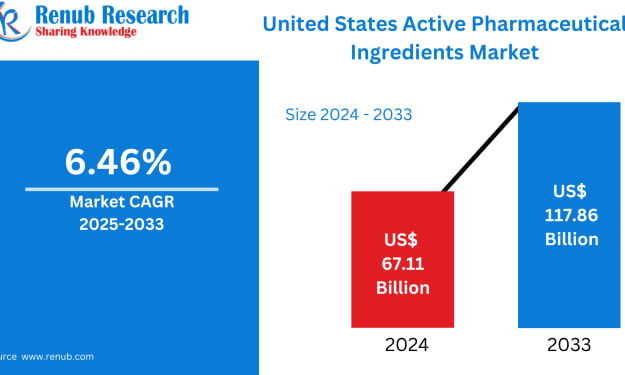
United States Active Pharmaceutical Ingredients Market The U.S. Active Pharmaceutical Ingredients (API) Market is anticipated to grow from US$ 67.11 billion in 2024 to US$ 117.86 billion in 2033, registering a CAGR of 6.46% during 2025–2033. This robust expansion is fueled by the rising demand for both branded and generic drugs, the increasing burden of chronic diseases, and rapid innovation in biopharmaceutical research. As the backbone of every therapeutic product, APIs are becoming increasingly strategic to healthcare security, drug affordability, and pharmaceutical competitiveness in the United States.
By jaiklin Fanandish5 days ago in Longevity
Miss Persephone's Manual to a Seemingly Ordinary Life
Miss Persephone was found at the dining table, her blue eyes swollen, her tears arriving and retreating like the tides of the ocean. Earlier that day, her family had visited her in the retirement home where she had lived for eight years. It was her eightieth birthday.
By Imola Tóth5 days ago in Fiction



Comments
There are no comments for this story
Be the first to respond and start the conversation.