
The Quiet Between Sounds: Listening to What’s Not Said
How silence reveals deeper awareness and teaches us to listen beyond noise


We spend most of our lives surrounded by sound — voices, traffic, notifications, the hum of machines, our own endless thoughts. Silence, by contrast, often feels unfamiliar or even uncomfortable. Yet within that quiet lies a profound invitation: to listen not only to the world around us but also to what exists beyond it. The space between sounds is not empty; it’s alive, vibrant, and full of awareness.
When we begin to notice silence, something subtle shifts. Instead of clinging to noise for a sense of identity or control, we allow stillness to hold us. Silence becomes the canvas upon which all sounds arise — the pause between notes that gives music its beauty. In this way, listening transforms from an act of hearing to one of presence.
In mindfulness practice, cultivating awareness of silence helps us reconnect with the deeper rhythm of life. When you focus only on sound, your attention moves outward; when you notice the stillness between sounds, your awareness naturally turns inward. This is where true listening begins — not in reaction, but in receptivity.
Imagine sitting outside in the early morning. You hear a bird call, a car pass, then a moment of nothing. That “nothing” is actually something — the quiet pulse of being itself. The more you tune into that space, the more expansive your perception becomes. Thoughts soften, breath slows, and you begin to sense an intelligence that doesn’t need to speak.
Silence also has a way of revealing truth. In conversation, for example, the quiet between words often holds more meaning than the words themselves. When you pause before responding, you create space for genuine understanding to arise. This simple practice — listening to what’s not said — can transform relationships, allowing communication to move from reaction to presence.
The challenge is that silence can bring us face to face with ourselves. When the outer noise fades, the inner noise becomes louder: old thoughts, unresolved emotions, fragments of fear or longing. But instead of running from this, mindfulness invites us to meet it. As we sit quietly and breathe, we discover that silence is not an absence — it’s a mirror. It reflects what we’ve been too busy to feel.
To cultivate this awareness, try a short exercise: find a quiet spot, close your eyes, and listen. Notice the sounds around you — near and far — and then begin to sense the spaces between them. Don’t label or analyze; simply rest in that subtle interval. That’s the sound of presence. Over time, this simple practice can deepen your ability to stay calm, grounded, and attentive, even amid chaos.
Silence, when approached mindfully, becomes a teacher. It shows us that not everything needs to be filled, fixed, or explained. Sometimes the deepest wisdom comes not through effort, but through surrender — through allowing yourself to be in the quiet. From this place, creativity, insight, and compassion emerge naturally.
Many guided meditations explore this relationship between sound and silence, helping practitioners access a state of deep inner stillness. You can find beautifully structured practices like this on Meditation Life, a space dedicated to mindfulness as an embodied, lived experience rather than a theoretical goal.
The more you listen to silence, the more you begin to hear life differently. Everyday moments — footsteps, the rustle of leaves, even your own breath — become part of a larger symphony that includes quiet as its most essential note. You realize that silence isn’t the absence of life’s music; it’s the measure that gives it shape.
In learning to listen to what’s not said, you rediscover what’s always been here — awareness itself. It’s steady, spacious, and vast enough to hold all sounds, all thoughts, all emotions. The quiet between sounds isn’t something you find; it’s something you remember. And once you do, the whole world begins to sound different — fuller, gentler, and profoundly alive.
About the Creator
Keep reading
More stories from Black Mark and writers in Longevity and other communities.
The Pause Before Words: Mindful Communication Techniques
In the rush of daily conversation, words often spill out before we’ve fully processed our thoughts. We respond reactively, repeat old patterns, or speak to be heard rather than understood. Yet, there is immense power in creating a pause before words — a small, deliberate space that allows mindfulness to enter communication. This pause transforms speaking from automatic expression into conscious dialogue, fostering clarity, presence, and emotional balance.
By Black Mark5 months ago in Longevity
How China Is Challenging the U.S. to Become the Next Great Space Power
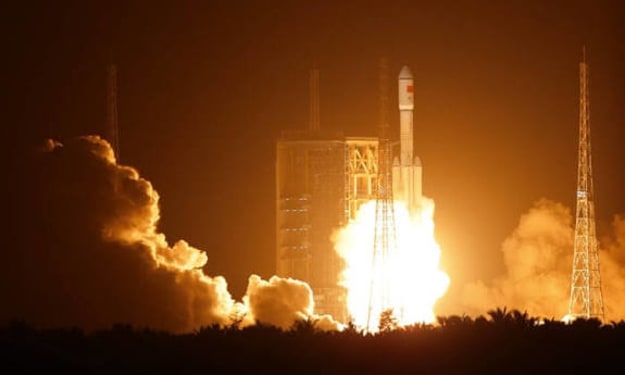
As Beijing’s space ambitions expand, Washington faces an intensifying geopolitical and technological rivalry in orbit and beyond. In the early decades of the 21st century, the United States long stood unchallenged as the dominant space power — a position built on decades of NASA leadership, unmatched launch capability, and a vibrant commercial space economy. But today, a determined China is mounting one of the most consequential strategic challenges in space since the Cold War, pushing to rival — and ultimately surpass — the U.S. in space influence, technology, and strategic advantage. National Strategy and Long‑Term Vision China’s leaders have openly signaled their ambition to become a global space powerhouse. Official space policy documents and state planning envision a broad array of capabilities — from heavy‑lift rockets to lunar exploration — aimed at reshaping the space order that has been U.S.‑dominated for decades. According to analyses of government planning, Beijing intends to establish a full suite of launch vehicles, satellites, and space infrastructure that could surpass current international norms by mid‑century. Underpinning this vision is a belief among Chinese space officials that self‑reliance and indigenous innovation are key to international competitiveness. Recent reports in state media emphasize that China’s aerospace industry is pushing far beyond imitation toward original technological breakthroughs in areas like rocket manufacturing, intelligent space systems, and advanced materials — all with the strategic goal of securing leadership in space. Commercial Space: From Government Giants to Private Innovators China’s rapid ascent isn’t limited to state space agencies. A growing ecosystem of private space companies — much like the commercial boom seen in the U.S. — has taken root, focusing on reusable rockets, satellite networks, and novel space services. A recent South China Morning Post report highlights Beijing’s push to encourage private innovation within its space sector, supporting technologies such as reusable launch vehicles, space debris monitoring, extraterrestrial resource utilization, and even in‑space biomanufacturing — fields long dominated by U.S. firms such as SpaceX or Blue Origin. This commercial expansion broadens China’s capabilities and compresses the technological gap with the U.S., challenging American assumptions that commercial innovation is exclusively an American forte. It also signals a shift in global space economics, where China may soon contend for commercial markets once dominated by Western companies. Military and Strategic Dimensions Alongside civil and commercial ambitions, China’s space strategy has clear military implications. U.S. strategic assessments note Beijing’s efforts to build counterspace capabilities — systems designed to deter, deny, or degrade another nation’s satellite operations — a key advantage in future conflicts. China has already deployed anti‑satellite weapons, jamming technologies, and sophisticated ground‑to‑space radar systems that could threaten U.S. space assets in a crisis. For the United States, which relies heavily on space systems for communication, navigation, and battlefield awareness, these capabilities represent a serious strategic challenge. Beijing’s ability to field space and counterspace technologies could blunt some of Washington’s military advantages in the Asia‑Pacific region and beyond. Lunar and Deep Space Objectives China’s Chang’e lunar exploration program is another marker of its space ambitions. With a series of increasingly complex robotic missions and plans for an International Lunar Research Station by the 2030s, Beijing aims to be a leading voice in lunar science and development — directly challenging the U.S. Artemis program and international partnerships spearheaded by NASA. � Wikipedia Missions like the strategically significant Queqiao‑2 communications relay satellite, which supports lunar missions over long distances, further demonstrate China’s growing sophistication in deep space operations and infrastructure deployment. U.S. Response: Maintaining Leadership Recognizing the challenge, U.S. policymakers are pushing legislative and strategic initiatives designed to preserve American competitiveness in space. A newly passed NASA authorization package includes provisions aimed at reinforcing U.S. lunar presence, strengthening Earth orbit assets, and countering Chinese influence in space science and technology — signaling a bipartisan consensus on the gravity of the space rivalry. A New Era of Cosmic Competition The emerging science and technological competition between China and the United States in space is unlike anything seen since the original Moon race. Today’s contest spans not only national prestige but military advantage, commercial opportunity, and scientific discovery. As each side pursues its vision of space dominance, the outcome will shape global power structures for decades to come — affecting diplomacy, security, and economic leadership both on Earth and beyond. If you’d like alternative versions, transcripts, or a set of headline + subtitle options for this topic, just let me know!
By Fiaz Ahmed 4 days ago in Longevity
The Piggy Project
I’ve had so many names in this life I lose track of which ones were ever really mine and which ones I wore because someone needed me to. Some were handed to me before I had words to refuse them, before I knew what they meant, before I knew I could say no. Most weren’t meant to hurt. That doesn’t mean they didn’t leave marks. Marks that told me who I belong to, who I am by way of who claims me, recognizes me in the good and bad, who walks beside me.
By Fatal Serendipity7 days ago in Confessions



Comments
There are no comments for this story
Be the first to respond and start the conversation.