quotes
Best health and wellness quotes from the most reputable Longevity sources, influencers, and celebrities.
It’s All About Perspective
Perspective is one of the most underused, underestimated tools in life. It won’t erase pain, but it can transform it. It won’t make your circumstances disappear, but it can shift the weight. Perspective is not about denying what is hard—it’s about discovering what is still possible. When you learn to adjust your internal lens, you stop reacting and start responding. You stop bracing for impact and start building from within. Because maybe it was never your life that needed changing—maybe it was the way you were taught to see it. Below are not just quotes I have written concerning perspective. They are my anchors, mirrors, and windows. Each one a reflection of how my view has determined my truth. 1. “Life really is a beautiful thing, but it isn’t always pretty.” – Annie Mae Edwards Beauty isn’t perfection. It’s found in rawness, in resilience, in the mess we survive. Perspective helps you see past the cracks—to the art being made beneath them. 2. “Perspective is one of the least utilized tools in life.” – Annie Mae Edwards The most powerful shifts aren’t external—they’re internal. Change your lens, and suddenly the impossible becomes survivable, the unbearable becomes educational, and the ordinary becomes profound. 3. “The grass isn’t more green on the other side; it is merely another shade.” – Annie Mae Edwards Comparison can blind you to your own blessings. What looks better from afar often fades up close. Your own life may already be rich with color—you just haven’t stood in the right light yet. 4. “When she learned to glow in her own darkness, she became the glimmer of hope she’d been searching for.” – Annie Mae Edwards We’re taught to fear the dark. But it’s in our shadows that we learn to self-illuminate. Hope isn’t always handed to you—sometimes, it’s something you grow inside yourself. 5. “Maybe your world has turned upside down. And maybe that isn’t a bad thing.” – Annie Mae Edwards Disruption feels like destruction—but what if it’s construction? Maybe life flipped you over so you’d stop walking in the wrong direction. 6. “Self-love is more important than any amount of likes.” – Annie Mae Edwards External applause fades quickly. But self-love? That sustains. That nourishes. That builds something no algorithm ever could: true worth. 7. “You are never out of resources. You are the best resource you could ever have.” – Annie Mae Edwards When the world tells you you’re lacking, remember: your creativity, your wisdom, your strength—they are renewable. You carry everything you need to begin again. 8. “Human interpretation is one of the most beautiful tragedies in life.” – Annie Mae Edwards We all see through our own filters, tinted by memory, emotion, and bias. It’s tragic. And beautiful. Because it reminds us how unique—and how misunderstood—we all are. Compassion lives in understanding that truth, and that we may never fully comprehend its scope. 9. “Perhaps the road is only rocky because it needs to be paved.” – Annie Mae Edwards Rough patches aren’t signs to quit—they’re invitations to create something smoother, sturdier, yours. What slows you down today might become your strength tomorrow. 10. “Perhaps the emptiness you are feeling is merely you making room for a fullness waiting to be uncovered.” – Annie Mae Edwards Hollow moments aren’t always signs of loss. Sometimes they’re the quiet before the bloom. Sometimes they’re the soul stretching to make space for what it’s finally ready to receive. 11. “Following the crowd is one of the easiest ways to get lost.” – Annie Mae Edwards When you shrink to fit in, you disappear. Your path was never meant to blend—it was meant to lead. Detours can be dangerous when they’re not truly yours. 12. “The only difference between a glass half empty and a glass half full is perspective. That should put into perspective just how important perspective actually is.” – Annie Mae Edwards A shift that small—a single thought—can change everything. Imagine what could happen if you started seeing your entire life with more grace, more patience, more belief in what could be. 13. “Nobody is perfect. That also includes you. Remember that when making judgment calls.” – Annie Mae Edwards Grace doesn’t just belong to others—it belongs to you. Be softer with your own process. Perfection is a myth. Growth is real. And it’s often disguised as messiness. The Takeaway: Perspective won’t hand you a new life—but it will hand you a new way to live the one you’ve got. And that can change everything. Reframing doesn’t mean lying to yourself. It means freeing yourself. It’s the quiet but radical act of asking, “What if there’s more to this than what I’ve been taught to see?” The road might be rough. The sky might be dim. But shift your gaze—just a little—and you might notice: There’s still beauty in the breakdown. There’s still purpose in the pain. And most of all… there’s still you—capable, worthy, and ready to see things differently. Because sometimes, a better life doesn’t begin with change. It begins with perspective.
By Annie Edwards 7 months ago in Longevity
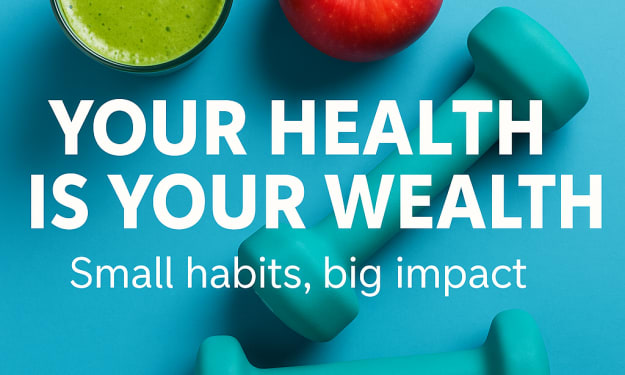
Your Health Is Your Wealth: Small Habits, Big Impact
Introduction In today’s fast-paced digital world, we often ignore the very engine that drives us—our health. We prioritize deadlines, devices, and distractions, while our body quietly absorbs the pressure. But here’s a truth worth remembering: your health is the foundation of your success, happiness, and freedom. It’s time to invest in it, one small habit at a time.
By KAMRAN AHMAD8 months ago in Longevity
Are Chemicals Causing Cancer in Young People
Cancer in young people is no longer a rare diagnosis. Over the past few decades, scientists and healthcare providers have observed a troubling rise in early-onset cancers. While genetics and lifestyle factors have always played a role, researchers are increasingly asking a critical question. Could everyday chemical exposure be a hidden culprit?
By Lucy watson8 months ago in Longevity
Is Obesity a Disease or a Lifestyle Issue?
Obesity rates are rising rapidly across the globe, with the World Health Organization estimating that over 650 million adults are clinically obese. As waistlines expand, so does the debate: Should obesity be officially recognized as a disease rather than just a condition caused by lifestyle choices?
By Lucy watson8 months ago in Longevity
Why Profit-At-All-Costs Business Models Can Be Harmful In Human Healthcare
Western Medicine has Accomplished some Amazing things. The Doctors who work in the Field of Western Medicine are often Truly Amazing Humans Who Seek to Live the Hippocratic Oath to its Fullest...
By Dr. Cody Dakota Wooten, DFM, DHM, DAS (hc)8 months ago in Longevity
The Problem Of Cause And Effect In Scientific Research
For Every Action There Is An Equal And Opposite Reaction. Newton's Third Law of Motion. It is something that many of us learn in School and Describes the Idea of Cause and Effect.
By Dr. Cody Dakota Wooten, DFM, DHM, DAS (hc)8 months ago in Longevity