
Suddenly quit smoking to "human life", not only cause cancer, but also sudden death?
Smoking is harmful to health

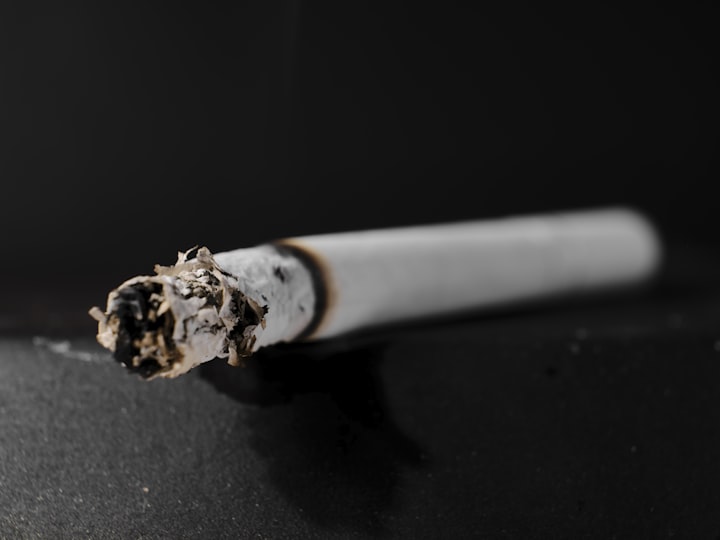
"You can't quit smoking blindly, blindly quitting smoking can lead to disease!" A good friend's words put Grandpa Wang into deep thought.
Grandpa Wang is an old smoker, with a history of decades of smoking, his son felt very worried about this and often advised him to hurry to quit smoking.
But he has been ignoring his son's words and continues to smoke as he sees fit. A while ago, his daughter-in-law found out that she was pregnant, which made the family happy.
This time, his son told him that he had to quit smoking because pregnant women are prone to fetal malformations when exposed to second-hand smoke for a long time. For the sake of his unborn grandchildren, Grandpa Wang was determined to quit smoking.
He did not expect to quit smoking just two days after a series of discomfort symptoms, mouth ulcers, dizziness, general weakness, insomnia, etc., and he felt miserable.
When he complained to his best friend, he told him that he could not just quit smoking, otherwise, it would affect his health.
This made Grandpa Wang feel very difficult, should he not quit smoking? Otherwise, it will affect health.
A, suddenly quit smoking to "human life", not only lung cancer but also sudden death?
Many people in life, like Grandpa Wang, have a series of physical symptoms after starting to quit smoking, and some people have even been found to have lung cancer after quitting smoking, so they point all the fingers at quitting smoking, thinking that it is caused by quitting smoking and worry about sudden death.
A series of physical discomforts that occur during smoking cessation, including insomnia, anxiety, dizziness, and fatigue, are not caused by disease, but rather by the body's reaction to self-conditions, which is clinically known as the withdrawal response.
Almost all smokers will experience withdrawal reactions when they quit smoking, which will occur a few hours after quitting, with the strongest reactions occurring in the first two weeks of quitting, after which the symptoms will gradually decrease until they disappear.
This is why the initial stage of quitting is the easiest stage to return to smoking, because the discomfort that occurs during this period is the strongest, and many people are unable to resist the temptation to smoke a cigarette, which can lead to a loss of success in quitting
As for some people who are found to have lung cancer after quitting smoking, you can't blame it on quitting smoking because cancer is the result of long-term effects, and quitting smoking can help you discover the disease as early as possible and achieve early detection and treatment.
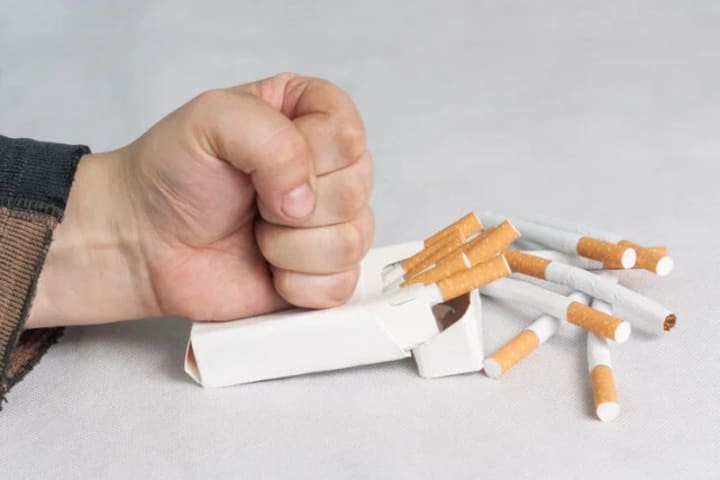
After quitting smoking, these benefits are visible to the body
Many people wonder if the blackened lungs can be returned to white after quitting smoking. Is it possible to restore lung function to what it was before?
After quitting smoking, the cilia in the lungs will gradually regain their function, and without the stimulation of tobacco smoke particles, the mucus secretion in the airways will gradually decrease, and people will feel that breathing has gradually become smooth. When there is less waste in the lungs, the color of the lungs will gradually lighten and become whiter than when you smoked.
Although quitting smoking will not restore the lungs to their original appearance, smoking can bring many other benefits to the body, what are the specific ones?
Dr. Ding Huizhen of the Affiliated Hospital of Yangzhou University shared a case of quitting smoking.
Grandpa Sun is 70 years old and has a long history of smoking. For many years, he was unmoved by his children no matter how they advised him to quit smoking, but some time ago he suddenly quit smoking on his own.
The reason for this is that a few years ago he was diagnosed with cholecystitis and had his gallbladder removed, and the doctor warned him to quit smoking in time, otherwise, he might get cancer later. So he made up his mind to quit smoking so that he would not burden his children with cancer.
After quitting smoking, he will feel that his breathing has become significantly smoother and he will not cough and cough up phlegm as he did when he was smoking.
The benefits of quitting smoking are immediate. Numerous medical studies have found that quitting smoking improves the neurological function of the patient, restores blood flow to the brain, and significantly reduces the risk of stroke.
Quitting smoking will also improve the circulatory system, the risk of coronary heart disease can be reduced by 50% after one year of quitting; the risk of lung cancer after 10 years of quitting will be 30-50% lower than that of continuous smokers; the risk of developing the disease after 15 years of quitting is almost the same as that of nonsmokers.
Third, how long does it take to quit smoking?
Data from the 2018 China Adult Tobacco Survey Report show that 19.8% of smokers have tried to quit, but 90.1% have not used a quit method and have a low quit success rate.
Xiao Dan of the Center for Tobacco Pathology and Cessation at China-Japan Friendship Hospital pointed out that the longer you quit smoking the more stable the results will be, and it is generally considered that 5 years of complete non-smoking is required to be called a successful quit. Many people will fail to quit smoking when the initial withdrawal response appears, especially in the first 2 weeks, the point in time when the symptoms are most intense, and the failure rate of quitting smoking at this node is very high.
Fourth, the addiction is difficult to solve, 3 ways to help you improve the efficiency of quitting smoking
"For some people who are not addicted to smoking or are mildly addicted to smoking, it is recommended that when you want to smoke you can divert your attention by doing something else, and people who are not addicted to smoking can generally quit in 3 days. For people who are not addicted to smoking, it usually takes 3 days to quit. For people who are mildly addicted to smoking, it takes longer to quit.
Some people who are more addicted to smoking, need to pay attention to these three things to quit smoking.
1. Spiritual therapy: get rid of the "mind addiction"
When you want to smoke, you can do something that makes you less comfortable, such as holding a cigarette in your hand that is not comfortable. Or hold back for a few minutes when you want to smoke, don't carry a cigarette on your body, etc. to make yourself uncomfortable when you smoke and gradually reduce your craving for tobacco.
2. Smoking cessation clinics: scientific cessation
There are special smoking cessation clinics in hospitals, and some people who cannot control their addiction through self-control can go to the hospital to seek help from professional doctors. The success rate of quitting smoking can be greatly increased by using scientific methods and individualized smoking cessation treatment programs under the guidance of a doctor.
3. Doctor's guidance: rational use of medication
Some people can also be guided by their doctor to use smoking cessation medications such as nicotine replacement therapy to treat their problem, which can also increase the success rate of quitting smoking.
Quitting smoking is a big test for smokers who have been smoking for many years, and as their sidekick, they must give maximum support and psychological encouragement! It is also important to keep the smoker as far away from the smoking environment as possible, as this will increase the probability of success in quitting.
About the Creator
blackwell marshall
There are two things I abhor most: erudition without faith and ignorance full of faith.
Keep reading
More stories from blackwell marshall and writers in Longevity and other communities.
Children three-volt moxibustion, grow strong and tall, and the second half of the year less sick!
One, children's three-volt moxibustion, the second half of the year less sick! Summer has come, three-volt day is very close, three volt, "winter disease summer conditioning" good time, you must seize!
By blackwell marshall3 years ago in Longevity
Day 4 of Quitting
If this is how sobriety feels, maybe it’s better to go through life a little buzzed… this, along with other hits like, I want to kill myself, I wish I was dead, and I’m going to throw myself off a bridge have been the only thoughts on rotation these past few days. I promise myself that if, in a month, I still feel like this (‘this’ meaning despondent, full of rage, and simultaneously numb) I can go back to smoking. Until mid-February though? Nicotine is off the table.
By sleepy drafts11 days ago in Longevity
By Diverting Entire Rivers for Over a Decade, the Netherlands Has Quietly Reshaped Its Coastline and Reclaimed Vast Stretches of Land from the Sea
The Netherlands, long celebrated for its innovative water management, has quietly undertaken one of the most ambitious land reclamation projects in modern history. By diverting entire rivers for over a decade, Dutch engineers have not only reshaped the coastline but also reclaimed vast stretches of land from the sea, a feat that is transforming the country’s geography, economy, and environmental landscape.
By Fiaz Ahmed Brohi2 days ago in Longevity



Comments
There are no comments for this story
Be the first to respond and start the conversation.